Showing posts with label publishing. Show all posts

Wednesday, October 15, 2025

In the Soup: Retired CSU professor John Calderazzo reads in the library

Poetry books arrived this week. The first was “In the Soup,” the second book of poetry by John Calderazzo. John lives in the foothills outside the tiny town of Bellevue, Colorado just north of Fort Collins and Colorado State University. John taught literary nonfiction during his time in the M.F.A. Program in Creative Writing at CSU. He was one of my faculty mentors and I enlisted his expertise as a literary fellowship juror during my time at the Wyoming Arts Council. He still writes and teaches in that genre but explores poetry in retirement.

John writes of many topics but travel is a big one. He is a world traveler so writes about trips to Peru and other overseas locations. His U.S.-based poems are set on Flattop Mountain in Rocky Mountain National Park, Elk Mountain in Wyoming, and Santa Cruz Island in California.  He dedicates some to friends and colleagues. “Kraken” is dedicated to Richard Jacobi, whom I knew in Casper, Wyo. John hears from Richard and his wife, retired University of Wyoming professor Vicki Lindner, about recent falls which, at a certain age, leads to complications, something this person of a certain age knows only too well. After watching a video of his Peru nephew’s toddler son falling over as he tried to walk, John  writes: “I sense what’s reaching out for him—gravity, the Kraken,/tentacled monster of the deep—already taking/his measure.”

The natural world has always featured heavily in John’s writing. In “Gathering Voltage,” he’s in the mountains again, this time in a summer lightning storm. He and his brother-in-law crouch as a bolt hits nearby and he feels “the fatal breath of the sky.” On another day, he rides his mountain bike in a storm: “Shivering as I fly, I sense a lightning/bolt moving into position, gathering/voltage, checking its GPS, its terrible/book of names.”

The author is not always in the wilderness. Sometimes, “The Retired Professor Reads in the Library.” He’s researching a travel essay and is in the aisle with his books and “old-time reporter’s notebooks.” He moves aside to let a student pass and wonders if the young man just sees “Him again—the old guy.” Thing is, he’s “as happy as I was at 10, freed from class to roam the school library.” I know the feeling, the old guy with his walker, crowding the aisle, as he reads a book pulled from the shelves but not sitting instead at one of the tables reserved for the elderly. If asked, I might tell you that some of the glory in the library is being there in the crowded aisle with my friends, the books.

"The Darker Moods of My Father" took me back to my own youth in the 1960s and '70s. He contemplates his father's "darker moods" and his rants on Vietnam and antiwar protesters and "priests drunk on holy water." Meanwhile, the writer remembers "this thing/that wanted to cannon me into jungle mud/since I'd turned eighteen." The poem ends with a revelation about his parents, about how his mother cautioned her husband about going too far with his his diatribes and the father looks sheepish, "knowing he'd gone too far, back in those days/when it was still possible to go too far." Suddenly we're back in 2025, when every day is a lesson on going too far.

John’s book is published by Middle Creek Publishing and Audio: The Literature of Human Ecology. A fine-looking book, printed in a large and very readable sans-serif type. The publisher is based in Pueblo Mountain Road in Beulah, Colorado, which is located between Pueblo and the mountains. I mention this because there are many fine small publishers tucked into many small places. My old friend Nancy Curtis runs High Plains Press from her ranch near Glendo, Wyoming, just a few miles off I-25 down a rutted dirt road that can turn into gumbo during a heavy rain. Anhinga Press has two co-directors in Tallahassee but founder Rick Campbell supervises from his windswept outpost on the Gulf of Mexico (MEXICO!).

One more thing. Some small presses receive support through their local and state arts agencies or some get National Endowment for the Arts publishing grants. I should say they used to get grants but not anymore from the battered NEA and not anymore in Florida where the Governor is on a scorched-earth campaign against the arts and the liberal arts education.

A sad state of affairs. My career was based on connecting local arts groups and publishers to government funding which they had to match 1-to-1. Most of the time, the government dollar was matched many times over. The U.S. government is now in the hands of a wrecking crew that wants to demolish poetry and prose, arts and education. They want to destroy everything I hold dear.

John Calderazzo writes about everything I want to preserve and protect.

Thursday, October 02, 2025

Fiction writers bring new life to dusty historical figures

Last night I finished reading "The Secret Life of Emily Dickinson" by Jerome Charyn. A beautiful novel, wonderful historical fiction. Charyn has made waves the past couple decades with his unorthodox takes on historical figures: Dickinson, the notorious Orson Welles/Rita Hayworth relationship, famous recluse J.D. Salinger, and Johnny One-Eye in the American Revolution. There are hundreds of other lives worth a second or even third look by someone of Charyn's skills. ,

Historical fiction is my new reason for living past 74. I've written two HF novels, the first will be out later this year from The Ridgeway Press in Michigan. I'm editing the second now. In the process, I've grabbed as many books off the HF shelf as I can muster. I was floored by "James" by Percival Everett, "Booth" by Karen Joy Fowler, "Horse," by Geraldine Brooks, "Gone, the Redeemer" by Scott Gates, and "Clark and Division" by Naomi Hirahara. 

All this innovative HF isn't without its detractors. Some traditionalists say that writers are playing fast and loose with the facts. Some say that facts are facts and that the timelines of history should be respected. They're valid points. Some HF writers are dogged with the facts. And so are some HF readers. Some writers also have hordes of researchers to help their work, as was the case with James Michener as his career progressed. He was so intent on research that he has a library named after him, the James Michener Library at University of Northern Colorado in Greeley. I've devoured Michener's novels most of my life, first "Hawaii," recommended by my mother, and onto "Centennial," the first novel I bought when I moved back to Colorado after college, and on to "Chesapeake" when I lived in Maryland.

But I also love the art of fiction and don't mind it being bent and twisted for a good yarn. I loved the real underground railroad in Colson Whitehead's "The Underground Railroad" and I was totally caught up in Jim's journey in "James" even when the story veered away from Twain's "Huckleberry Finn" which, of course, was also fiction. 

This reminds me of arguments about creative nonfiction during my days as an M.F.A. student. Annie Dillard was taken to task for some inventions in "Pilgrim at Tinker Creek." It led to a prize-winning book so I'm willing to forgive and forget. Others aren't. Remember that CNF stands for "creative" nonfiction.

It may be that I'm too old to care about literary minutiae. Or that I'm too pissed-off about MAGA savageries to mind when a writer invents something lovely to read.

A bit of both

Friday, August 08, 2025

There is a world of difference between a 125,000-word novel and a flash of 50 words

Spending my days and nights with a close reading of the formatted text for my historical novel, "Zeppelins over Denver." Much of my adult life was spent writing and editing so this is just another in a long line of projects. But, the process is different with a 125,000-word novel. If that seems like a lot of words, it is. But they were composed one sentence, one paragraph, one page at a time. I write and revise short stories, which is a slightly different task. A short story may be 5,000 words. In 2025, flash fiction has taken over the litmags and I am pleased that I've publish a few in print mags and online. It's a neat exercise to write a story that's a page long and not pages. Some very talented writers taught me the way. The always-busy Meg Pokrass has shown me and others the way. I recently had a piece rejected by 50-Word-Story that I thought was pretty good for a 50-word-story. I had revised it from a 250-word story but maybe that was the problem. Sometimes a 250-word story just wants what it wants. 

Back to the novel. The story must be compelling and the characters memorable. The writing must be crisp. And very importantly, the text must be error-free. This is the challenge with a 125,000 word novel in this day of self-publishing. Traditional publishers used to employ editors and fact-checkers. They still do, I suppose, but I don't know for sure because I've never been published by one. I did have a st6oory reprinted in a Coffee House Press anthology, "Working Words: Punching the Clock and Kicking out the Jams." ML Liebler was the editor. I've also had a creative nonfiction piece published in a Norton anthology, "In Short: A Collection of Brief Creative Nonfiction." But my historical novel is not being published by a traditional press. Thus, the work must be done by the writer. That takes time and attention to detail, lots and lots of details. Since my book is historical fiction, this writer must pay attention to period detail in the case of 1919 Colorado. What did people wear and how did they speak? What models of automobiles were on the road? What was it like to fly a biplane? Many questions that I try to answer as best as I can. 

An editor must pay attention to detail. But it is inevitable that mistakes will slip in. One must forgive oneself in the end. Nobody's perfect. We try to be. AI is available. My MSN Word keeps bugging me about the CoPilot AI program. No thanks, I keep saying. Will that ever become a necessity in the publishing world? My daughter uses ChatGPT when writing her college papers. The professor says it is OK as long as it is noted. Good grief. I might have used it when tasked to compare and contrast the Early and Late English Romantic Poets. In fact, I may just go to CoPilot and propose this very topic, see what the bits-and-bytes say. It might be fun. 

Not sure how the late Dr. Alistair Duckworth might respond. 

Oh yes I do: Off with his head!


Monday, March 07, 2022

"The Weight of a Body" collection now available in print version

The print version of my book is now available to order on Amazon. "The Weight of a Body: A Collection of Short Stories" features 12 stories set (in no particular order) Wyoming, Colorado, and Florida. The collection was originally published by Denver's now-defunct Ghost Road Press and I decided earlier in the year to republish it as an e-book and now a print version. Here's the cover:


The act of republishing on KDP Amazon entails formatting, design, and editing. I formatted my MS Word files on Draft2Digital (D2D). I then brought that over to KDP to transform it into an e-book. It took me awhile to read an e-book on my Kindle and even longer to make one. My guide through the process was writer and critique group colleague Liz Roadifer. Read her books here

Here's a teaser from the opening story, "Roadkill:"
The shapes grew out of the smoke and fog -- three pronghorn antelope, running hard. Matthew Kincannon mashed the car's brakes and swung the wheel hard left. He missed the first two, collided with the third on its white-tufted rump which rose like a balloon before its rear legs smacked the windshield, its hooves scraping the glass like sharpened fists.
This won't be my only project on KDP. Stay tuned for news about my second collection later this year. Most of those stories are set in Wyoming and Colorado. 

Sunday, February 27, 2022

Sunday morning round-up: Legislature weirdness, online publishing, and "The War on Powder River"

Russia invaded Ukraine this week. Putin does not want a democracy on its border. The Ukrainians are fighting back. The U.S. knows what joining the fight would bring. So we work with sanctions and what’s left of our free press. We also send war materiel to help Ukrainians fight the despot’s hordes. Any student of warfare knows a declaration of war would bring disaster. So what do we do?

I hope to have the print edition of my book of stories up on Amazon this week. The e-book is already on the site. Working with Kindle Direct Publishing can be a challenge. A traditional press would do most of this work. Formatting the text, deciding on a book cover, overseeing the printing process, sending out proofs, publicity. It’s all up to me now. Not sure if I’m going to put my second book of stories on KDP. I just want to have books in hand instead of taking up space in the Cloud. This blog is more of a journal than a publishing platform. Wish me luck.

The Wyoming State Legislature is in town. They will do plenty of damage in 20 days. We now experience first-hand what gerrymandering and voter suppression can do. Also Trump. And right-wing social media and TV. The nuts are out in force to suppress mask mandates, UW’s gender studies curriculum, American racism discussions in K-12 classrooms, gender equity, party-switching at election primaries, voting access, and any talk about Medicaid expansion for the state’s working poor. I’m sure more ridiculous proposals will emerge from the muck in the next two weeks. Wyoming voted overwhelmingly for Trump in 2016 and 2020. We now live in a Trumpist fiefdom.

I did not expect a nonfiction account of the Johnson County War to be shot through with irreverent humor. But that's what I got when I picked up Helena Huntington Smith's “The War on Powder River: The History of an Insurrection.” The book was published in 1966 as a Bison Books imprint from the University of Nebraska Press. This 1890s event is often referred to as the Johnson County War. It pitted the rich owners of large cattle herds against the little guy who owned a few head or a few hundred. The cattle cabal wanted to keep the open range in WYO. The little guys wanted to keep the maverick cattle that they found, stragglers from massive herds brought to Powder River Country by rich Easterners and Brits with the hope of amassing beef fortunes. Smith did an amazing job at taking a jaundiced view of an 1890s event that many people outside of Wyoming know little about. Smith’s research is impressive although this non-historian cannot vouch for all of the details. She cracks wise when describing the gentry founded ranches in Powder River Country which they enjoy in summer and desert once the first snow flies. Cowboys remain behind to watch the herds. While the winters of 1884-86 were balmy by WYO standards, the winter and spring of 1986-87 was a whopper. Many thousands of cattle froze to death on the overcrowded prairie. When the beef barons returned from the south of France, they left the round-up of strays to cowboys and got pissed off when small landholders rustled a few cattle. They got their payback in 1892, and also their comeuppance. It is easy to see the hubris of 1892 in Wyoming’s present.

Smith was an Easterner who spent some time in WYO. The TA Ranch south of Buffalo has named one of its dude ranch accommodations for Smith. The TA has the last surviving structures from the range war. Smith was a combat correspondent for Crowell-Collier magazines (Collier’s, Victory, Woman’s Home Companion) during World War II. In 1957, American Heritage magazine republished her account of the Battle of the Bulge. She recounts the breakout of Panzer divisions and how rear echelon soldiers, mechanics and engineers, were issued bazookas and ordered to stop Nazi tanks. Some of them were surprisingly successful and earned medals. Smith’s account has all the battlefield dark humor one finds in a good soldier’s memoirs. She brought that same humor to her account of the Johnson County War. I couldn’t find a full bio online but discovered she was a Smith College grad and wrote for magazines and wrote several books. The UW Heritage Center and State Archives probably has some good info on her. She obviously loved a good story.

Wednesday, November 17, 2021

India press picks up Ken Waldman's first novel

I received a head's up notice from friend and traveling writer/performer Ken Waldman. He has a new Kickstarter project for his 20th book, a first novel, "Now Entering Alaska Time." I will contribute, as I usually do, because Ken is a good guy and he always finds new and interesting ways to get his work into print. He also has been a burr under the very large saddle of Donald Trump since Inauguration Day, 2017. He is eight volumes into his "Trump Sonnets" series. Other writers have plagued Trump with poetry but none quite like Ken. See a sample and some performance videos here

As I wrote in 2019, the books are shelved in my presidential library. Ridgeway Press in Roseville, Michigan, printed all of the Trump Sonnets titles. 

What will future generations make of them and us?

Ken's novel is being published by Cyberwit.net Press located in Prayagraj in India. I checked out its web site and the press boasts a big stable of writers from all over the world. As far as I know, Ken has not yet traveled in India. But soon will, I expect.

Friday, April 09, 2021

In Trump Sonnets, poet Ken Waldman tracks how America lost its mind

I just received a copy of Ken Waldman's "Trump Sonnets, Volume 8: The Final Four Months."

This is good news/good news. Another book of Trump sonnets to read. And, as the title says, "final" four months of the Trump scourge. A traumatic four months. A traumatic four years. Poet M.L. Liebler, who published the book at his Ridgeway Press in Michigan, writes in the foreword:

Ken has successfully brought form to the most unformable and unformidable, mean-spirited, fly-by-the-seat-of-his pants scoundrel who did his damndest to take this country down.

Waldman takes us through the final four months through sonnets in the POV of Americans: a dog walker in Brooklyn, a prison guard in Lexington, Kentucky, and a house painter in Hilo, Hawaii. Closer to home are the words of a baker in Cheyenne and a locksmith in Casper. The baker rhapsodizes about the two Q Girls who are "both up for war against Democrats." The locksmith is more thoughtful. He (I think it's a he) says that a civil war may be on the horizon but is wary of "citizens desperate or angry enough" to assassinate a Supreme Court elder or "wayward" senator. There is also an architect in Fort Collins who blasts the "toxic idiocy" of those who believe that Trump won the election. The Brooklyn dog walker sums it up this way: "Put them behind bars -- him, Jared, the kids. Or send them to Mars."

We hear many voices. I've been reading the selections in a more lighthearted mood than I did the first seven "Trump Sonnets." That is because T has disappeared from public view and is no longer on Twitter to rattle my world. He also is gone from the White House which he treated like his own Scarface villa (he already has one of those in Mar-a-Lago).

As evident during Waldman's 35-year career as an itinerant poet and fiddler, he has a keen wit and is always busy creating. He's published 19 poetry and prose books and nine CDs that "mix Appalachian-style string band music with original poetry." As a touring artist whose home base is in Alaska, most of his gigs since March 2020 were cancelled or postponed. He's been featured at the Dodge Poetry Festival in New Jersey, the Woodford Folk Festival in Queensland, Australia, and the Word of South Festival this weekend in Tallahassee, Fla. He's also conducted residencies in more than 200 schools, including ones in Casper and Cheyenne. He's also served as a judge for Wyoming Arts Council literary fellowships.

Front Range dwellers can see him on stage on May 22, 7 p.m., at the Lakewood Cultural Center in Lakewood, Colo. He will appear with Willi Carlisle and special guests Ben Guzman and Colin Gould. Tickets are $27 and you can get them here

I will file volume eight with Waldman's one through seven in my presidential library. My grandkids, if I ever have any, might like to read them and see how America lost its mind in the 21st century. 

You can't actually buy the book until September 1. Get more info at the Trump Sonnets site or Waldman's home page. The book will be distributed by nonprofit literary book distributor Small Press Distribution at orders@spdbooks.org. 

Friday, November 06, 2020

Read it now or read it when all the election results are in -- "Trump Sonnets, volume 7: His Further Virus Monologues"

As of 11:30 a.m. on Friday, Nov. 6, we don't yet know the result of the presidential election. We do, however, know the result of Ken Waldman's "Trump Sonnets" series. The seventh book in the series arrived today. Subtitled " His Further Virus Monologues," it returns to the single-sonnet form that Waldman made so readable in his first five books. The sixth, "His Middle Virus Soliloquy," is what it sounds like: a long piece comprised of connecting sonnets, two to a page. A 63-page journey of Trumpist ramblings in poetic form. It's a book that urges you to go on Trump's breathless ride through his fevered mind. He is infamous for his rambling monologues at rallies of true believers.  The author gives shape to that.

I read Book 7 in a review copy. We were smack-dab in the pandemic and the election was weeks away. I read it with the same dread and bemusement that I've read the others. Flashing in my mind like a neon sign was this: We elected this man president of the United States? I would finish a sonnet, ask the question, and move on, enjoying the ride. Then something will remind me of that big question:

From July 24, 2020 sonnet: 
I know when I walk off the eighteenth hole  
on November 3rd, I am second to none. 
I'm very prepared for my second term. 
No president's done more in his first term.

I see him at one of his golf courses. I think Yikes -- this man is president! We all are doomed!

I expect different feelings when I reread volume 7. Who knows when we will get all of the election results? Who knows how the lawsuit-crazy Trump will react -- he's already filed a flurry of lawsuits over alleged voting irregularities. Will we get him out of the White House by Jan. 20? 

But I will feel all warm and fuzzy if he is denied a second term. I've already been enjoying memes on Facebook that belittle Trump and his minions. Yes, we can be sore winners too. And it's OK to take a few minutes to gloat. So, as he read what may be the final installment of Waldman's series, I too will gloat. It's been so long since I've had a chance to do that. I will enjoy myself while I can. President-elect Biden's real work begins next week. Trumpists are still in charge of the Senate and Supreme Court. We all need to get busy.

Waldman is a poet and performance artist so it's not surprising that he has developed a video and stage show to go with the sonnets. The video will get more use in the near future because performing artists aren't performing. Due to the president's ineptitude in dealing with the virus, most public spaces are closed. So don't look for Waldman and his partner Lizzie Thompson to be on the road again until 2021. Some have been cancelled and some have been rescheduled for the new year that all of us look forward to. Get more info at kenwaldman.com or trumpsonnets.com.

M.L. Liebler's Ridgeway Press of Roseville, Mich., published all of Waldman's series. Small presses publish many good books every year. Most poets would have few outlets for their work if it wasn't for places such as Ridgeway. Show them some love and buy a book from a small press directly or through an indie bookstore. You'll be glad you did.

Sunday, November 04, 2018

Part X: The Way Mike Worked -- The Passing Parade

I can't remember The Retiree's name. He had worked in my division, Information Services, at Denver's Gates Rubber Company, before I arrived on the scene in 1983. He came by occasionally to visit the other old-timers. At 32, I was part of the younger cohort stepping into their shoes as they gradually marched off into the horizon. My parents' generation, the generation that weathered major cataclysms to give birth to many children and kick-start the post-war economy.

Sometimes The Retiree came for lunch at the corporate cafeteria. One afternoon, I came across him in the lobby. He recognized me, invited me to sit in the comfy chair next to him. We watched as the corporate parade passed. The Retiree gestured to a middle-aged guy he used to work with.

"Wanted to buy a sailboat and circumnavigate the globe," The Retiree said.

The guy worked in my department. "Did he do it?"

"What do you think?"

I thought no, he did not.

We chatted some more. He spotted a woman he knew. She walked over to say hi. "Hi," she said.

They exchanged pleasantries. He asked if she was still making fantastic cakes.

"Not as much. Julie moved back home with her two kids. I do a lot of babysitting." She seemed a bit embarrassed. When she went back to work, The Retiree explained.

"She made the cakes for employee birthdays. You had to get there early -- guys stampeded to the break room. Fights broke out to get that last piece of three-layer devil's food cake." He got a faraway look. "I still dream about it."

"That good?"

"Better. Yeah, she was going to open her own bake shop. But she didn't. One thing or another came up." He shrugged.

I sensed a theme developing.

"You know a lot of people," I said. "And their stories."

"People tell their stories all the time. You just have to listen." He paused. "What you pay attention to makes the difference."

Another guy walked by. We called him The Actor. He just played Sweeney Todd for a local theatre and got to murder a bunch of obnoxious people whose meaty parts were made into pies. He was talented and drank a bit.

"I worked with him for a few years," The Retiree said. "He went out to Hollywood for awhile. He probably told you that."

"Not a word."

"He had a few bit parts. Played a dead guy in a soap opera."

"So I work in the graveyard of broken dreams?"

He laughed. "Beware." With that, he took off, probably to take a nap. I went back to work to ponder my future.

The above conversation is fictional. You can probably tell because the exchange rolls so trippingly off the tongue. As if it were a scene from a play or novel. That's something a fiction writer can do when blogging. If I was trying to write, say, a memoir, I would have to let you know that I was reconstructing the dialogue because there was no way I could remember what was said verbatim more than 30 years ago. What I can do is recall the feeling I had when sitting in the lobby with The Retiree. Holy Shit, if I don't watch out, I could end up like this endless retinue of sad sacks going back to work in the rubber mines. On some days, I was already there.

It would be rare to find a kid that says he or she wants to grow up to write paeans to industrial rubber hoses. Yet, there are a surprising number of us who grow up to sing the praises of hoses or cars or computers or paper products. We want to be something else but, as the saying goes, a job, any job, pays the rent. In 1983, I was approaching 33, was married, and tired of living on a prayer. I wanted to land a job that entailed some writing, and that's when I began looking for jobs with big companies. 

At Gates, I did know The Retiree I quote at the beginning of this piece. I knew many of them. I photographed scores of retirement parties, took a lot of employee anniversary shots.  Lots of grip-and-grin shots of a VP  congratulating a union guy who had spent the last 30 years making radiator hoses in the deepest darkest confines of the ancient factory. The cavernous work rooms were loud and covered in carbon black, the ingredient that blackens your hoses and fan belts. It was everywhere -- on the walls and floor and machinery. It was in and on the machines. It was on the employees and their work clothes. When I ate lunch with my female coworkers, they always grabbed extra napkins so they could wipe the carbon black off of the seats less their dresses get streaked black. I followed their example until I noticed that the union guys watched us. We were literally trying to wipe away their presence. I was a writer supposed to know a metaphor when I saw it.

I eventually saw it.

I left the corporate world for academia in 1988. We sold our house that we bought with money from rubber writing. I could walk to work. Now, when I'm in Denver and I drive down South Broadway, I see that corporate HQ now bears a different company logo. Across the street, the massive factory is gone. After Gates abandoned it and it turned into a magnificent ruin, urban explorers made it their playground. Replacing it are rows of modern condo complexes for the new crop of college graduates eager for the Mile High lifestyle. They can catch the light rail at the hub at the corner, where the Gates garage once fixed employee cars at a reduced rate. The company clinic and grocery store are no longer there. "The song "16 Tons" says "I owe my soul to the company store. That wasn't exactly the case, as it was just convenient to shop at the company store. This wasn't Appalachia during the Great Depression. But it was the ending of a certain type of employment. Chris and I paid nothing for an emergency Cesarean and seven days in the hospital for mother and son. All the prenatal and postpartum appointments were free. A billion-dollar privately-owned company in a booming economy could be generous. Every employee's kid got a free gift at the annual Christmas party and rode the Lakeside rides for free at the summer picnic.

It sounds good. But Gates was already building factories in right-to-work states and overseas. The ranks of the URW were beginning to decline. A new health care plan was in the works and a fully-funded retirement plan was being replaced by a 401(K). I know because my department was tasked with explaining the changes to employees who weren't always appreciative when being lied to. The new century approached. Technology would save us all. The international open market would signal a new golden age. Reagan said so.

The first short story I wrote in my CSU M.F.A. writing workshop was called "Who Needs Fedder?" It concerned a young corporate guy who chronicles the travails of his co-worker Fedder when he quits the corporate softball team. He quickly became a non-person, like Doc Daneeka in Catch-22. The story seemed outlandish to my younger classmates. The older ones thought it said a lot about people they had known in the corporate world or in the military. The story was published in 1990 in Bob Greer's High Plains Literary Review in Denver. I never knew what my former Gates colleagues thought about the story as I lost touch over the years. Now they're all retirees like me, reminiscing about those glory days.

You can read "Who Needs Fedder" in my book of stories, The Weight of a Body. It's out of print, but I'll find the file and link it to this post. I will reread it, just to find out what this writer thought of his corporate career.

Monday, May 07, 2018

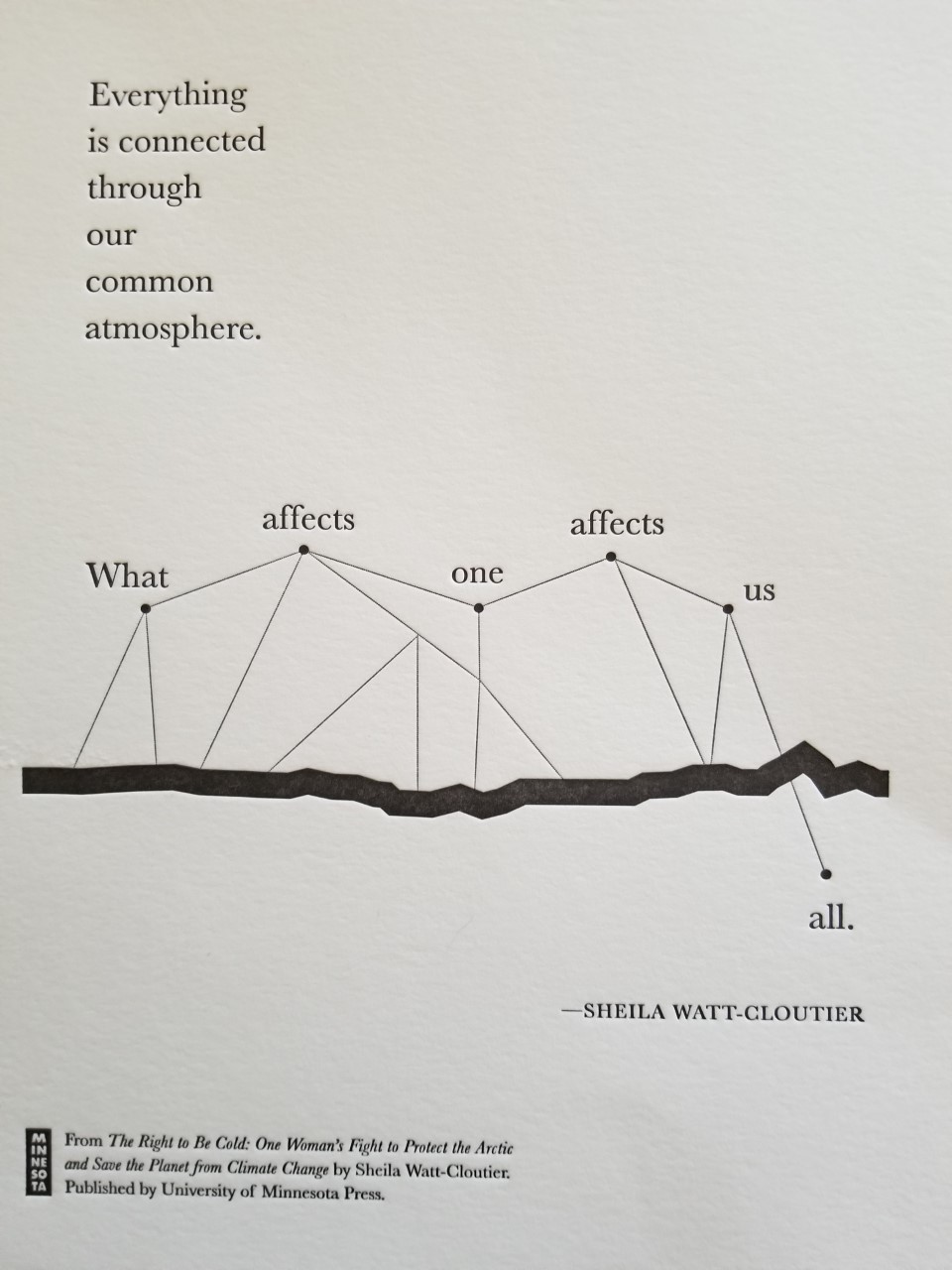
A broadside is designed to get a reader's attention

Broadside published by University of Minnesota Press, 2018. 
I received a broadside in the mail this week. A broadside is a printed sheet that promotes a larger work, such as a book. Propaganda broadsides were plastered on walls throughout the colonies during the War for Independence. The London Times distributed broadsides of famous British literary works to soldiers in the World War One trenches. The idea, it seems, was that a bloke absorbed in Shelley or Wordsworth would not notice he was being blown to bits.

Some publishers still print broadsides, mainly of poetry. I have some of those from David Romtvedt and Bill Tremblay, among others. They usually are printed in support of a collection. Flash fiction is suited for broadsides but I don't know if that is a thing or not.

I received a broadside from University of Minnesota Press promoting Sheila Watt-Cloutier's book "The Right to be Cold: One Woman's Fight to Protect the Arctic and Save the Planet from Climate Change." The broadside was a prize offered to like UM Press on Facebook. I liked and I received. See the image above.

This broadside did its job. I did not know Watt-Cloutier's work until the envelope landed in my mailbox. She writes about climate change from an Inuit's point of view. The Arctic nation is almost invisible to us in The Lower 48. My knowledge of people in the Arctic centers around the term "eskimo" and all that it entails: igloos, kayaks, dog sleds, walrus-hunting, "Nanook of the North." My education on Arctic peoples comes mainly from 1950s-era National Geographic magazine which, as we all know now, was a very one-sided view of the world.

I plan on reading Watt-Cloutier's book. I will order it from UM Press. I looked through its catalog and was impressed by the scope of its publications. It includes works on an array of topics, focusing on the culture of the upper Midwest. I know as much as that region as I do about the arctic, although I have walked the intriguing streets of Minneapolis and read a number of books from excellent Twin Cities publishers Graywolf, Coffee House, and Milkweed. 

I watched a TED talk by the author. I read one of the author's postings on the UM Press blog and watched one of her TED talks. She made me see the effects of global warming on humans. We hear a lot about the effect of rising sea levels on coastal populations. When it comes to the Circumpolar Region, we hear more about polar bears than we do about the humans who have lived there for centuries. I live in a high dry climate, albeit one that will be affected by shorter winters. This will impact outdoor recreation and hunting and all of those people that depend on those for their livelihoods. But the Inuit need solid ice for their hunts. As the author says, they risk drowning by falling through the ice that once was solid beneath their feet. And efforts of environmental groups have affected their lives in real ways. It's easy for a city boy in Cheyenne to support bans on seal hunting thousands of miles away. If fact, it's easy for this non-hunter city boy to cast aspersions on hunters of the deer and antelope I see as I travel Wyoming. 

In the days of sailing ships, a naval broadside was meant to get the attention of and possibly demolish another ship. A printed broadside is meant to get your attention and educate you in the process.

This one did its work.

Tuesday, November 21, 2017

On the look and smell of old-fashioned print books

The New York Times reports that sales of "old-fashioned print books" are up for the third year in a row, based on figures from the Association of American Publishers. And indie bookstores are doing well, reversing a decline sparked by big box bookstores, Amazon and e-books.

Good news for book lovers. Are the books being read and understood? No, if the American electorate is any indication.

But I am a book lover. At this point in my life, I am trying to shed books with little success. I occasionally clean up the shelves and take a few boxes of books to the library store. But I find a need to read a certain book that I can't get at the library and I end up buying it. My latest purchase was "Sons and Lovers," the 1913 novel by D.H. Lawrence. When a friend and one-time indie bookstore owner saw the book in my car, he picked it up and said, "This is how I learned about sex." I replied that I hadn't reached that part yet. Paul Morel and his potential sweetheart Miriam are still in the platonic stage.

I had a selfish motive for reading "Sons and Lovers." I discovered it was filled with wonderful details about a British coal-mining village of Eastwood before World War I. My grandfather lived and worked in a British coal-mining village before and during the early years of the war. I portray a character like that in the novel I am working on. Also, I never read a Lawrence novel. How I could be an English major and not read Lawrence is a surprise to me. I knew more about his life in Taos than I did about his books.

"Sons and Lovers" is a good read. The prose is dense at times but it was 1913, the same era as Edith Wharton, William James and Upton Sinclair. I read "The Jungle" earlier in the year and it was slow going at times.  Lawrence's prose is better that some of his contemporaries. He had an eye for detail.

This edition of "Sons and Lovers" is a trade paperback published in 2003 by Barnes & Noble Classics. It carries a scent but doesn't have that old-book smell.

But my 1921 copy of John Dos Passos' "Three Soldiers" does. It got it at an estate sale for $4 with the tag "library condition." Well used but not battered. From the Merced County Free Library. It still has the sleeve for the borrower's card and date stamps on the outside front cover. It smells like old paper. The pages are yellowing. But it's still readable, so that's what I'm doing. The novel concerns the journey made by three young men as they volunteer for service in World War I. Written after the war by veteran Dos Passos, the slang and expressions and description are of that time and are quite something. I can read about old times and smell them all at the same time. Not possible with an e-book.

Not sure what I will do with my books (old and new) after I'm finished with them and my research. I would say leave them to my adult children but they look upon their parents' accumulated goods as if it were radioactive waste. They're both big readers but my literary passions are not theirs.

It's good news to see that print books are back. Is it a trend or a passing fancy? Who knows. My habits are not likely to change. I will still get suckered into used book sales and garage sales and will just have to have that 1930 edition of "Death Comes for the Archbishop." I found that book at the annual Delta Kappa Gamma used book sale in Cheyenne. Only 50 cents. Who could pass that up?

Thursday, November 10, 2016

Readings begin Nov. 18 for Blood, Water, Wind, and Stone: An Anthology of Wyoming Writers

Made in Wyoming (and published here too): This new anthology from Jackson's Sastrugi Press features a great line-up of the state's writers,
Attached is the latest info on readings and book signings for Blood, Water, Wind and Stone: An Anthology of Wyoming Writers. My story, "George Running Poles," was selected for inclusion by editor and poet Lori Howe. Sastrugi Press is the publisher. Great to have a Wyoming-based press (Jackson) and a Laramie-based editor. The rest of us are scattered all over the state. 
I will read with others at the Dec. 8 event in Laramie. Not only that -- goodies will be served. And Night Heron is a great place to buy Christmas presents for those readers in your life. Order now at Sastrugi Press.
Cody Opening: Friday, November 18, 5-7pm. Legends Bookstore, 1350 Sheridan Ave. Cody, WY 82414. Ph: (307) 586-2320, website: www.legendsbooks.com.
Casper Opening: Saturday, November 19, 6-8pm. Backwards Distillery, co-hosted by Wind City Books. Hosted by Backwards Distillery at 158 Progress Circle, Mills, WY 82644. www.windcitybooks.com or www.backwardsdistilling.com, (307) 472-1275.
Sheridan Opening. Sunday, November 20, 2:30-5pm. Sagebrush Community Art Center, 201 East 5th St. Sheridan, WY. Ph: (307) 674-1970. website: www.artinsheridan.com
Cheyenne Opening: Saturday, December 3, 3:30-5:30pm. Laramie County Library, 2200 Pioneer Ave. Cheyenne, WY 82001. Ph: (307) 634-3561. Website: http://laramiecountylibrary.org.
Laramie Opening: Thursday, December 8, 6-7:30pm. Night Heron Books, 107 E. Ivinson St., Laramie, WY 82070. Ph: (307) 742-9028. Website:  www.nightheronbooks.com.
Jackson Opening: Saturday, December 10, 5-7pm. Valley Bookstore, 125 N. Cache St. Jackson, WY 83001. Ph: (307) 733-4533. Website: http://valleybookstore.com

Friday, August 26, 2016

"George Running Poles" finds a home in new Wyoming anthology

I've been working on a novel since the spring. I got tired of agents and editors asking me, a short-story writer, if I had a novel. This longer piece grew out of a short story that wanted to go long. So now it is. I won't say what it's about because it's supposed to be bad luck. I will say that it's set in Colorado in 1919-1920. An intriguing era, this post-war period. The Great War altered how people viewed the world. Women got the vote and Prohibition became law which led to lawlessness, even in rural Colorado. The Klan was on the rise, attacking Irish- and Italian-Catholics -- and Hispanics -- when they couldn't find any black people to torment (the alt-Right is nothing new). Americans were spooked by the Russian Revolution (the U.S. had 8,000 troops in Russia in 1918-1920 fighting the Bolsheviks) and blamed commie troublemakers for everything from labor unrest to avant-garde art. That gives me a few subjects to use for conflict in my story. Then there's the usual problems caused by the human heart in conflict with itself.

On the short story front, I heard two weeks ago that my story "George Running Poles" has been accepted for the new book, Blood, Wind, Water, and Stone: An Anthology of Wyoming Writers. It will be published in the fall by Sastrugi Press of Jackson. Lori Howe, a fine poet, is the editor. Look for it at an indie near you. Support your Wyoming writers! Just to whet your appetite, here is the story's opening paragraph:
Two teen boys walk along the asphalt bikeway in Riverton, Wyoming. George Jumping Bull pushes a shopping cart he found abandoned in the winter-brown grass. He’s wearing black sweatpants bunched over white running shoes and a red bandanna tied around his close-cropped hair. Jimmy Jones wears his black Oakland Raiders cap sideways, its bill pointing east. He milks a pint bottle of vodka as he walks. George reaches for it.
Lynn Carlson has asked me to write a short piece for the blog she co-authors/edits with Susan Mark. The blog, Writing Wyoming: Words, wind and everything else Wyoming, features great posts about writing and marketing your work. I've pulled a number of publishing leads off of this blog. Lynn's latest post on Aug. 16 is about the Storycatcher Workshop she attended in Fort Robinson, Nebraska. Go read it. Lynn asked me to write a composite post by Sept. 9 on the subject of reading your work at open mic sessions. I readily agreed, as it took me awhile to read my work in public, period. I was 39 or 40 the first time I read in public as a late-blooming grad student at CSU in Fort Collins. Since then, I have embarrassed myself many times in public, from Denver to Cheyenne to Washington, D.C. What experiences do you have as a writer in a public forum? Let me know so I have something to blog about in September. Here's the topic: "A good noise: in praise of the open mic." Lynn took the title from a John Gorka song:
'Cause if you cannot make yourself a good noise
tell me what you're doing here.
My daughter Annie now lives in Chicago. Her northside neighborhood was once Polish and then Hispanic and now, I'm afraid, is in danger of gentrification. A brewpub has opened next to the wig store and funky murals are replacing graffiti. Hipsters have been sighted. She wants us to come visit so is arranging interesting sites to see and tours to go on. The Chicago Mafia Tour sounds intriguing. I may prefer the Chicago Literary Tour which includes stops at sites occupied by such fine writers as Gwendolyn Brooks, Ernest Hemingway, Lorraine Hansberry and Carl Sandburg, and the office of the woman who first published James Joyce in the U.S. Writers with Chicago roots continue to compose great works. I'm talking about you, Larry Heinemann, Dave Eggers and Walter Mosley.

Monday, January 04, 2016

What is on my plate for 2016

What I'm looking forward to in 2016....

Retirement. On Jan. 15, I will work my last day at the Wyoming Arts Council in Cheyenne. I was among the fortunate to have a job that I loved. I depart the WAC on the eve of its 50th birthday, which comes up in 2017. It has nurtured the arts throughout the state. Sure, I'm a liberal artsmonger, but Wyoming's cultural world would not be what it is today without all of us working toward the same goals. It took me awhile to shut up and listen when I went into communities, to find out what their residents wanted instead of telling them what was best. This is a good strategy for all of us. In fact, if I were asked for my hard-earned advice on the matter, I would reply, "Just listen."

Publishing. I have a roomful of written work awaiting publishing. To date, I have published one book of short stories and numerous stories and essays in magazines and journals. But there remains a lot of work that's yet to see the light of day and the eyeballs of readers. Suire, I've been sending stuff out. But the act of writing is comprised of several full-time jobs. First, the creation. Second, the publishing. Third, the promotion. During my career as a professional writer/editor/bureaucrat, I've been able to do the creation part. But those other two parts? Not so much. It was fascinating to hear Kent Nelson's publishing strategy at last summer's Wyoming Writers, Inc., conference in Cheyenne. Kent, a one-time squash champion and lapsed attorney, keeps his stories circulating, up to 20 at a time. When one is rejected, he sends it back out into the world. In this way, he's managed to publish many books and scores of stories. But it takes time, and attention, and that's what I plan to do with my new-found time and my lagging attention span.

Presidential elections. Yes, I also cringe when I think about it. Republican bloviators such a Trump make me fear for the future of our republic. "Make America Hate Again" is not a winning slogan. As one who has blogged frequently about the paranoid excesses of U.S. conservatives, I am not surprised that Trump has found a footing among them. Scared Old White People (SOWP) make up his base. As an Old White Person (OWP) myself, I am glad to report that I am not among the scaredy-cats.

Traveling. I have traveled extensively in the U.S., at least traipsing through all of the states in the lower 48. But I've only been overseas twice. I plan to remedy that in retirement, with trips planned to Italy and Mexico with more to come. Chris and I are curious travelers. Maybe I should say that, as travelers, we value curiosity. When we find ourselves in a new place, we like to roam around and check it out. Never know what you'll find.

Tuesday, September 17, 2013

Comic book writers are writers by any other name

I spent last weekend hobnobbing with writers and poets and editors.

One of the most intriguing ones was Kelly Sue DeConnick. She writes for Marvel Comics. Once upon a time I would have said that wasn't real writing. Comic books? Nah!

I've changed my mind. Not because I've read a bunch of recently-published comic books. I will, I swear, just as soon as I get over to the local comic book store. But it was DeConnick's talk at the Casper College Literary Conference that got me thinking about the comics and the literary world.

The literary world is M.F.A./fiction workshops/writers' retreats/coffee house poetry readings/small presses/chapbooks/NEA/grants/fellowships. Maybe some graphic novels based on cool books or short stories. But not comic books. 

The non-literary world is blockbuster best-sellers/romance/hobby writers/agents/New York Times Book Review/hard-boiled mysteries/big publishers/Barnes & Noble/advertising/marketing/film rights. And comic books.

We turn comic book superheroes into special effects-laden films. Batman/Superman/Spiderman/Avengers/The Incredible Hulk. And so on.

Kelly Sue DeConnick told a literary conference audience on Friday that she got her first jobs in comic books "by being a loudmouth on social media."

DeConnick is not only is on Facebook and Twitter (with 20,000 followers). She has a cool Tumblr site at kellysue.tumblr.com and her stand-alone western, "Pretty Deadly," which is set for an Oct. 23 release, is at pretty-deadly.com.

DeConnick, 43, grew up on military bases. "Very much a part of military culture to have comic books," she said. "It makes sense that people who sign up to give their lives for their country might see themselves in the heroic themes of comic books."

She loved "Wonder Woman" comics, although she noted that "Wonder Woman spent a lot of time in chains in the '70s."

Which brings us to the gender issue. Male writers and illustrators might feel compelled to portray a female superhero in bondage. DeConnick, now a member of the Comic Book Boys Club, has no such inclinations.

She writes Captain Marvel and Avengers Assemble for Marvel Comics. The Captain is now a woman, Carol Danvers. DeConnick wanted Danvers to be a real woman, one with flaws and good female friends, one who could also set right the universe when necessary.

This Captain Marvel in a long line of Captain Marvels began to gain a following. A group of fans called the "Carol Corps" grew with each issue. They submitted fan art based on the character, and they began to send Carol Danvers stories to DeConnick.

Then came the merch, such a Carol hoodies and dogtags.

"I got a letter from a civil rights attorney who wears Captain Marvel dogtags under her clothes every time she goes to court," DeConnick said. "I've heard from a doctor who wears dogtags when she goes into surgery."

The Carol Corps raised $2,000 online for the Red Cross after Hurricane Sandy. And it appears that a CarolCon-style ComicCon is in the works.

Issue No. 15 is out and DeConnick is working on the next installments. "The Internet doesn't know this, but she [Carol Danvers] gets her first kiss in issue 17."

DeConnick said that she works hard to present real women in her comics. She tries to avoid the Smurfette Principle -- the lone female character must represent all female traits. To avoid stereotyping, she applies the Sexy Lamp Test to her stories: "If I can replace one of my female characters with a sexy lamp and the plot still functions, I might need another draft."

DeConnick seems to enjoy her role as one of the few female comic book writers. Of the top 300 books produced in June, 6 percent were produced by women. Some of them were written by the same women, so DeConnick estimates that women might make up 2 percent of her industry.

However, when Marvel Comics asked her in 2009 to write the next saga of Norman Osborn, a.k.a. the Green Goblin, she was "proud to have been asked to pitch on a boy book." The result was "Osborn: Evil Incarcerated."

Still, it gets a bit old always being asked the same question: "What does it feel like to be a woman writing in a man's field?"

"I used to joke -- 'I write through my vagina'."

She's married to another comic book writer, Matt Fraction. who's never asked similar questions.

"I don't want to be He-Hulk," she said, "I want to be She-Hulk."

As is the case with most writers, DeConnick wrote a lot before getting published. She said that she may leave the comic book world behind some day in favor of novel-writing.

She often gets letters from young writers who ask how to get started in the biz."I ask them what they're written and they'll say 'nothing.' Nobody is going to ask you to fix a sink if you've only washed your hands."

Wednesday, May 08, 2013

Register now for the Wyoming Writers, Inc., conference in Laramie June 7-9

I'm one of the faculty this year, but don't let that stop you from registering for the conference at www.wyowriters.org. Deadline for early registration is Friday, May 10. 

Saturday, April 20, 2013

Nice horsey. Wheeze. Cough. Gasp!

In my childhood dreams, I was Roy riding Trigger while Dale Evans cheered us on. I had a serious crush on Trigger and Dale.
My cowboying experience is limited.

As a kid, I yearned to ride the range with Roy Rogers and John Wayne. My favorite shows were all westerns: Gunsmoke, Cheyenne, Bonanza, The Lone Ranger, Rawhide, Sugarfoot, Have Gun Will Travel, Maverick, and so on. I galloped through my dreams on Trigger or Silver or any number of TV horses.

In reality, I couldn't get anywhere near a horse without heavy wheezing and gasping for breath. I had asthma, and horses and hay and tree pollen and weeds and cats were the enemy. That ruled out any horseback riding, or even horseback viewing from a close proximity. Petting zoos were out of the question.

It was tough on a kid of the West.

I was 27 and living in Florida the first time I rode a horse. My asthma had abated, and a nice young woman named Chris had asked me to accompany her on a horseback ride. This nice young woman had owned a horse at one time, and had been riding since she was a kid. I asked her if she would help me pick out a very docile horse, the kind of horse which would be nice to a newbie. "What's the fun in that?" she said with a smile.

At the stables, she selected a steed with spirit, and then found an old nag for me. We rode along together for awhile, and then she asked if I minded if she galloped ahead. She took off, horse hooves pounding the ground, disappearing into the Central Florida forest. My horse and I galumphed along. Eventually we rounded a bend to find Chris standing in the trail next to her horse. Chris has sand and twigs in her hair. The horse had an innocent look on his face.

"He threw me," Chris said. She held up her right hand. "And he stomped on my hand."

I regarded her nice hand. "Is it broken."

She flexed it. "No. I'm glad the ground's sandy."

I patted my horse, urged her to not get any bad ideas from her colleague. Chris got up on her horse and we rode together for the rest of the afternoon. It was a warm January day, the kind of days tourists flock to Florida for. We rode into the sunset and later got married, moved back to the West and had kids, only occasionally taking time for horseback riding. I must admit that I have successfully ridden horses a half-dozen times.

I'm no cowboy.

But I just published a story entitled "Cowboy Stories." It's part of a new anthology from Colorado's Western Press, "Manifest West." It features poetry, essays and short stories about contemporary cowboys. My fictional cowboy is an urban variety, but has little to do with John Travolta or saloon line dancing. He's just an old cowboy who hangs around a Cheyenne downtown dive bar and tells stories. He has lots of stories. It was seem as if he's too old to have adventures, but he's not. He gets mixed up with some animal rights advocates and some coasters making a film about the New West. Hijinks ensue.

Read the story to find out what happens. Keep posted as to publication dates by going to Western Press at Western State Colorado University in Gunnison.

Hi-yo Silver! Away!

Friday, March 29, 2013

Mary Gillgannon conducts self-publishing workshop April 2 at the Laramie County Library

Writer Amanda Cabot sends this reminder:

If you're interested in self-publishing, either in e-book or print-on-demand format, you won't want to miss Mary Gillgannon's workshop at the Laramie County Library in Cheyenne next Tuesday.  She'll be covering the pros and cons of self-publishing as well as the issues associated with cover art, formatting, distribution, marketing -- in other words, everything you need to know about this important subject.

Tuesday, April 2
6:30 to 8 p.m.
Cottonwood Room (first floor)

Thursday, January 24, 2013

In memoriam: Gaydell Collier

Gaydell Collier and her dog Maxie
Gaydell Collier was gracious and generous. She shared her expertise in writing and publishing with anyone who asked. She was also one of those people whom writers admire unconditionally: a librarian. She knew books, but people were her specialty. Gaydell passed away January 18 at Rapid City Regional Hospital, across the border from her beloved ranch in Crook County, Wyoming. Here's the obit that appeared on the Wyoming Arts Council blog:

Gaydell came from the East Coast and as a child told people she would eventually make her home in Wyoming.
She attended the University of Wyoming, and met her then-future husband, Roy Hugh Collier. While living in Laramie and the Harmony area, Collier worked as circulation manager at the UW library, and collaborated with Eleanor Prince in producing three publications: Basic Horsemanship: English and WesternBasic Training for Horses: English and Western; and Basic Horse Care.
She and her husband purchased their Crook County Ranch in 1977. Collier took over the Crook County Library Director position and was there for 14 years, while also operating her ranch bookstore, Backpocket Books.
She was co-editor along with Nancy Curtis and Linda Hasselstrom on three anthologies: Leaning Into the Wind: Women Write from the Heart of the West in 1997; Woven on the Wind: Women Write about Friendship in the Sagebrush West, in 2001; and Crazy Woman Creek: Women Rewrite the American West in 2004.
Her publications continued in periodicals, reviews, anthologies, and magazines. Her last book was the memoir, Just Beyond Harmony, published in 2012. She received a Governor’s Arts Award in 2004. She was a charter member of Bearlodge Writers in Sundance and of the statewide writers group, Wyoming Writers, Inc., as well as a sustaining member of Women Writing the West and Western Writers of America.

Monday, November 12, 2012

Call for entries: What's sexy about the zombie apocalypse?

This isn't exactly my cup of tea, but thought I'd pass along this call for entries because it comes from a local press. Who knows, I may even try my writing hand at zombie erotica. As they say, write what you don't know -- you might learn something.

This comes from Angelic Knight Press editor Stacey Turner:
That's right, folks! Our new anthology project is all about zombies. Well, zombies and erotica. What's sexy about the zombie apocalypse? You tell us!

What we're looking for is short fiction, 1k-2k words, featuring zombies and erotica in some form or fashion. I'll be taking 50 stories for the anthology. Subs may be submitted starting today. The deadline for submission is December 31. The proposed date of release is February 14, Valentine's Day.

Regardless of the subject matter, stories must be well written and interesting, with definite emphasis on originality. Please read our submission guidelines page and submit accordingly.

Payment will be shared royalties.

Where did this idea come from? KillerCon of course! It actually began as a joke, but so many people thought it interesting that we decided to run with it. I have to give credit for the title to Benjamin Kane Ethridge. There are already several authors from KillerCon sending stories, so join them and us in this project!

What are you waiting for? Get writing!