Showing posts with label climate change. Show all posts

Monday, May 07, 2018

A broadside is designed to get a reader's attention

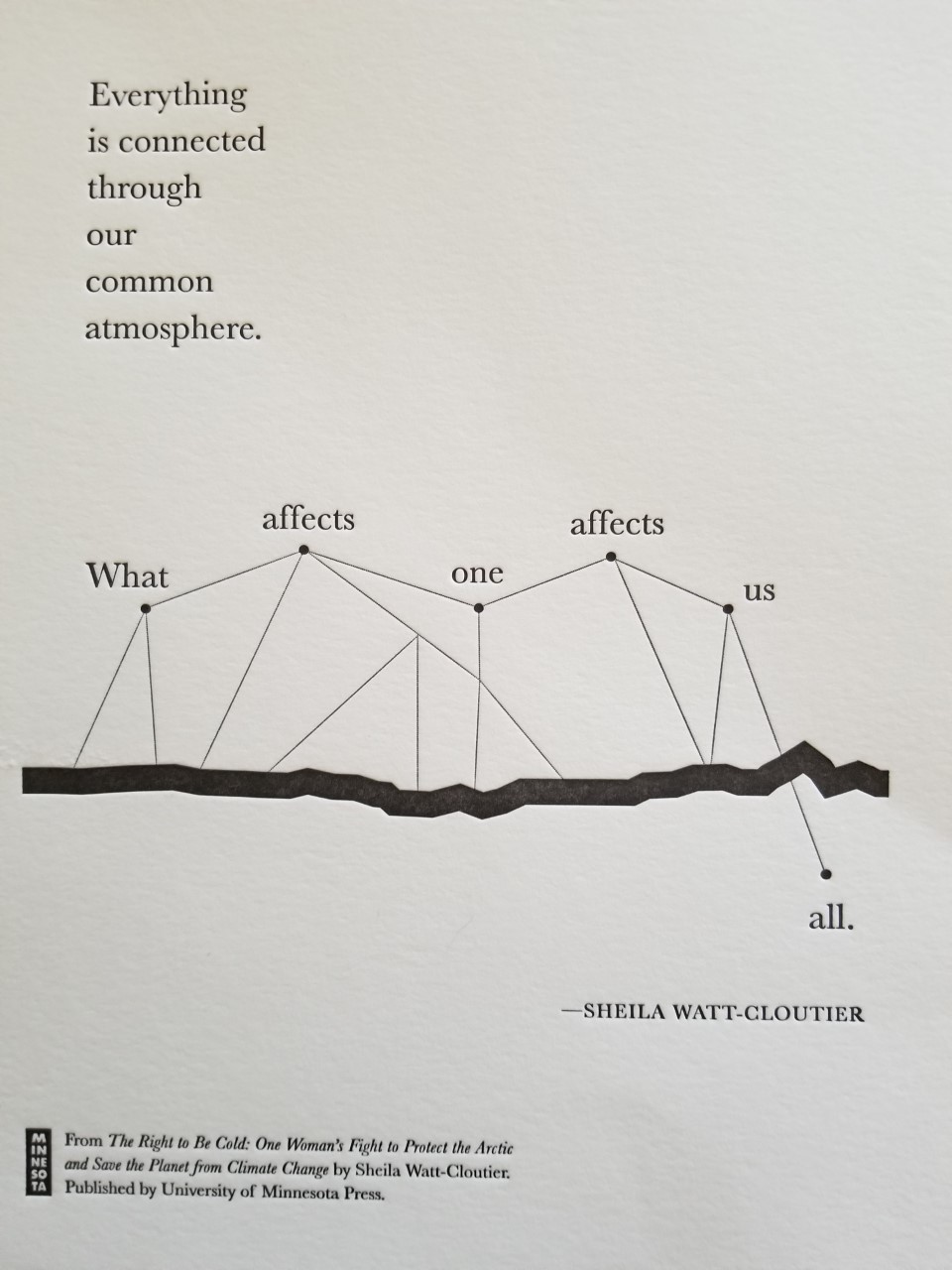
Broadside published by University of Minnesota Press, 2018. 
I received a broadside in the mail this week. A broadside is a printed sheet that promotes a larger work, such as a book. Propaganda broadsides were plastered on walls throughout the colonies during the War for Independence. The London Times distributed broadsides of famous British literary works to soldiers in the World War One trenches. The idea, it seems, was that a bloke absorbed in Shelley or Wordsworth would not notice he was being blown to bits.

Some publishers still print broadsides, mainly of poetry. I have some of those from David Romtvedt and Bill Tremblay, among others. They usually are printed in support of a collection. Flash fiction is suited for broadsides but I don't know if that is a thing or not.

I received a broadside from University of Minnesota Press promoting Sheila Watt-Cloutier's book "The Right to be Cold: One Woman's Fight to Protect the Arctic and Save the Planet from Climate Change." The broadside was a prize offered to like UM Press on Facebook. I liked and I received. See the image above.

This broadside did its job. I did not know Watt-Cloutier's work until the envelope landed in my mailbox. She writes about climate change from an Inuit's point of view. The Arctic nation is almost invisible to us in The Lower 48. My knowledge of people in the Arctic centers around the term "eskimo" and all that it entails: igloos, kayaks, dog sleds, walrus-hunting, "Nanook of the North." My education on Arctic peoples comes mainly from 1950s-era National Geographic magazine which, as we all know now, was a very one-sided view of the world.

I plan on reading Watt-Cloutier's book. I will order it from UM Press. I looked through its catalog and was impressed by the scope of its publications. It includes works on an array of topics, focusing on the culture of the upper Midwest. I know as much as that region as I do about the arctic, although I have walked the intriguing streets of Minneapolis and read a number of books from excellent Twin Cities publishers Graywolf, Coffee House, and Milkweed. 

I watched a TED talk by the author. I read one of the author's postings on the UM Press blog and watched one of her TED talks. She made me see the effects of global warming on humans. We hear a lot about the effect of rising sea levels on coastal populations. When it comes to the Circumpolar Region, we hear more about polar bears than we do about the humans who have lived there for centuries. I live in a high dry climate, albeit one that will be affected by shorter winters. This will impact outdoor recreation and hunting and all of those people that depend on those for their livelihoods. But the Inuit need solid ice for their hunts. As the author says, they risk drowning by falling through the ice that once was solid beneath their feet. And efforts of environmental groups have affected their lives in real ways. It's easy for a city boy in Cheyenne to support bans on seal hunting thousands of miles away. If fact, it's easy for this non-hunter city boy to cast aspersions on hunters of the deer and antelope I see as I travel Wyoming. 

In the days of sailing ships, a naval broadside was meant to get the attention of and possibly demolish another ship. A printed broadside is meant to get your attention and educate you in the process.

This one did its work.

Sunday, January 18, 2015

Dear Florida: Sorry we burned all of that coal but it couldn't be helped

The February issue of National Geographic features an excellent -- and scary -- article about the effects of global warming on south Florida. As the planet warms and sea levels rise, Miami is destined to be either 1. A floating city; 2. nonexistent. Some are planning for the inevitable. Many are not.

National Geographic maps show one of the worst-case scenarios for sea level rise. In 2100, a five-foot rise is expected, which would inundate most coastal areas.
If sea levels rise five feet, nearly one million of the current homes near the coast will be below the average day’s high tide.
--clip-- 
In total, some $390 billion worth of property could be damaged or lost—a sum fives times as great as Florida’s state budget.
I grew up in one of those sea-level homes a half block from "The World's Most Famous Beach." It's possible I learned my love of hyperbole from Daytona Beach boosters. I did learn to surf and love the ocean. At one time, I was thinking of becoming a marine biologist. My brothers and I arose every morning with dreams of good surf. Often we were disappointed. But we usually spent a part of every day in salt water -- or on it. I wasn't big on fishing but some of my brothers were. We were water people.  

I now live on an ancient seabed in Wyoming. Sometimes, when the wind blows from the southeast, I smell salt water. Sometimes I also smell the refinery, but that's another story. Parts of Wyoming's ancient seabed contain seams of coal produced by flora and fauna from those ancient seas and seashores. For a hundred years or so, we've been digging up the coal to burn in power plants that add pollutants to the air and warm the climate. In this way. we contribute to the sea gobbling up my old Florida home and, one day in the far future, providing some bitchin' surfing in Cheyenne, Wyoming.

In Gov. Mead's State of the State speech this week, he received applause and enthusiastic huzzahs from legislators when he said this:
“In coming years, I will continue to work with bulldog determination on coal initiatives, port expansion, new technology, and value-added products. And in coming years, we don’t need to let up, we need to double down. We must assure coal’s continuity.”
Surf's up!

Sunday, December 14, 2014

What happens when Wyoming tourists no longer want to drive?

Gas prices are lower and expected to go even lower. We may be in for $2.50 gas prices in early 2015.

Yellowstone had a record 4 million visitors in 2014.

All good news for Wyoming.

Or is it?

America's love affair with cars may be over. Hard to believe for us Baby Boomers. I've been driving for almost 50 years. I couldn't wait to get my license and a car and tear around Volusia County, Florida -- and possibly use my new motorized self to get a date.

I did get a date or two. And I've driven in hundreds of counties all over this country and had a pretty good time doing it.

But those days may be over, at least in urban centers where most of the population lives. Kids these days -- they don't dream so much about piloting their own car as they do about saving the planet. Public transportation and car-sharing and walking and biking are hip.

Teton County, the gateway to Grand Teton and Yellowstone national parks and the cornerstone of Wyoming tourism, just opened a new terminal for its Southern Teton Area Rapid Transit (START) bus line. We have buses in Cheyenne and Casper and maybe a few other communities. But none of us has a transportation terminal that includes a "bus barn" for storing vehicles indoors away from the cruelties of Wyoming weather. The first phase of this transportation terminal was dedicated Friday. When it's completed, it will even include employee housing, a real concern for any middle class person hoping to make a living in one of the richest counties in the country.

The state has no plans to widen tourist-clogged Teton County roads. And many environmentally-conscious residents don't want those roads widened anyway. So the county plans for more rapid transit to get residents and visitors out of their cars. As it is now, visitors can fly into Jackson and spend a week without a car. In fact, they may prefer that.

The town of Jackson's web site had a link to this article written by Tim Henderson for the PEW Charitable Trusts. It talks about the drop in rates for commuting by car, not only in cities but here in the Great Wide Open:
Western areas known for wilderness and a car-loving culture are seeing big decreases. In Oregon, Washington and Colorado, the percentage of workers commuting by car dropped by either 3 or 4 percentage points. 
The car commuting rate in Teton County, Wyoming, with its breathtaking mountain views and world-renowned skiing at Jackson Hole, dropped from 79 percent to 70 percent. No other county saw a larger decline. 
“We took a number of actions between 2000 and 2010 with the intention of changing the mode of travel away from the auto, particularly for the work trip in our area,” said Michael Wackerly of Southern Teton Area Rapid Transit. Some of the steps included providing commuter buses to get workers from neighboring Idaho, bus passes for Teton Village employees and higher parking fees to encourage bus use. For Teton County, the motivation was largely environmental. 
“A transportation system oriented toward automobiles is inconsistent with our common values of ecosystem stewardship, growth management and quality of life,” said the county’s 2012 master plan.

The Western Greater Yellowstone Consortium, a four-county partnership in Wyoming and Idaho, cites the expectations of Eastern tourists, many of whom come from cities where driving is falling out of favor. “A growing percentage of those visiting our National Parks from the nation’s urban centers and other countries expect to have alternatives to driving a private vehicle,” the group said in laying out its transportation goals.
You can read the rest of the article at http://townofjackson.com/current/more-cities-and-states-car-commuting-skids/

Many tourists "expect to have alternatives for driving a vehicle." They may be prompted by an environmental ethic. They may not want to be bothered with the hassles getting around unfamiliar territory on their own. Or they may not want to endure a National Lampoon-style family summer vacation family trip from Des Moines to Yellowstone. Where's Aunt Edna?

Sure, Jackson may be filled with tree huggers (along with the occasional Dick Cheney). But what about tourists visiting other Wyoming destinations? It's hard to imagine Cheyenne Frontier Days without city streets clogged with coal rollers and RVs. But even at CFD, the city uses school buses to transport tourists from a big parking area off of I-25 to concerts and the rodeo. And the city offers a free downtown circulator bus each summer. Downtown is very walkable and there are more and more reasons to walk around in it. We have a superb bikepath system, although commuting by bike on roadways still can be a harrowing experience.

There is a huge difference between Jackson and Cheyenne, One of the first comments I heard after moving to Wyoming in 1991: "Too bad you live in the ugly part of the state." It's true -- Jackson Hole is gorgeous while you have to hunt for the beauty in the High Plains. It's there, but it's not staring you in the face as it is every day in The Hole. More and more, Teton County residents realize what a gift they have. It's reflected in transportation policies and planning and a strong "locals" movement and arts and cultural activities such as the summer's Wild Festival which has the goal of "deepening our connection to nature through the arts."

In Wyoming, tourism is as important as digging carbon out of the ground to incinerate in giant power plants that obscure our national park vistas and contribute to global warming. But changes in national attitudes and demographics may be the real key to the state's future.

Monday, September 22, 2014

You can see the end of coal from the People's Climate March

More than 300,000 rally for the People's Climate March Sunday in NYC. Can you say, "Goodbye, coal?" I thought you could.

Tuesday, May 27, 2014

Getting famous for all of the wrong reasons

Maybe that should be "infamous?"

The New York Times again weighed in on Wyoming's controversy surrounding science education in our public schools.

Let's recap. At the tail end of the most recent legislative session, Republicans stuck a little footnote onto an education bill that would prohibit using national science education standards in our classrooms. Wyoming is the first state to legislate against the standards.

What's the fuss all about? The standards teach that global warming is caused by humans burning fossil fuels.Wyoming gets most of its income from digging up coal and drilling for oil and natural gas. Some legislators thought it was counter-productive and possibly unpatriotic to teach kids that the coal lighting their classrooms and paying a big portion of their teachers' salaries was destined to kill off the human race.

The New York Times sent a reporter to Wyoming to see what the hubbub was about. It was a good article, one you can read more about here.

The NYT Editorial Board followed up with an op-ed piece Saturday that carried this headline: "Willful Ignorance in Wyoming." It's short and to the point. "Willful ignorance" sums it up pretty well. Take a few minutes to read it here.


Wednesday, March 19, 2014

Stop the cosmos, Wyoming wants to get off

March Madness.

A month that saw the return of "Cosmos" also brought us a maddeningly unscientific move by the State of Wyoming.

On March 14, the Casper Star-Trib explored the effects as Wyoming (through a footnote in a bill passed by the Republican-dominated legislature) became the first state to block national science standards:
One of lawmakers' big concerns with the Next Generation Science Standards is an expectation that students will understand humans have significantly altered the Earth's biosphere. In other words, the standards say global warming is real.
That's a problem for some Wyoming lawmakers.
"[The standards] handle global warming as settled science," said Rep. Matt Teeters, a Republican from Lingle who was one of the footnote's authors. "There's all kind of social implications involved in that that I don't think would be good for Wyoming."
Teeters said teaching global warming as fact would wreck Wyoming's economy, as the state is the nation's largest energy exporter, and cause other unwanted political ramifications.
Micheli, the state board of education chairman, agreed.
"I don't accept, personally, that [climate change] is a fact," Micheli said. "[The standards are] very prejudiced in my opinion against fossil-fuel development."
We staties realize that a chunk of our salaries comes from taxes on coal that is burned in rickety old power plants that produces greenhouse gases that are warming the planet. Many of us also have children or grandchildren who attend science classes in Wyoming public schools where teachers should be teaching science and not some hare-brained wingnut theorem based on how many Tea Party votes there are in Lingle. I also know that Wyoming doesn't exist in a vacuum, that every wacko move by our legislature has a way of zooming around the Internet for everyone to read. Thinking about moving your family to Wyoming? Interested in having your kids learn that coal is the breakfast of champions or that our ancestors rode around the prairie on dinosaurs? We have just the education system for you. And good luck getting into that tier-one university.

The above Casper Star-Trib article went viral this week, with coverage by the Washington Post and Education Week, among many mainstream news outlets, as well as progressive blogs such as Daily Kos and Think Progress.

One might speculate that pols such as Teeters and Evanston's Micheli (also a Repub) are purposefully going out of their way to portray Wyomingites as a bunch of bumpkins just so people won't flock here when floods, caused by nonexistent global warming, inundate the coasts. That attitude is in stark contrast to our governor's efforts to attract tech-savvy companies to Wyoming. For two years, I've heard him at the Wyoming Broadband Summit push for more tech companies to locate in Wyoming. I've also heard him lobby for increased connectivity, from Cheyenne to Jackson, from Lingle to Evanston. We all want greater connectivity. The danger, of course, if that communiques from Wingnuttia reach the wide wide world much quicker.

Sunday, January 19, 2014

Such a huge ocean and such a small beach

We watched the trucks pour sand on Melbourne Beach. Truck after truck dumped their loads and returned for more.

"Where does all of that sand come from?" Chris asked.

"They may be dredging it from the ocean," I guessed.

The sand poured in. A grader pushed it into long piles against the dunes.

I looked out at the ocean from the sixth floor of the Double Tree. Compared the thin strand of beach with the wide swath of the Atlantic Ocean. Every few seconds, a wave broke on the shore, carrying with it grains of sands and taking away grains of sand. Many poems have been written about the relentless nature of the ocean's actions. I can't think of any right now because I lack coffee and my blood has no rhythm. 

You wonder how long this process takes, from dumping the sand, to the waves eating it away to the dredging of the sand and the replacing the sand for the gamboling tourists.

My brother Tim found out that the cost of the replenishment will be around $22 million.

Wonder how many times it will have to be done as global warming raises the sea levels and bigger and meaner storms batter the coast.

More sand!

Tuesday, September 03, 2013

350Cheyenne screens award-winning "Chasing Ice" Sept. 12

This announcement comes from writer and Wyoming Tribune-Eagle columnist Edith Cook:
We are showing the film Chasing Ice at the Laramie County Library in Cheyenne on Thursday, September 12, 2013, at 6:30 PM.
The event is free of charge, sponsored by 350Cheyenne
This film of electrifying beauty documents the quest of one man (National Geographic photographer James Bolag) to explore glaciers and ice-sheets worldwide; he wished to determine how and why they melt. 
Winner of the 2012 Sundance Film Festival, Roger Ebert labeled the film “heart-stopping.” The New York Times made it its Critic’s Pick and the NY Daily News gave it a five-star rating.  Please attend if you can do so.

Sunday, August 25, 2013

Tell the EPA that you want clean Wyoming air

Cheyenne writer Edith Cook writes thoughtful op-ed pieces for our local paper, the Wyoming Tribune-Eagle. Her favorite subject is the environment, mostly how Wyoming stacks up against the rest of the world when it comes to environmental protections, renewable energy, recycling, etc.

In Friday's WTE, she issued a call for the implementation of new Environmental Protection Agency clean air standards for outdated Wyoming power plants. These standards are opposed by our Governor and legislature and our entire Congressional delegation.

One of the themes running through Edith's piece is the traditional tug-of-war between the state's two major industries: Energy extraction and tourism. Tourists prefer pretty landscapes and clean air. Energy companies tend to dig up landscapes and pollute the air. When writers or musicians or artists bring up these uncomfortable facts, all heck breaks loose. 

But the EPA wants to hear from Wyomingites on these new clean air standards. You can bypass the middleman and write an e-mail or a letter to the following (thanks to Edith for this info). Be sure to comment by tomorrow (Aug. 26) and reference Docket ID No. EPA–R08–OAR–2012–0026:
visit http://www.regulations.gov and follow the simple instructions for submitting comments;

email comments to: r8airrulemakings@epa.gov;

fax comments to: (303) 312–6064;

snail-mail comments to: Carl Daly, Director, Air Program, Environmental Protection Agency (EPA), Region 8, Mailcode 8P– AR, 1595 Wynkoop Street, Denver, Colorado 80202–1129.

Friday, May 03, 2013

Welcome to the coal state -- and our cool, energy-efficient welcome center

Southeast Wyoming Welcome Center
Join the Wyoming Office of Tourism, the Department of State Parks & Cultural Resources and the Wyoming Arts Council at a ceremony to dedicate WIND CODE, a sculpture by Laramie artist Stan Dolega, at 10 a.m. on Saturday, May 4, Southeast Wyoming Welcome Center, north entrance, exit 4 off I-25.

Stan’s sculpture was funded through the Wyoming Art in Public Buildings. It's a great addition to the very cool Welcome Center building, which uses alternative energy sources to supply most of its power. According to its architectural firm:
The design team harnessed sunlight and wind to deliver nearly 40 kW of zero-emissions power—enough to offset more than half of the building's electrical demand. Photovoltaic (solar) panels on the roof and walls of the building generate approximately 27 kW of electricity, while five on-site wind turbines provide the balance of renewable power.

The welcome center's HVAC system was built around a ground source heat pump (geo-exchange) system that utilizes the relatively constant temperature of the earth to provide efficient building heating and cooling and features more than 11 miles of heat-transferring geo-exchange coils buried beneath the 26.6-acre project site. Thermal displacement ventilation—a low-energy-use air distribution system in which incoming air originates low in the space and rises in thermal plumes to exhaust outlets at the ceiling—was implemented for the public and office portions of the facility. In addition to saving energy, thermal displacement ventilation enhances indoor air quality and thermal comfort for building occupants.

Daylight harvesting, which optimizes the amount of healthy natural light brought into building spaces while limiting the use of electric lighting, was enhanced by the welcome center's long axis and relatively narrow width. High-efficiency electric lighting supplements natural daylight when necessary.
Stan Dolega's "Wind Code" sculpture
This ceremony will be part of a 9 a.m.-3 p.m. open house at the Welcome Center celebrating the beginning of National Travel and Tourism Week in Wyoming. Visit the many interactive displays inside which highlights Wyoming's culture, history and energy sources. Interesting to note that this week Gov. Matt Mead announced that Wyoming will mine its ten billionth ton of coal in May. More and more of our coal is destined for China although Washington and Oregon are in a snit about letting thousands of coal trains travel through their bobo urban neighborhoods. Hey, what's not to like about a spritz of coal dust on your mocha latte?

Sunday, February 03, 2013

New Greenpeace video about our Powder River Basin coal

New video about plans for our Powder River Basin Coal (includes model trains and special effects).

Friday, January 25, 2013

Bobby Jindal to RNC: "We've got to stop being the stupid party"

Wyoming Republicans: Bibles in schools, roadkill in the freezer, silencers on hunting weapons, an aircraft carrier on Crow Creek, a Dept of Ed Director who's ruining the schools, highest suicide rate in the nation, crumbling roads, Rep. Gerald Gay who says that gays are evil, "coal is your friend" classes for middle school students, what global warming?, the earth is 6,000 years old, "public employees are bums," "Obamacare is a commie plot," Dick Cheney, Agenda 21, Tea Party, wolves are four-legged terrorists, drug tests for poor people, etc. Stupid is as stupid does, Gov. Jindal. 

Thursday, December 13, 2012

Books about vanishing glaciers and wildlife art make WY Outdoor Council''s "best of" list

Dr, Janice H. Harris is the former chair of the Women's Studies Department at the University of Wyoming. As president of the Wyoming Outdoor Council board of directors, she offers her list of best books for 2012 on the subjects of natural history and the environment. Sad to say I haven't read any of the books on her list, but plan to remedy that in 2013. 

She has high praise for an art book, Bob Kuhn: Drawing on Instinct, edited by Adam Duncan Harris (University of Oklahoma Press, ISBN 978-0806143019). Dr. Harris adds the caveat that the editor is her son, a curator at the National Museum of Wildlife Art in Jackson. But there's no caveat when it comes to quality. We have this book in our office and it's a beauty. Bob Kuhn spent a long lifetime sketching and painting animals. He also served as mentor to scores of wildlife artists in Wyoming and elsewhere. The museum has a lot of Kuhn's work -- drop in and visit next time you're in The Hole.

Another of her selections with Wyoming ties is Ice: Portraits of Vanishing Glaciers, James Balog and Terry Tempest Williams (Rizzoli, ISBN 0847838862). This features photographs from the Extreme Ice Survey along with observations by noted environmental writer (and part-time Wyoming resident) Williams. This should be mandatory reading for any Wyoming global warming deniers. Williams was writer in residence at UW a few years ago and ruffled a few feathers with her enviro town meetings held at various locales around the state

The one I plan on reading first is Eating Dirt: Deep Forests, Big Timber, and Life with the Tree-Planting Tribe, Charlotte Gill, (Greystone Books, ISBN 978-1-55365-977-8). Here are Dr. Harris's reflections on the book:
One of first things you notice when you start reading Charlotte Gill is her wit. Given the title and the cover of the book, she had me initially skimming here and there to see where these dirt-eating, tree-planting folks live. I figured remote Brazil. Not at all. When not planting trees in Cascadia, from February through October in the Pacific Northwest, Gill lives in Vancouver writing award-winning short stories. It shows. I loved Eating Dirt. I now want to read Ladykillers, winner of the British Columbia Book Prize for fiction. How can a book about being wet, filthy, bitten, and exhausted be such a joy to read, such a page turner, such a rich introduction into the history and current practices of the timber industry of the northwest? This is a gem.
Gill is a fellow short story writer, and she has wit -- what's better than that?

Friday, December 07, 2012

King Coal holds a seminar in Gillette

An Overpass Light Brigade protest in Portland, Maine.These LED-light-fueled protests are coming to an overpass or state capitol near you.
King Coal holds a seminar in Gillette on Dec. 13, "Powder River Basin Coal: Domestic Challenges and International Opportunities:"
“Coal is important as an abundant, low-cost energy source for the U.S. economy,” UW School of Energy Resources Director Mark Northam says. “The energy programs at the University of Wyoming are looking at ways that coal can continue to be used in the decades to come, because maintaining a viable coal industry is important to ensuring stable, low-cost, reliable electric power generation.”
Domestic challenges, according to Wyoming, the nation's Republican-controlled energy colony: President Brack Obama
Unstated international opportunities: China
The international challenge whose name we dare not say: Global warming

Saturday, December 01, 2012

Men's Journal writer Mark Binelli explores Wyoming and finds it "droughty"

Men's Journal writer Mark Binelli dropped into The Big Square States of Colorado and Wyoming this past summer. He wanted to see what the heck was going on with all this drought and record-breaking heat and cataclysmic fires and dying cattle. He's another in a long procession of coasters who have ventured West to bring reports of the frontier back to the settled multitudes. Nothing wrong with that. Mark Twain did it. He wasn't from any coast, unless you consider him a denizen of the Mississippi River coast, and he did end up living in Connecticut. But writers dropping into Wyoming to explore the curious ways of its populace has a long tradition.

So what did Binelli find? We're in the shit, climate-change-wise. Wyoming cattlemen are worried about the drought and the heat but they also pooh-pooh talk of global warming and hate the federal gubment. Nothing new about that. But Binelli does actually interview real people, as a any good reporter would. He attends a cattle auction in ultra-conservative Torrington (Freedom!) and sits down to breakfast with rancher Bob Cress of La Grange. At the auction, he overhears a couple of cowboys making small talk. One asked another how he's doing. "Droughty," says the other. Droughty -- I like that. It's funny, too, a little poke in the eye to Old Man Drought. That might tell you more about rural Wyoming than a slew of magazine stories. Read the entire Men's Journal article at http://www.mensjournal.com/magazine/will-the-west-survive-20121123?

Friday, April 06, 2012

Gardeners gather in Gillette to rethink the future

Gardening is in again. Rethinking Gardening in the 21st Century is the title for the Gillette Master Gardeners Conference. My fave garden blogger, David Schmetterling of Montana Wildlife Gardener, is Friday's keynote speaker. The conference will bring together authors, Master Gardeners, vendors, horticulture experts, and backyard gardeners to share enthusiasm and knowledge. To view the complete conference agenda, click here.

Saturday, January 28, 2012

Tropical heat wave strikes Cheyenne


I got tomatoes out the ying-yang and it's only January 28!

I exaggerate. But not by much. Cheyenne is now officially in a warmer zone in the USDA's "Plant Hardiness Zone Map." Our high-and-dry-and-cold climate once was in zone 4, which could be described this way: "Don't put your mater plants in the ground until after Memorial Day. And be prepared for frost the day after Memorial Day. And raging hailstorms the day after the day after Memorial Day."

Now we're in zone 5. Planting before Memorial Day is now permitted, even encouraged. Not so fast, says Shane Smith at the Cheyenne Botanic Gardens. This is from the CBG web site: 
Cheyenne used to be solidly in zone 4 is now one full zone warmer, zone 5. “Because this map is mostly based upon temperature, it doesn’t account for Cheyenne’s extreme winds and lack of winter snow cover. Therefore, I would caution people to not jump blindly into growing zone 5 plants and instead look at what is proven to do well here,” said Cheyenne Botanic Gardens Director Shane Smith. Cheyenne gardeners should instead stick to following the colder, zone 4 designation especially when selecting trees and shrubs, stated Smith.
I trust Shane's judgement. High Plains gardeners have to be cautious. However, as global warming continues -- and if I live long enough -- outdoor tomatoes in January may be possible.

Monday, December 12, 2011

While stalking the family tree, I ponder dust storms in the high mountains

Family with trophy tree, Snowy Range, Wyoming

Warm December days, still nights and lunar eclipses probably presage a cold, windy snowy Christmas. But for now, I'm enjoying the weather.

I as thinking of the weather yesterday when hiking up a snow-packed trail near Corner Mountain in the Snowy Range. Our family was in search of our Christmas tree. We don't need snowshoes because we stay on the cross-country ski trail which has been packed down by cross-country skiers and no new snow has been added the past five days.

There's good snowpack this year, thus far, despite the recent warm spell. But if it's to equal last year's record, it will have to start snowing again and keep it coming through May. Last spring and early summer flood warnings were in effect all over Wyoming. This was the second year for that after a decade of drought. That's how it goes in the West.

The snow-melt cycle may be changing, according to an article in the New York Times. Dust that originates in the Four Corners region may be increasing and that may affect what happens in the Rockies each spring. There is an entity invesitating this and you can check out some of their finding at a web site. The Colorado Dust-on-Snow (CODOS) project is part of the Center for Snow and Avalanche Studies based in Silverton, Colo. There may not be a better place for snow and avalanche research than Silverton.

The NYT article was fascinating. Here's an excerpt:
In the last few years, winter dust storms on the high peaks of the Rocky Mountains in Colorado have sharply increased in number, affecting the rate of melting snows into the Colorado River, a main source of water for agriculture and for the drinking supply for more than 20 million people. Of 65 so-called dust-on-snow events since 2003, when tracking began, 32 have struck in just the last three years, according to the Center for Snow and Avalanche Studies, a nonprofit research group based in Silverton, Colo. Dust can accelerate how fast snow melts because it absorbs heat.
“It’s not a mysterious process,” said Chris Landry, the organization’s executive director. “Anybody who has thrown coal dust on their driveway or sidewalk to melt it down knows the theory.”
Much of the dust carries a distinct chemical signature, too, heavy in iron oxides. The same rust-colored mineral that makes red-rock canyon country of Utah and Arizona can also absorb solar energy, again potentially accelerating the rate and timing of snow melt in crucial watersheds.
Looking at the CODOS study map, I notice that two of the research areas are in northern Colorado at the headwaters of the North Platte. I'm going to look into those stats to see how it affects the river that flows through half of Wyoming.

So, at the same time we're getting more snow, it's melting faster. The land dries out and we get more dust storms in Utah, Arizona and California. Visibility suffers. Asthma cases increase. Read Kirk Johnson's Dec. 10 NYT article about changing air quality in the West. 

All of this, of course, is tied in with global climate change.

As I hike the winter Rockies, I think about that all that. We're on a family outing. We have a U.S. Forest Service permit in hand that allows us to thin the tree herd. There will be a line of cars and trucks all day shuttling in and out of the Snowies with trophy trees on their roof racks. The USDA says that this tree-trimming helps to maintain a healthy forest. There are environmentalists who say it is a waste of time and energy. That may also be true. Our forests are in trouble, which is definitely true. On Sunday, we walked among beetle-killed trees. This area is not so bad compared to other parts of the Snowies, especially the west slope where campground have been closed for the culling of beetle-killed trees. 

We bagged out tree and had a great time. Dust, meanwhile, was all around us but hard to see. Hard to see, but taking its toll.  

Saturday, December 10, 2011

Laramie River station one of the nation's dirtiest power plants


The EPA may not be working very effectively when it comes to protecting our air and water. But it will be totally toothless if the all-Republican Wyoming Congressional delegation gets its way.
From WPR:
Wyoming is home to one of the nation’s dirtiest power plants, according to a new study by the Environmental Integrity Project. The report examined emissions reports from power plants around the country and found that Basin Electric’s Laramie River station is one of the top 10 emitters of arsenic, chromium, nickel and selenium. Those are all toxic heavy metals.

Sunday, October 02, 2011

CSU's 100 Views of Climate Change looks at the subject from all angles


Until John Calderazzo showed me his web site, I didn't know that there were 100 views of climate change.

That's the name of his site, 100 Views of Climate Change. It's an official Colorado State University site, one among hundreds at this place that started its life as Colorado A&M -- the big white Aggie "A" still lurks on the mountain above town.

John teaches in the CSU creative writing program which is part of the English Department. He is a writer of creative nonfiction which, put simply, means that he uses fiction writing techniques in his published books and articles and essays about volcanoes, rain forests, watersheds, etc. He takes his facts as seriously as he takes his technique. His book on volcanoes is fascinating. He once taught in China and had written extensively about Asia. Recently, he climbed his first big mountain, a 19,000-footer in Mexico. Pretty good for a guy who won't see 60 again.

I had a chance to visit with John when he was in Cheyenne for the Literary Connection put on by LCCC. He served as my first adviser when I went to CSU in 1988 as a thirty-something corporate dropout. We had a lot in common, including Florida roots, and he was only a few years older than me. We worked on several free-lance writing projects together. It's always good to see an old friend.

As is true with many Boomers in their sixties, John is not sitting in his office counting paper clips and marking off the days until retirement on a wall calendar. Well, he may be doing that but he's also bringing the climate change debate to CSU, Fort Collins, Colorado's Front Range and the Rocky Mountain West. He and his wife, Sue Ellen Campbell, are doing this together. Sue Ellen is also a published writer, professor and environmentalist. The duo has seen first-hand the depredations of climate change. They have written extensively on the subject.

When it was time to do something about it, they thought that they might as well start close to home. So many scientists at this university. Climatologists, soil biologists, ecologists, bioethicists, agronomists, water hydrologists and so on. And sometimes, to translate the work of these scientists, in come the artists, writers and performers.

No reputable scientist disputes the fact that global climate change is a real thing. However, the topic of "global climate change" sparks as many storms as a spring Rocky Mountain low pressure system. Policies that address climate change would affect almost all the ways that we've done business in the West for 100 years. They would affect coal mining, oil and gas drilling, coal-fired plants, transportation, infrastructure, home construction, and almost any other topic you could think of. Just the term "climate change" sends Wyoming Republicans into a tizzy. It's likely they work in the energy industry. It's certain that much of their election war chests come from EnCana and Peabody, etc. Many of their constituents work in the energy industry and make better money doing that than they would in almost any other endeavor. Local business groups and chambers of commerce welcome energy companies and energy jobs. The mayor of Gillette was just in Washington, D.C., telling a congressional committee to send more energy jobs his way.

So, it's not surprising that any hint of doing something about climate change causes berserkity to break out all over.

Chris Drury: "Carbon Sink: What Goes
Around Comes Around"
Here's a recent case in point from Wyoming's lone four-year university. A very talented artist, Chris Drury from the U.K., designed and installed a public art work on the UW campus. It's entitled 'Carbon Sink: What Goes Around Comes Around." It's made of real Wyoming coal and real beetle-killed trees from Wyoming forests. The burning of one of these things -- coal -- undoubtedly caused the warming planet which led to the pine bark beetle surviving winters which led to the killing of the trees. All of the parts will eventually return to the earth from whence they came, which is one of the messages of the piece. A giant circle of coal and wood spinning across a university lawn on its way back to the source. This also is our fate. The fate of humankind, of course, will be determined by the way we treat the planet.

Here's how the project was described on the UW Art Museum blog:
Chris Drury's Carbon Sink: What Goes Around Comes Around places beetle-kill pine and coal -- both natural resources in Wyoming -- in a formal structure derived from a mushroom spore, twisting into a vortex to suggest the natural process of decay, decomposition, and transformation.  Typical of the artist's work, who routinely connects natural phenomena from the macrocosmic to the microcosmic, the whirling deep, dark, and beautiful reflective properties of the coal play off the raw wood that has been charred so the materials merge at the center.
Some Wyomingites were not amused (snippets from stories about the installation from both the New York Times and The Guardian via Inhabitat): 
The coal industry immediately took offense: “They get millions of dollars in royalties from oil, gas and coal to run the university, and then they put up a monument attacking me, demonizing the industry,” stated Marion Loomis, the director of the Wyoming Mining Association.  
Two legislators also jumped into the fray -- Republican Representative Tom Lubnau and Gregg Blikre from Cambell County, site of the massive Powder River Basin coal mine. 
“While I would never tinker with the University of Wyoming budget – I’m a great supporter of the University of Wyoming – every now and then you have to use these opportunities to educate some of the folks at the University of Wyoming about where their paychecks come from,” stated Lubnau.

As it turns out, it was a tempest in a teapot. No coal-crazed Republican legislators attacked the UW Art Museum budget. But we'll have many more of these. Some will be a lot more serious.

Chris Drury is obviously a thoughtful man in search of meaningful discussion of a big subject.
Maybe UW needs a dose of 100 Views of Climate Change. CSU is right down the road...