Showing posts with label cultures. Show all posts

Monday, May 07, 2018

A broadside is designed to get a reader's attention

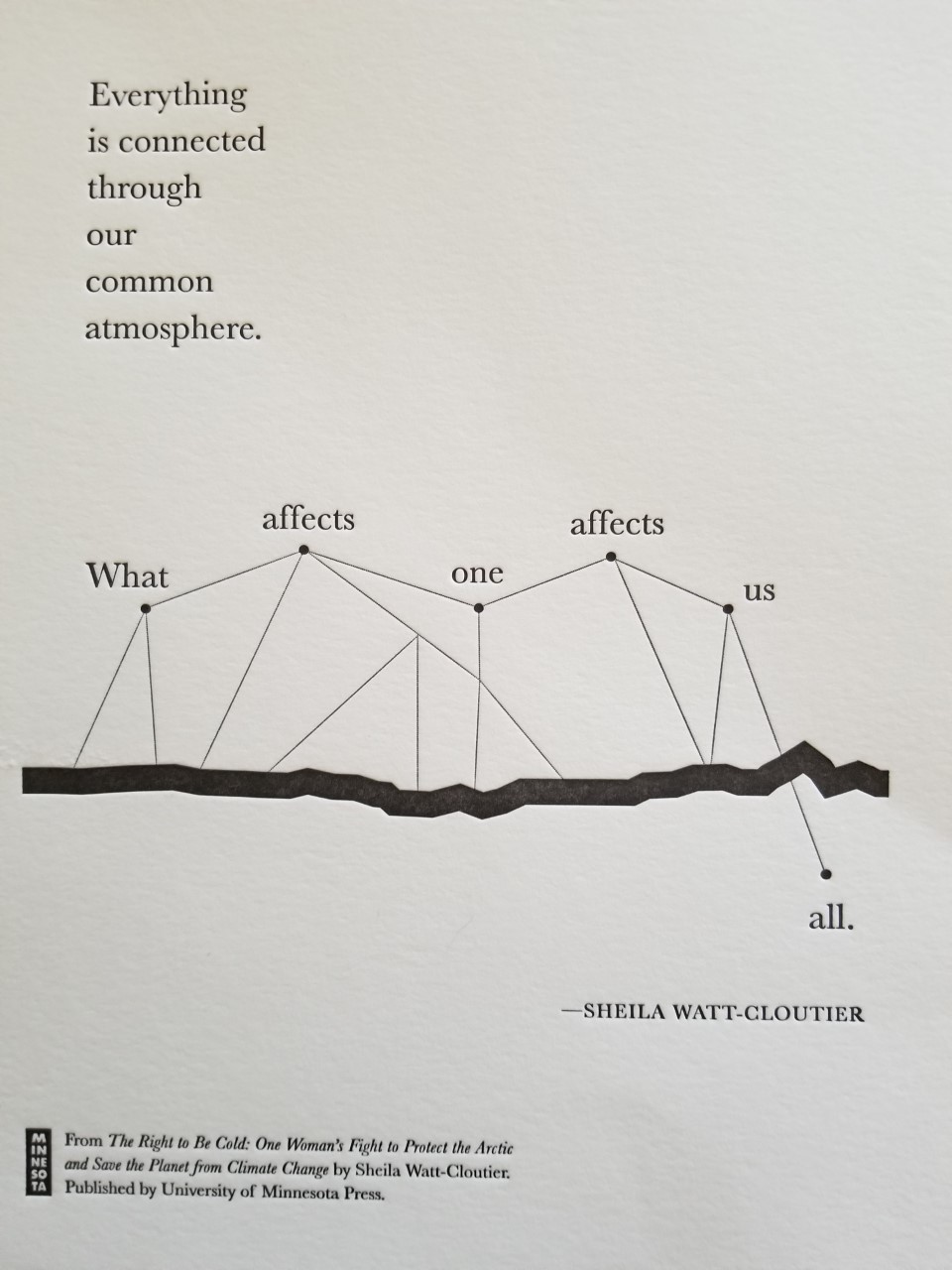
Broadside published by University of Minnesota Press, 2018. 
I received a broadside in the mail this week. A broadside is a printed sheet that promotes a larger work, such as a book. Propaganda broadsides were plastered on walls throughout the colonies during the War for Independence. The London Times distributed broadsides of famous British literary works to soldiers in the World War One trenches. The idea, it seems, was that a bloke absorbed in Shelley or Wordsworth would not notice he was being blown to bits.

Some publishers still print broadsides, mainly of poetry. I have some of those from David Romtvedt and Bill Tremblay, among others. They usually are printed in support of a collection. Flash fiction is suited for broadsides but I don't know if that is a thing or not.

I received a broadside from University of Minnesota Press promoting Sheila Watt-Cloutier's book "The Right to be Cold: One Woman's Fight to Protect the Arctic and Save the Planet from Climate Change." The broadside was a prize offered to like UM Press on Facebook. I liked and I received. See the image above.

This broadside did its job. I did not know Watt-Cloutier's work until the envelope landed in my mailbox. She writes about climate change from an Inuit's point of view. The Arctic nation is almost invisible to us in The Lower 48. My knowledge of people in the Arctic centers around the term "eskimo" and all that it entails: igloos, kayaks, dog sleds, walrus-hunting, "Nanook of the North." My education on Arctic peoples comes mainly from 1950s-era National Geographic magazine which, as we all know now, was a very one-sided view of the world.

I plan on reading Watt-Cloutier's book. I will order it from UM Press. I looked through its catalog and was impressed by the scope of its publications. It includes works on an array of topics, focusing on the culture of the upper Midwest. I know as much as that region as I do about the arctic, although I have walked the intriguing streets of Minneapolis and read a number of books from excellent Twin Cities publishers Graywolf, Coffee House, and Milkweed. 

I watched a TED talk by the author. I read one of the author's postings on the UM Press blog and watched one of her TED talks. She made me see the effects of global warming on humans. We hear a lot about the effect of rising sea levels on coastal populations. When it comes to the Circumpolar Region, we hear more about polar bears than we do about the humans who have lived there for centuries. I live in a high dry climate, albeit one that will be affected by shorter winters. This will impact outdoor recreation and hunting and all of those people that depend on those for their livelihoods. But the Inuit need solid ice for their hunts. As the author says, they risk drowning by falling through the ice that once was solid beneath their feet. And efforts of environmental groups have affected their lives in real ways. It's easy for a city boy in Cheyenne to support bans on seal hunting thousands of miles away. If fact, it's easy for this non-hunter city boy to cast aspersions on hunters of the deer and antelope I see as I travel Wyoming. 

In the days of sailing ships, a naval broadside was meant to get the attention of and possibly demolish another ship. A printed broadside is meant to get your attention and educate you in the process.

This one did its work.

Sunday, April 08, 2018

This isn’t the first time that National Guard units have been sent to the border

1916 cartoon by Clifford K. Berryman, via National Archive Berryman collection. Not sure if the Uncle Sam of 2018 can jump the massive wall that soon will be built at the border. 

Guys in white pajamas shot at my grandfather. That’s the way he told it, anyway. Or maybe it’s just the way I remember his stories. For a few months in 1916-17, Grandpa and his troop of Iowa National Guardsmen faced Pancho Villa’s irregulars across the Rio Grande. He told us that the white-clad Mexican fighters couldn’t shoot straight but Iowans in their spiffy regulation uniforms weren’t much better. They didn’t know it yet, but they were practicing for the big show in France. The U.S. entered the war about a month after Grandpa and his unit returned to Iowa.

Trump isn’t the first commander-in-chief to send National Guard units to the U.S./Mexican border. It’s different this time because Trump is in a snit about not getting enough funding from Congress for his stupid border wall. During the campaign, Trump promised rabid rally crowds that he would build a wall and by gum, he will get his wall, or else your husband or cousin or daughter from the Iowa National Guard will spend the next year trying to snag the caravans of Mexicans that Trump imagines are invading the U.S.

Mexican revolutionary Pancho Villa did invade the U.S. in 1916. His seasoned troops invaded Columbus, New Mexico, and killed 18. Villa lost almost 100 men due to the shiny new machine guns employed by U.S. troops. Villa fled back across the border, leaving Americans in a panic. Pershing’s troops, aided by the first airplanes used by the U.S. in combat, pursued Villa through northern Mexico. They killed a few of his lieutenants but never snagged Villa.

Trooper Raymond Arthur Shay, Iowa National Guard, Iowa City. He and his farm-boy cohorts knew how to ride and care for their horses. They spent most of that southwestern winter dismounted, swatting flies, and taking pot shots at insurgents. Prior to this border expedition, the farthest Grandpa had been from home was basic training at Camp Dodge outside Des Moines. He was a farm boy, oldest of nine kids. Now here he was, hunkered down on the banks of The Big Muddy and the big fool told him to push on – or at least to keep firing at the tiny men in pajamas he could barely see. Their horses weren’t much good either, as this guerilla war was unsuited to cavalry charges. Horses did come in handy for the U.S. Army patrols sent into enemy territory to find Villa. As far as I know, Grandpa never made it across the border.

Four years before, General John J. “Blackjack” Pershing, commander of this Mexican Punitive Expedition had wrapped up another war like this. In 1911-13, he waged what most considered a successful campaign against the Muslim Moros in the Philippines. In Pershing’s view, the Moros were pajama-clad insurgents worth fighting. But not these poor, undisciplined Mexicans. Pershing grew increasingly frustrated. His hands were tied by Congress. Politicians -- always coming to the border on their junkets. Reporters in tow asking stupid questions. There was no winning under these circumstances. This refrain would be echoed decades later by other U.S. generals in other wars. You know, Vietnam.

At the end of January 1917, Pershing abandoned the border foray. The following winter, Grandpa, now a newly minted second lieutenant, found himself in France eyeballing German trenches across a bombed-out moonscape. World War I trench warfare, with its machine guns and barbed wire, rendered obsolete any “Charge of the Light Brigade” operations. Still, the Iowans had shipped over with their horses as cavalry looked fine on parade days. One spring morning, a resurgent General Pershing staged an inspection and picked the unit’s best mount to ride. It belonged to Lieutenant Shay. That was the high point of the war for him, his favorite story, and ours.

Other stories weren’t quite as romantic. Dismounted, in the trenches, poison gas washing over doughboys as they struggled to don their gas masks. Never enough time. Enough of the gas seeped into Grandpa’s lungs to cause some harm, but not enough to get him sent home before the Armistice.

Grandpa’s gas mask and helmet rest in a box in my basement. Photos, too, of him and his troopers in France. Photos of Grandma – his wife -- and her nursing school graduating class. I think about them and their war when I drive down Cheyenne’s Pershing Avenue, as I do almost every day. Cheyenne, a military town, became the adopted home for the globetrotting General Pershing. He married Helen Frances Warren, the daughter of Wyoming’s first U.S. Senator, and served at Fort D.A. Russell, now F.E. Warren AFB. Their home is now a living museum, preserved for future generations. The base itself is a national historic site, home to war trophies from the Philippines and the old airfield where World War I ace Eddie Rickenbacker cracked up his biplane and almost died. It also was the training site for Spaatz’s Flying Circus and the U.S. Army’s airmail service -- Charles Lindbergh was one of its first pilots.

The Pershing family experienced its share of tragedy. If you take a stroll through Cheyenne’s historic Lakeview Cemetery, you will come across a large grave marker for Frances E. Warren and her three daughters, ages 3, 7 and 8. In 1914, Gen. Pershing left his wife and four children at the Presidio in San Francisco to take over command of a brigade at Fort Bliss, Texas. Things were heating up at the border and the general was there to plan for the inevitable. In August of 1915, Pershing received a telegram that his wife and daughters died of smoke inhalation at a Presidio fire. Only his 6-year-old son survived.

Pershing Avenue starts at F.E. Warren AFB and runs straight through town past the Veteran’s Administration Medical Center where the aging Lieutenant Raymond Shay spent some of his last days. The road ends on the east side of town. If you know where to look, you can see Minuteman III missile sites out on the prairie.
     
Combat casualties were minimal in my grandfather’s World War I unit. They were surpassed by deaths from infection and disease, especially from the Spanish flu. Grandpa’s lungs deteriorated from gas attacks. After he returned to the States, he recuperated for months in an Iowa Army hospital. When he took a turn for the worse, the Army transferred him to Army Hospital Number 21 – soon to be renamed Fitzsimons Army Medical Hospital after a hero of the Great War. The dry Denver climate, famous for its healing properties, may have helped his recovery. He really took a turn for the better when he met my grandmother, an Army nurse. He and Florence Green married in 1921, stayed in Denver, raised a family, and lived a good long time.

Now Grandpa and Grandma share a plot at Fort Logan National Cemetery in Denver.

Wonder what they would make of our boy Trump.
Tuesday, November 21, 2017

On the look and smell of old-fashioned print books

The New York Times reports that sales of "old-fashioned print books" are up for the third year in a row, based on figures from the Association of American Publishers. And indie bookstores are doing well, reversing a decline sparked by big box bookstores, Amazon and e-books.

Good news for book lovers. Are the books being read and understood? No, if the American electorate is any indication.

But I am a book lover. At this point in my life, I am trying to shed books with little success. I occasionally clean up the shelves and take a few boxes of books to the library store. But I find a need to read a certain book that I can't get at the library and I end up buying it. My latest purchase was "Sons and Lovers," the 1913 novel by D.H. Lawrence. When a friend and one-time indie bookstore owner saw the book in my car, he picked it up and said, "This is how I learned about sex." I replied that I hadn't reached that part yet. Paul Morel and his potential sweetheart Miriam are still in the platonic stage.

I had a selfish motive for reading "Sons and Lovers." I discovered it was filled with wonderful details about a British coal-mining village of Eastwood before World War I. My grandfather lived and worked in a British coal-mining village before and during the early years of the war. I portray a character like that in the novel I am working on. Also, I never read a Lawrence novel. How I could be an English major and not read Lawrence is a surprise to me. I knew more about his life in Taos than I did about his books.

"Sons and Lovers" is a good read. The prose is dense at times but it was 1913, the same era as Edith Wharton, William James and Upton Sinclair. I read "The Jungle" earlier in the year and it was slow going at times.  Lawrence's prose is better that some of his contemporaries. He had an eye for detail.

This edition of "Sons and Lovers" is a trade paperback published in 2003 by Barnes & Noble Classics. It carries a scent but doesn't have that old-book smell.

But my 1921 copy of John Dos Passos' "Three Soldiers" does. It got it at an estate sale for $4 with the tag "library condition." Well used but not battered. From the Merced County Free Library. It still has the sleeve for the borrower's card and date stamps on the outside front cover. It smells like old paper. The pages are yellowing. But it's still readable, so that's what I'm doing. The novel concerns the journey made by three young men as they volunteer for service in World War I. Written after the war by veteran Dos Passos, the slang and expressions and description are of that time and are quite something. I can read about old times and smell them all at the same time. Not possible with an e-book.

Not sure what I will do with my books (old and new) after I'm finished with them and my research. I would say leave them to my adult children but they look upon their parents' accumulated goods as if it were radioactive waste. They're both big readers but my literary passions are not theirs.

It's good news to see that print books are back. Is it a trend or a passing fancy? Who knows. My habits are not likely to change. I will still get suckered into used book sales and garage sales and will just have to have that 1930 edition of "Death Comes for the Archbishop." I found that book at the annual Delta Kappa Gamma used book sale in Cheyenne. Only 50 cents. Who could pass that up?

Saturday, June 24, 2017

What do the Mozambique and Fort Collins beer cultures have in common?

No surprise to find an exhibit about beer in the craft-brewing Nirvana of Fort Collins, Colo.

What is surprising is to find an art museum exploring beer making in Africa. The exhibit, "Crossing Communities: Beer Culture Across Africa," is up in the Griffin Foundation Gallery at the CSU Gregory Allicar Museum of Art through Sept. 23. The Griffin is in the new wing of the museum that opened last year.

I visited on a particularly hot afternoon in late June. Good day for a cold one. I didn't find that at the Allicar but I did find a fascinating exhibit of handmade beer-making equipment from Uganda, Cote d'Ivoire, Malawi and other African cultures.

Exhibit sponsor is Maxline Brewing, a newbie to FoCo, getting its name from its site along the Max Bus Line in Midtown. According to the exhibit catalog, Maxline joined the project in its early days. Brewery staff toured the exhibit, "examined the ceramic brewing pots and learned about traditional African brewing methods, rituals, and ceremonies." Maxline's brewer then went to work crafting a beer meant to imitate those traditional brews. The brew, named "Kulima" for the Swahili word for "cultivate," is made from millet, maize, barley, hops, gesho leaves, and grains of paradise. Maxline's Crowler label was designed by CSU's Liz Griffin.

The public-private partnership is music to the ears of this former arts administrator. A privately-endowed gallery at a publicly-funded land grant university teams up with an eager local start-up company to educate the public about a commodity -- beer -- and traditions of other cultures. The African ceramic vessels were donated to the museum's permanent collection by Robert F. Bina and Delores De Wilde Bina. An anonymous donor helped fund the purchase. Partnership such as this one have been going on for a long time. Often the catalyst is a local or state arts agency or the NEA. But not always, as I found no mention of Fort Fund or Colorado Creative Industries in the catalog. Not necessary. This is America and we don't requite the imprimatur of the culture ministry to approve an exhibit. We damn well can show anything we want. Almost anything, as attempts at censorship are often in the news. But if I was the culture minister, I would want to be associated with this fine show.

The exhibit is comprised of 39 pieces. They include water and grain-carrying vessels, brewing pots, and drinking vessels. All are handcrafted in a technique displayed in the film that accompanies the exhibit. The drinking vessels may be the most interesting. Some were large enough to serve an entire village while other were akin to mugs we use in the West. One featured five spouts, looking almost like an invitation to a drinking game.

Beer in Africa is not just for pleasure. It also serves a ceremonial function. Find out more about this in exhibit catalog essays by CSU student art major Laura Vilaret-Tuma and Dr. David Riep, associate curator of African art. Vilaret-Tuma's essay is "Ceramics Across the African Continent." Dr. Riep writes about "the spiritual aspects of terra firma in ceramic arts across the African continent." Get more info and photos of the exhibit at the museum's web site.

The making and drinking of beer is ritualized all over the world. Beer is a staple at football games and backyard barbecues. Friends sit in a pub drinking beer and swapping tall tales. some of them true. The advent of craft beer caused beer brewing to become almost ceremonial, with brewmasters concocting their creations in public view. Like ancient magicians, they combine intriguing ingredients, such as the aforementioned gesho leaves and grains of paradise, to the mixture. True, their brewing vats are stainless steel and not ceramic, but they serve the same purpose. We sample the beers with a reverence that startles, even annoys, the casual beer drinker slamming down a few cold Buds. Advancing age and good sense led me away from keggers to craft beers. I can sip them at my leisure, marveling at the brewer's art. Most of these beers have a higher alcohol content that mainstream varieties (I am talking about you, Melvin Brewing Co. of Alpine, Wyo.). This can ambush newbies. They won't see God but they may end up talking to Ralph on the big white telephone.

If you require an excuse to travel to FoCo for a ritual beer tasting. the museum invites you to the reception for the exhibit on Thursday, June 29, 5-7 p.m. View the arts and sample Maxline's Kulima out in the sculpture garden.

What better way to spend a summer evening?

Thursday, April 27, 2017

Message to Sen. Mike Enzi: You are no help on the Senate HELP Committee

Received this letter from my U.S. Senator Mike Enzi today. It was a response to my postcard appeal back in March to Sen. Enzi, a member of the Senate Arts Caucus, to save funding for the National Endowment for the Arts, which Trump has targeted in his draft budget. Every time I receive a Congressional response, I frame it with  drawings of the human body in the excellent big-format book, "Wall Chart of Human Anatomy," 24 charts of "3D anatomy based on the National Library of Medicine's Visible Human Project." It's a very sciencey book which is appropriate due to  the hundreds of marches for science we had last weekend. Republicans have yet to show that they have human circulatory systems. 
I received a nice note from Sen. Enzi today. It was short, but I understand, as Sen. Enzi had an action-packed week advising Wyomingites the proper attire to wear (or not to wear) to a Wyoming bar. He was specific about the attire -- a tutu -- but not specific on which bar. It could be the railroaders bar in Bill or the cowboy bar in Cheyenne or the brewpub in a barn in Ten Sleep. He told high school students in Greybull that anyone who wears a tutu into a bar in Wyoming gets what he deserves. We know he was talking about Wyoming's Larry "Sissy" Goodwin, a heterosexual Wyoming man who wears women's clothes and has been beat up several times by drunks who don't think that Wyoming men should be walking around in tutus. Sissy and I have spoken at Democratic Party and union meetings. Sissy is quite a dresser.

So Sen. Enzi has been busy apologizing and, in turn, not apologizing.

So I will forgive the abruptness of his response. But I do want to deconstruct it as it includes some strange statements. Some non-explaining explanations, if you will. Maybe even some alternative facts.

Sen. Enzi points out that he is a member of the Senate Health, Education, Labor and Pensions (HELP) Committee. As such,
"I believe that the arts and humanities are an important part of a quality education for our children."
Who can argue with that? Children need the arts just like they need to breathe. But it's not just the children -- all of us need the arts. Republicans know that they can get into the least amount of trouble by saying they are for the children and education. If they said, "I love the arts for art's sake" at the local bar, they would be beat to a pulp. Or if they said they supported the rights of artists to artistic expression -- the same result. They might be spared if they said they supported their local arts councils which sponsor much-needed artistic performances in some of the smallest communities in the state. But then if they told the mugs at the bar that the money for these activities came from taxpayer dollars, they might object. Tax money shouldn't support the arts and artists. That's something they might say. Or this: The arts should be self-supporting. This is funny coming from a Wyoming taxpayer, who annually receives more in federal funding than they contribute.

Does anyone find it odd that the Senate has a committee called HELP? There might have been a time when Congress looked out for people's health care, public education, the rights of labor unions and the ability of seniors to support themselves after a lifetime of working. Those days are gone. If you need any proof, just take a look at the Repubs' latest healthcare legislation. None of us will get any HELP from this bill. Keep your eyes on Sen. Enzi's vote when it comes to the Senate. Let's see how much HELP he offers to his constituents. He was a foe of Obamacare and will probably gush over the latest cruel version of Trumpcare.

Here's another statement from Enzi's letter:
"In Washington, I am working to encourage people across the country to get more actively involved in the arts."
As James Baldwin once said, "I can't believe what you say, because I see what you do." This is a notable writer saying that "actions speak louder than words."

The statement that really got me riled was this one:
"As we celebrate the arts, culture, and humanities that are native to our land, we encourage our young people to learn about the past and develop their own artistic abilities."
What exactly are the "the arts, culture and humanities that are are native to our land?" You have to admit that the native artists who etched the petroglyphs were talented. Native artists to our land created beautiful baskets and pottery and jewelry. They built Mesa Verde in Colorado and the mounds in Indiana. The medicine wheel on the crest of the Big Horns.

Not sure that's what Sen. Enzi means. The man reads books and he attends arts events around the state. As a mayor, he energized the arts in Gillette. But his statement smacks of the Nativist mentality that got Trump elected. When they say native, they mean white men. White Protestants founded this nation, by God, and we are the native race. All those other cultures don't count. Witness the Arizona law that forbids schools to teach Latino culture. Are African-American art forms such as jazz and blues and hip-hop counted among the arts native to this land? Salsa dancing? Non-representational art created by New Yorkers and Coloradans and Wyomingites who may find their influences in art from Puerto Rico, Mexico, Zimbabwe, Japan, Iraq, or Ukraine?

The U.S., surprisingly enough, did not invent the arts and humanities. We come from many cultures, many lands, many religions. We all deserve to be heard and seen.

Sen. Enzi wraps up his letter with a cautionary note that "the president's budget is always just a starting point." OK, so get started and do something to ensure that arts and humanities thrive in these United States. Make a stand and say that you will no longer follow the voting patterns of the Republican right-wing kook caucus. Tell your constituents you will no longer follow Trump as he marches us off of a cliff.

HELP us!

And I leave you with this artistic image, which I thought was hilarious.

This from Wyoming Equality: LGBTQ friends and straight allies put a tutu on, we're going out!
Find a #ToLiveAndLetTutu party near you: https://goo.gl/IqdZQ6

Friday, March 03, 2017

CRMC sponsors first Culture Fest Promoting Health and Justice April 29 at LCCC

This comes from a press release:
Culture Fest sponsored by Cheyenne Regional Medical Center
The first Culture Fest Promoting Health and Justice will take place in Cheyenne on Saturday, April 29. The goal of this festival is to celebrate the various cultures represented in our Wyoming community and address social determinants of health that often contribute to health disparities of minority groups. During the festival, there will be opportunity to display your cultural arts and educate community members. There is also opportunity for performance on the “big stage. 
The main event will take place on Saturday, April 29, at Laramie County Community College’s Pathfinder Building, 1400 E. College Drive, from 10 a.m.-4 p.m. 
Check out the Participant Letter and and the Market Registration Form2
FMI: Monica Jennings at 307-432-3640 or monica.jennings@crmcwy.org
A line in the participant letter caught my attention:
We sincerely appreciate your willingness to devote your time and share your expertise with the multicultural communities in our state. Your commitment to the well-being of others does not go unnoticed.
Sounds as if this might be a good event to talk about the ACA, Medicare, Medicaid expansion, and any number of timely topics. Wyoming has many health challenges, not least of which is mental health care. I've written often about the challenges my daughter faced in getting the appropriate mental health treatment in Wyoming. She finally found resources in Aurora and Denver. The feds played a role, too. Which raises concerns about the Trump administration's proposed gutting of health and mental health agencies. If Trump continues to wage endless wars, veterans will continue to have mental health challenges. No aircraft carrier task force or joint strike fighter jet can effectively challenge a stubborn case of PTSD.

Monday, February 06, 2017

Is corporate America really our enemy?

I watched the entire Super Bowl, from its hope-filled opening to its bitter end. I saw an hour of the pre-game show but didn't watch the post-mortem, when Trump's boy, Tom Brady, celebrated in style. Or I assume that he did.

Funny how this football game became a forum to challenge #45. Big corporations paid big money to air their inclusive views on race, immigration, history. Budweiser told the story of its German immigrant founder, including a scene at the docks where nativist Know Nothings harass him and other "foreigners." 84 Lumber aired the story of a Latin American mother and her young daughter and their trek to the U.S., to reunite with the father. Unfortunately, the imagined Trump wall almost got in their way. Air B&B addressed intolerance by exhibiting the many faces of our neighbors. All of the ads featured Americans of varying colors and creeds and statuses. The America that exists now, not the fear-plagued, hateful nation summoned by Trump. Creative people imagined these ads, wrote them, shot them, acted in them, edited them. Creativity is one of our greatest strengths. It can reveal, in creative ways, the xenophobic ways of the fascist, who hates creativity and humor and the First Amendment.

At the end of last night's game, I wondered: Will it be the corporations that save us from Trump? You must be a huge entity to afford Super Bowl ads. To be a huge entity, you need to appeal to the largest possible audience. For years, Coke and Bud and McD's have featured a rainbow of talent in their commercials. Look at ads from your childhood in the 50s-70s. White people. Look at commercial TV now and you see America as it actually exists. We have African-Americans and Latinos, Somalis and Salvadorans. We have hearing-impaired people signing a language that it as foreign to most of us as Urdu. We have people in wheelchairs.

This apparently irritates Trump supporters, who tend to be rural and white. They look around their small town and see people like them. They watch cable TV and see a changed America, one that is foreign and scary. It's mainly urban and young. They go to Denver and Salt Lake City and Albuquerque and see this America in living color. It's intimidating. Almost like a foreign country.

Many of my city friends laugh when I say that I'm a city boy. I say I live in a capital city, the largest one in my state, one of only two Metropolitan Statistical Areas. If asked, I say that the population is 68,000, the size of some suburbs in their state. They think I'm funny.

Back to corporations. Many liberals see them as the enemy. They are trying to take over the world, make everybody live in a cookie-cutter world. They are the enemies of craft brewers and locavores and indie bands.

But corporations employ smart people and see what's going on. Corporate brewers buy up craft brewers and try to duplicate their appeal. Fast-food giants try to be like the mom-and-pop neighborhood bistro, offering artisan this and handmade that. They know things are changing. But we sneer at them, superior beings that we are. Meanwhile, they hire people of color who are dependable and smart. These companies understand that Trump's prejudices will kill their businesses.

Look around you. See who works at your favorite restaurant and coffee shop. Investigate their politics. See who they are connected to in public. You can hate Starbuck's if you want, but it is an open-minded company, one that challenges the Trumpsters. Buy a coffee there and one at your locally-owned coffee shop. Thing is, your local shop may be owned by rabid Republicans just following a proven business model. Maybe Starbuck's is more attuned to your beliefs.

Some wingnuts are calling for a Budweiser boycott. Last summer, Bud changed its flagship beer's name to "America." I didn't drink any America. I thought it was silly, and that only bikers and cowboys would fall for it. But now I will drink a Bud for every Fat Tire or 90 Shilling I drink. Not sure if my heart can take too many fast-food meals, but there must be something I can eat at Wendy's. It's important to support those companies who dared to challenge a despot on the biggest sporting event of the year

Friday, September 09, 2016

The Broncos vs. The Bard

A writer, dead for 400 years, caused me to miss the first half of the Denver Broncos season opener.

I know, where are my priorities? William Shakespeare vs. two NFL teams that battled it out in Super Bowl 50?  Denver, our southern neighbor, was at a fever pitch for weeks leading up to the game. My Colorado hometown may no longer be a cow town but it still bleeds orange and blue every fall. Three Super Bowl championships, multiple Super Bowl appearances (we don't talk much about the first three or the one in February 2014), many league championships and wins over the dreaded Raiders. I was a jock in high school and a sports reporter as a young man. Sports are in my blood.

But so is Shakespeare. My accountant father's library still had his college Shakespeare texts but nothing on finance and economics. I was more interested in reading first-hand accounts of World War II. Dad seemed happy that his eldest child loved reading and books. I think he was a frustrated academic, one who would have been more comfortable surrounded by books than IRS rules and regs. Not a teacher but /probably a researcher, as he wasn't all that good with people.

Shakespeare's First Folio is touring the U.S., courtesy of the Folger Shakespeare Library in Washington, D.C. Actually, six of the first folios are touring and one landed at the State Museum in Cheyenne. Published in 1623, it is kept under lock and key in a climate-controlled glass case watched over by a security guard. The pages are open to Hamlet's famous "To be or not to be" speech. The text is small and difficult to read, not only because of its size but because the language -- Early Modern English -- is arcane to us. Here's a sample:


A bad quarto was basically a bootlegged copy of the script, written hurriedly by an audience member or recalled later by actors. Think of a bootlegged copy of, say, a Grateful Dead concert in the 1970s. The good quarto was a copy of the play taken from the source. The first folio is the 1623 version that featured 36 plays, 18 of which had never before appeared in print.

I didn't have to read the fine print to know the value of what I saw. The first folio saved 16 of Shakespeare's plays from oblivion. They include Macbeth, The Tempest, Henry VIII and Twelfth Night. Forsooth, what would Hollywood have done without the three witches or Prospero's island? I would never had been treated to a nude version of Macbeth's witches at Gainesville's original Hippodrome Theatre. My life would be leff without it. 

If you want to talk monetary value, a first folio was sold at auction in 2001 for $6.1 million. I'll take two! When it was hot off the presses, a first folio went for about a pound. In today's money, that's somewhere between $150-$250.

But it's not the money really now is it? As the State Museum exhibit points out, Shakespeare and his plays have given us phrases that we use every day and countless hours of entertainment at the movies. I believe that I first heard lines from Romeo and Juliet in a Bugs Bunny cartoon. Every state boasts a Shakespeare company, usually one that tours performances every summer. In Wyoming, that's the Wyoming Shakespeare Company out of Lander. I recall a memorable version of King Lear on the Cheyenne Botanic Gardens lawn. Nature provided its own thunder and lightning for the famous storm scene with King Lear and The Fool. Here's Lear: 
Blow, winds, and crack your cheeks! Rage, blow!
You cataracts and hurricanoes, spout
Till you have drenched our steeples, drowned the cocks!
You sulfurous and thought-executing fires,
Vaunt-couriers of oak-cleaving thunderbolts,
Singe my white head! And thou, all-shaking thunder,
Smite flat the thick rotundity o' th' world,
Crack nature’s molds, all germens spill at once
That make ingrateful man!
Now that's a storm. 

Last night was rounded out with a presentation by UW Prof Peter Parolin: "From the Fringes to the Folio: Crossing Borders with Shakespeare in Life, on Stage, and in the Globalized World." Fascinating talk, and I was surprised on how many stayed after the food and wine and entertainment to hear an academic speak. I had not thought about "migration as one of Shakespeare's principal themes." But Parolin has, at length. He accompanied it with  a PowerPoint presentation, his first, which acted as a helpful assistant to the talk. 

I had not thought of migration and immigration as big Shakespeare topics. But crossing borders happens a lot. The Merchant of Venice and Othello are good examples, with their "foreigners" as key characters. Parolin even quoted a brief snippet from Shylock's speech: "In Aleppo once..." The Syrian city has been in the news lately as it suffers the slings and arrows of outrageous fortune -- and the forgetfulness of presidential candidates. 

Thanks to everyone at Wyoming Cultural Resources for bringing the folio to Cheyenne and staging the event. The First Folio will be in town through the end of September. 

I made it back to my Smart TV to watch the second half, in which the Broncos staged a comeback. With 9 seconds left, the Carolina Panthers kicker nailed a field goal but it was negated by a Broncos timeout. The second kick went wide to the left. That kicker was feeling some slings and arrows last night on Twitter. In Denver, they were partying like Falstaff and Prince Hal in 1402. 


Thursday, April 12, 2012

"There's nothing left to do but sing" -- Climbing Poetree performs April 19 at Center for the Arts in Jackson


Performance poetry group Climbing Poetree will take the stage at the Center for the Arts in Jackson on Thursday, April 19, 7 p.m. FREE! Brought to you by pARTners. This is an amazing chance to see art for social justice in action.

Sunday, September 04, 2011

UPDATE: Cheyenne Interfaith Council 9/11 commemoration

September 11, 2011 - 10th Anniversary of 9/11. The theme of the Cheyenne Interfaith Council Observance is “Remembrance, Healing, and Hope." On the 11th, there will be a presentation by Hands in Harmony starting at 2:45 PM at the Capitol. The Interfaith Service will begin at 3:00 PM with a program that includes music, readings from the Quran, Hebrew Bible, Gospel, Greek Orthodox, and other traditions... Each faith community is asked to bring a meaningful “broken” item to the September 11 commemoration. All broken items will be brought forward and used by a local artist, Forest King, to create a work of art symbolizing the transition from brokenness to hope. Please come! 

Saturday, August 20, 2011

"Tierra y Libertad" mural going up in downtown Laramie

Artist’s rendering of a beautiful mural in Laramie that links the food we eat with the people who harvest the food that we eat. Way to go, Laramie. Artist Talal Cockar's "Tierra y Libertad" is the first in a series of murals in downtown Laramie sponsored by the University of Wyoming Art Museum and the Laramie Main Street Alliance.

Saturday, July 02, 2011

Stories about ethnic traditions in Wyoming at Laramie County Public Library July 14

Not only did I get a cool tie-dye “One World, Many Stories” T-shirt for joining the library’s summer reading program. I will also receive a cool mug when I’ve read at leats 30 minutes a day for 25 days (done!). Also a bevy of good summer programs at the library. Here’s one:

"One World, Wyoming Stories"
When: Thursday, July 14, 7-8:30 p.m.
Where: Laramie County Library Cheyenne (map)
Description: Annie Hatch, Wyoming Arts Council Folk & Traditional Arts Specialist, and Andrea Graham, Folklorist with the University of Wyoming American Studies Program, will share stories about a variety of ethnic traditions in Wyoming. They’ll also encourage participants to share their own stories. This is held in conjunction with the “One World, Wyoming Stories,” exhibit in the library through August 16. (Adults, Sunflower Room, 3rd floor)

Thursday, December 23, 2010

Impulsive 1840s pioneers longed "to see what the next elevation hides from view"

I’m reading Will Bagley’s first volume of a projected three-part series about the West’s overland trails. It's entitled “So Rugged and Mountainous: Blazing the Trails to Oregon and California, 1812-1848.” It's published by the excellent University of Oklahoma Press.

It sat on the new non-fiction shelf at the library. When I saw it, I said, “We need another book on the Western migration?” I opened the book as was glad to see that Bagley acknowledged his predecessors, noting that “some of America’s best writers have told this tale.” We know the names: John Unruh, Francis Parkman, Mark Twain, Washington Irving, A.B. Guthrie, Fawn Brodie, Vardis Fisher, Wallace Stegner, Alvin M. Josephy. And so on.

I’ve read a number of the fictional accounts of the trails, notably A.B. Guthrie’s “The Way West.” As is true for most Americans, I learned my “Way West” history from movies, such as the huge 1962 Cinerama epic, “How the West Was Won.” Many, many movies have been based on the subject, including my favorite, “Blazing Saddles.” And yes, I know this is a lampoon of classic western films and bears no resemblance to the West’s true story. Except for the farting-around-the-campfire scene. So very real.

I’ve read only snippets of non-fiction accounts. That’s now changing.

I was hooked from the first sentence of Will Bagley’s preface: “All peoples have a myth, and as Americans we love our legends but often loathe our history.” A good line to keep in mind during times of revisionist history-making. South Carolinians recently celebrated the sesquicentennial of the Civil War secession in Charleston with a formal ball. Slavery wasn’t mentioned. But all the white folks at the ball looked marvelous.

Conservatives love their mythic West. We saw this most recently in the Wyoming Legislature’s enshrining a new “Code of the West” based on mythic cowboy lore. We Liberals also have our myths. Beginning in the 1960s, we fell all over ourselves romanticizing “the noble savage” and turning it into an icon of popular culture. Native Americans are admirable in many ways. But they are humans, too, and share the same failings as their Anglo brothers and sisters.

Bagley’s dogged research led him to the conclusion that the true story is more exciting than any myth we might conjure. I agree. What makes regular people pull up stakes, pile their goods in a wagon and trek 1,500 1,800 miles from Independence, Mo., to Oregon's Willamette Valley? I’d often wondered. I’m not the first to speculate that it was wanderlust or even ADHD (see my short-short fiction piece, “How the West was Won”). But the definitive answer doesn’t seem to exist. Bagley scrolls through the reasons and makes a great case that it was many things. Some were looking for land and other new opportunities. Others were fleeing the wretched, malarial climate of the Mississippi River Valley. Others were just moving on.

He sums it up this way:
Men often went West to escape debt, the law or family responsibilities. Yet what sets apart the pioneers of the 1840s was that they were generally very ordinary people who undertook an extraordinary task. Many of them were impatient and curious. “Emigrants are generally too impatient, and over-drive their teams, and cattle,” William Ide noted. “They often neglect the concerns of the present, in consequence of great anticipations of the future – they long to see what the next elevation hides from their view.”
Impulsivity and hyperactivity and curiosity. Traits held by so many Westerners.

I can’t wait to get back to Bagley’s book. It’s a long journey, but I have just the right sort of doggedness to see it through.

Sunday, December 05, 2010

Cheyenne's Tuesday farmers' market moves downtown in June

While spending my allowance Saturday at the Cheyenne Winter Farmers' Market at the Depot, I ran into Sara Burlingame-Thomas. Whenever there's a farmers' market or progressive cause, Sara can't be far away. Most of the time she's leading the charge.

Back when Sara was proprietor of the now-defunct Sara's Breads, she started up an alternative market, held each Tuesday in a parking lot on Yellowstone Road just a bit north of Dell Range and about three blocks from my house. The market is sandwiched between Cool River, the neighborhood liquor store, and a chain bread store that makes some nice sweet rolls. It's a small lot, but it's been home to the market for years.

Sara says that in June 2011, the market will move to the Depot Plaza downtown. My neighborhood will miss it, but it will be a big boost to downtown. That means that the plaza will be lively at least three nights a week each summer. There will be the Tuesday market, the Friday evening concerts and the big Saturday market that begins the week after Frontier Days ends. During Frontier Days, the plaza stages nightly concerts. A half-block away is the Atlas Theatre with its nightly melodrama, sometimes featuring yours truly as emcee.

But before and after CFD, tumblin' tumbleweeds are the only things moving downtown on many nights. There are a few bars and restaurants. People come out to see the films at the Lincoln Theater. But there are too many vacant downtown buildings, some that have been empty for decades. And many businesses close at 5, even in summer.

Sara says that the market wants to feature live music and work out some deals with local restaurants to get people to stay downtown to eat after buying their grass-fed beef and lettuce and and bedding plants from vendors. Great ideas.

Now, if we can only come up with a creative idea to fill in downtown's Big Gaping Hole. Just filling it in would be a start. What about a community garden?

I'll plant the first seed.

Monday, November 22, 2010

Connecting culture and agriculture in rural Wisconsin

Fascinating info and video about the Wormfarm Institute in rural Wisconsin. One of the winners of this year's Wisconsin Governor's Awards in Support of the Arts, residencies at the Wormfarm include 15-18 hours per week of growing and cultivating and harvesting in the institute's vegetable garden. The rest of the time, artists can cultivate their own art. Veggies, fruit and art is sold at Roadside Culture Stands. There's also a gallery in the local town.

FMI: Connecting culture and agriculture

Thanks to The Artful Manager's blog for this.

After watching the video about the Wormfarm produced for the awards, I am in love with this place. Although I am a city boy, I've planted my own veggie gardens in three states since 1974, with time off for various reasons. My Cheyenne, Wyoming, garden has been expanding the past three years. I do not have grandiose plans, but prefer to grow my own because it is fun and the results are so tasty. As a writer, I get ideas while gardening -- and sometimes mull over my latest story while plucking weeds from beneath he tomatoes. I'm now working on a gardening story. Wait, don't run away. It's a very exciting story involving sexual hijinks -- and I'm not just talking about botanical pollination, although that can be very stimulating for gardeners. I'll see where it goes...

Sunday, November 07, 2010

Art blossoms all over Georgia -- and in airports all over U.S.

"Dogwood," a sculpture by John Portman in downtown Atlanta. I think this a dogwood blossom in bronze I(although I couldn't determine the medium). These blossoms light up the Georgia spring which usually occurs in late March. In Wyoming, the calendar may say spring but the landscape cries snow and cold. The Atlanta airport has a fantastic public art program. Walking the concourse like walking the corridors of a museum. Art, history and science displays.

Here's another airport that really values art:

Friday, August 07, 2009

WyoDems' Petersen: "Ashamed and disappointed" in Wyoming senators

From today's WyoDems press release:

Wyoming Democratic Party Chair Leslie Petersen issued the following statement after the U.S. Senate voted to confirm President Obama’s Supreme Court nominee, Judge Sonia Sotomayor:

“Today’s confirmation of Judge Sonia Sotomayor is a historic event for the U.S. Supreme Court and for the American people. Our nation’s highest court will gain a sharp mind and a highly experienced justice to its bench. Her dedication to the court and commitment to the Constitution have been proven throughout her expansive legal career as a judge, a litigator and a prosecutor. With more judicial experience than any justice on the court in the last 70 years, she couldn’t be more prepared to rise to the monumental task of serving our country as a Supreme Court Justice.

"On this day we would also like to pause and appreciate the life of Judge Sotomayor as a remarkable citizen. Her achievements and hard work are humbling proof that the American Dream is alive and achievable. Judge Sotomayor will be the first Latina and only the third female to serve on the Supreme Court, making her a strong role model and an inspiration to millions of Latino and female Americans. Today is a great day for the American people, and I congratulate Judge Sotomayor and wish her the best of luck as she embarks on this important journey."

We are ashamed and disappointed that neither of our Senators voted for this outstanding woman.

Contact: Brianna Jones, brianna@wyomingdemocrats.com, (307) 752-5288

Monday, April 20, 2009

All the President's books

On Friday, President Obama accepted a book from Venezuelan President Hugo Chavez. The book was Eduardo Galeano’s "Open Veins of Latin America." Obama should read it, he really should. Galeano is an amazing writer. An outspoken leftist who had to flee right-wing death squads in his home country of Uruguay and more death squads under Argentina’s military junta. Galeano wrote his masterpiece "Memory of Fire" (Memoria del Fuego) while an exile in Spain.

Pres. Obama may read the gift book from Chavez. The prez, after all, is a reader. A writer, too. Reading good writers keeps the mind open, allows new ideas to permeate the brain and circulate freely. Allows you to consider new ways to do things. Chat with former enemies of the U.S., for instance.

Americans seem to have the idea that we invented the world. But the world was well on its way by the time we formed our democracy. Some 300 years of Latin American history had transpired by 1776. And a bloody history it was. In his book, Galeano tells short stories of the good and the bad and the in-between. The stories are compelling and the history, compelling and infuriating. How can humans make the same mistakes over and over again? So writers have something to write about.

I learned volumes about the history of this region from "Memory of Fire" when I read it in the early 1990s. As a writer, I was impressed with Galeano’s style. He did his research and transformed it into this book that was both personal and universal. Wikipedia described it this way: "It starts with pre-Columbian creation myths and ends in the 1980s. It highlights not only the colonial oppression that the continent underwent but particularly the long history of resistance, from individual acts of heroism to mass revolutionary movements."

He also prompted me to read John Dos Passos’s "U.S.A." trilogy, which documented our history in a similar fashion. Dos Passos documents labor struggles and war and politics through a variety of characters. He intersperses that with "newsreel" sections which document world events in the manner of movie theater shorts. It was a very original idea and ahead of its time. Dos Passos went from being a rabble-rousing leftist in the 1930s to a diehard Republican in the 1950s. People can change, can’t they?

"Open Veins of Latin America" has already shot up the book sales lists. I would like to see a photo of our president reading Galeano’s book. Sipping coffee in the Oval Office, his attention on reading. This photo would send out all kinds of messages. The main one is: "I read. I understand."

Friday, March 13, 2009

You say "pork," I say "infusion of capital"

Wyoming’s two senators and one representative brought home the bacon this week.

The $410 billion Omnibus Spending Bill passed by Congress and signed by Pres. Obama includes $14.5 million in spending for Wyoming, all projects requested by the delegation. That includes millions for highway construction and improvements, $1.9 million for a pathways system in Grand Teton National Park, $3.42 million for a biology research lab at UW, almost $1 million for various health and drug prevention programs, $300,000 for renovation of a water treatment plant in Lincoln County and $285,000 for literacy and math programs on the Wind River Reservation. All reasonable requests that serve the public good. It’s almost as if Senators Enzi and Barrasso and Representative Lummis were community activists, even though they’re Republicans.

Included in the bill are a number of programs to boost Wyoming’s creative economy. They include $190,000 (requested by former Rep. Barbara Cubin) for the Buffalo Bill Historical Center in Cody for digitizing and editing historic papers of William F. Cody. TV pundits have had a lot of fun criticizing this particular earmark (dare we call them earmarks?), going so far as to make fun of Buffalo Bill. One pundit, who shall remain nameless, referred to Bill as a horse thief and a philatelist, which are fighting words in Cody’s hometown of Cody. Why stamp-collecting is regarded with such low esteem in Park County is a long story and will have to wait for another time. Suffice to say, the barflies at the Irma Hotel Bar tonight are damn mad and are just about ready to shoot somebody, preferably a pointy-headed Democrat.

Here’s another cultural earmark: $114,000 to the Ark Memorial Foundation in Laramie for construction of Creative Arts Center. This was another project promoted by Cubin. The Creative Arts Program at Ark serves mentally challenged teens and young adults. The organization is a trailblazer in theatre and visual arts programs that feature the talents of people thought by some to have no talents. That’s why Ark won a Governor’s Arts Award three years ago.

The bill also included $95,000 to the Carbon County Museum Foundation for construction of multi-use museum, $171,000 to Citizens for Civic Auditorium for planning and construction of Casper Civic Auditorium and $380,000 to the City of Evanston for improvements to the Historic Evanston Roundhouse and Railyard. All these projects were a long time coming and will be a boost to their communities. Anyone who’s been to Evanston’s historic downtown knows what I’m talking about. Renovations to the Roundhouse and railyards and the museum have turned the town into a destination instead of just another pit stop along I-80.

All these projects are a boon to Wyoming, which is trying to reshape itself from the country’s "energy sacrifice zone" into a place with scores of vibrant arts and cultural amenities. These earmarks all mark progress.


You’d think the members of our Congressional delegation would be proud of their ability to help Wyoming plan for the future. But no, they’d rather play pitiful partisan games. All three voted to kill the $410 billion omnibus federal spending bill, calling it "fiscally irresponsible" and "pork-laden." Pork-barrel spending, too.

Pork-barrel my ass.

Bill Luckett, director for the Wyoming Democratic Party, told the Casper Star-Tribune:

The delegation's pointed criticism of earmarks while securing funding for their own pet projects is "blatant hypocrisy."

"It's an insult to the intelligence of Wyoming's people that they scream about earmarks out of one side of their mouth while they stick earmarks in the spending bill with the other side," Luckett said.

"It was Jesus Christ who said, 'Let he who is without sin cast the first stone,' " he added.

Sunday, January 25, 2009

Heart Mountain Center takes shape

Whenever I'm in Park County, I try to stop at the site along Hwy. 14A of the Heart Mountain Internment Camp from World War II. Thousands of Japanese-Americans from the West Coast were interned here following FDR's presidential order. The best time to stop is on a windy and cold January day. You get the full picture that way, what it might have been like to arrive in northwest Wyoming after being forcibly removed from your home in balmy southern California. I don't have to imagine the cold. I do have to imagine the despair and sense of abandonment they felt. The camp held up to 11,000 people from 1942-45. I look up at the camp's namesake, Heart Mountain, and try to see the heart at its summit. A geologist told me that the mountain looked more like a heart until a landslide carried away part of the summit.

At long last, the Heart Mountain site is getting an interpretive center. Ruffin Prevost reports in the Billings Gazette that the center's first phase is nearing completion, "incorporating a design that evokes two barracks from the original camp (see artist's rendering above).

And with only a handful of original buildings and a lone chimney still standing on the site, backers of the new center hope to re-create for visitors the gritty details of camp life.

"This is history - it's a big deal. I'm just so proud and pumped about being part of it, and it's going to mean so much to a lot of people," said Allen Rapacz, president of Schutz Foss Architects, with offices in Billings and Gillette, Wyo. Construction began in August and should be complete sometime next month, he said, adding that initial funding has covered building the exterior of the center's main structure, with the interior and an additional adjacent section to be completed later.

"We're trying to replicate what it looked like then, but using modern materials," Rapacz said. Sections of the center's interior will re-create barracks rooms, showing the spartan and primitive conditions under which internees lived, he said. "We will actually re-create exactly what that was like, with wood siding on the inside, and just one single light bulb in the room," Rapacz said, adding that former internees and their families will provide some original furnishings.


Dave Reetz, head of the Heart Mountain Foundation, said that one section of the center will be named in honor of former internee and Transportation Secretary Norman Y. Mineta and retired Sen. Alan K. Simpson, Reetz said.

"The Mineta/Simpson Friendship Hall will recognize their unique and long-standing relationship, which has come to symbolize the enduring bond between the former internees and their Wyoming friends," Reetz said. Simpson and Mineta met nearly 65 years ago during a Boy Scout gathering near Heart Mountain, and eventually served together in the U.S. Congress.

I've heard both Simpson and Mineta speak on the subject. It's fascinating that a white boy from Cody and a "Jap" kid from the internment camp could meet and become friends -- and then serve together in Congress. Simpson's a Wyoming Republican (and an outspoken one at that) and pretty much the party's senior statesman these days. His sense of moderation fell out of favor and was negated by other Wyoming Republicans who served recently in D.C. You know who I'm talking about.

The Gazette article didn't say when the center will be open to visitors. The exterior will be completed in February, with the interior to be finished when more money's available. Funding thus far has come from state and federal governments, along with corporate and foundation money and individual contributions.