Wednesday, August 01, 2018

A return trip to the Mind Eraser may help me with mobility issues

I can't walk. OK, I can walk but with difficulty. I fell three months ago and the docs finally figured out I sustained some spinal damage that took its time showing up. My fall was a wimpy fall. I lost my balance and fell into s snow-packed gutter. It was the last snow of the season in Fort Collins and I was helping my daughter move. Nobody saw my fall. If they had, I am sure they would have rushed over to help the old guy out of the gutter. So no witnesses. I brushed the snow from my keister and realized I was going to walk around the rest of  the day with a cold, wet butt. Five days later, my back began to ache. The ache stretched across the entire lower back. It hurt like hell. I started having trouble walking. I retrieved my cane from the closet and used that to get around until I couldn't and then made the transition to a walker. My fingers began to tingle and I lost coordination in my left arm.

It took three months to get to the "bottom" of the problem. My spine sustained some damage from the wimpy fall. A minor whiplash exacerbated my arthritic spine, and maybe a blow that I had sustained in an earlier fall or a traffic accident from three years ago. Whatever, I needed surgery. That's today. I was bummed to hear I needed spinal surgery but I hunted down a great surgeon for the task. So nervous about it. Excited, too, as this might be the beginning of the end of my decrepitude. The doc says I will probably need therapy to get back the use of my legs and arms. I can deal with that. But not walking? I am an active guy and this frustrates me. Even when I write, I get up and pace. I work out in the gym three days a week and swim two days a week. I love to hike but the  mountains have missed me this summer and I have missed them. 

I have a friend Tom with MS. We've known each other for 25 years. He was jut diagnosed when we met at our Denver church. I've seen his struggle. I've been part of the group getting him from his van to the wheelchair. I've helped Tom negotiate non-accessible spots, of which there are too many. He no longer walks and has difficulty with his hands and arms and innards. Still, he keeps on. When our boys were teens, we took them to Six Flags Elitch's in Denver. My son Kevin went off to swim with a girl he met and the rest of us decided to ride the Mind Eraser. Tom's son Brian insisted. Riders with a handicapped tag get to go to the front of the line along with their family members. The Elitch's staff members were good about helping Tom into the contraption that looked like a medieval torture device. The ride picked up speed and five minutes later, my mind was totally erased. I screamed the entire time, or at least I think I did. We were shaking when we disembarked but also laughing like fools. Tom needed help getting back in the wheelchair and we enjoyed some of the more sedate rides the rest of the day.

Tom showed courage and grace getting on that ride. I was skeptical he insisted, as did Brian. Tom's mind has remained sharp even while his body did not. He played baseball but now is just a dedicated follower of the MLB, notable his hometown Red Sox and our regional favorite, the Colorado Rockies. I look upon him as an example of what you can do when threatened with one of life's toughest physical and mental challenges. When I had to use the walker, I stopped going out. I didn't want people to see me in such sad shape. After six weeks of that, I was a mess. My wife challenged me to go to our annual Fourth of July party and bocce ball tournament. I sat and kept score while she refereed. A few of the grown men had stopped at the Fireworks Superstore on the way to the party. They set off smoke bombs and twirly, flashy things. No big rockets as fireworks are illegal in this Wyoming town that everyone in Colorado equates with Fourth of July celebrations. I had fun. We all did. At that point, I began to get out of my shell and get back in the world. That's it, isn't it? You have to get out in the world. No excuses.

Following today's surgery, I will be challenged to see what my body can now do. Sure, that's a challenge. But it's the mind that's the real issue. I get to test the strengths and weaknesses of my physical self. But it's my spiritual and mental state that makes the difference.

Maybe I need a return trip to the Mind Eraser. 

Saturday, July 14, 2018

Do odd things happen to writers, or are writers just odd?

A question for my writer friends: Do odd things happen to you, or are you the odd thing?

The answer is important. The world is odd, filled with strange happenings that call out to be translated into poems and stories. But I may be the odd one for noticing and then spending hours/days/months on writing a story to make some sense of this odd occurrence. Maybe it doesn't have to make sense, it just has to be entertaining or thought-provoking. It may never be published, never. read by more than a few blog fans. 

To get on with the story...

I had a weird experience Tuesday at a Colorado hospital that will remain nameless. I was the subject of a Cervical CT Myelogram procedure. The docs and nurses in Radiology were supposed to start in on me at 1 p.m.. And then it was 2 and then 3. Finally, the head tech explained to me that the computer had hijacked the hospital. It mistakenly booked me in the fancy Radiology room next door and wouldn't acknowledge that I was waiting in the plain vanilla Radiology Room. I said why don't you put me in the fancy room. He said it was expensive, only used for the difficult cases. I was glad that I wasn't a difficult case. 

The IT guys stormed the premises. They were not like the "IT Crowd" technos who told frantic operators this: "Have you tried turning off  the computer ans turning it back on?" They came to rescue. The problem seemed to be a tough one. The IT guys figured out they had to discharge me from the hospital and admit me all over again, trick the computer into thinking I was a new patient suited only for the cheap room. 

They did that and thought they had it licked when the computer changed its mind and put me back in the fancy room. There must have been ten people in the room, some working frantically on the computer, others preparing the room for the medical procedure that was sure to start any time now. I talked about books with a nice nurse who was writing a children's book in her spare time. Earlier, as she checked me in, she found out I was a writer and said that she thought that I looked like the creative type. I was flattered, as people usually think I look like Colonel Sanders. 

After two hours, they tricked the computer for good and the Radiology team jumped into action. The doc pumped me full of contrast, which one of the techs described as a "sticky oil" which, when scanned, highlights the details of my cervical spine. Once they pumped me full of sticky oil, one of the techs got on with tilting me at various angles on the table while another tech shot images on the scope. They tilted me head first and then prone. They tilted me forward for a second time to make sure the contrast reached into the furthest reaches of my upper vertebrae. I didn't object. I only wanted to do this once. They took some other pictures with me on each side and one of my neck and shoulders. Satisfied, they sent me over to the CT room where another tech scanned me. 

When I got back to the recovery room, a new nurse turned on her computer and looked for my chart. "You don't exist," she said. 

Odd, but I was lying right there. A few minutes later she found me.

"Looks like the computer discharged you" 

Of course. 

The nurse got me readmitted and discharged me again, because that was part of her job. 

As my wife Chris drove me back to Cheyenne, a few things occurred to me. It wasn't a bad way to spend five hours. It was 95 hot degrees outside, cool inside. Chris had taken the day off so we spent some quality time together. The staff was kind and patient. It made me wonder if they were this nice to all patients. The nurses admitted that many who come through their doors are very sick and usually older than me. Some of the procedures involve a lot of physical pain. Pain, as always, turns your attention inward and you are not always aware of others feelings. Me, well, I was in a little bit of pain but didn't want to be a pain. So, after lying around two hours waiting for the multimillion-dollar computer system to recognize me, I decided that resistance was futile. I could have told them to forget it and make me another appointment. But I didn't want to come back another day.  

It was very entertaining. The staff gave me a handful of cafeteria food coupons to make up for the delays. I hope I'm not back at that hospital any time soon, not even for chicken-fried steak night.

Monday, July 02, 2018

Good books and late-night comedians will not save us from the Trump cult

It was the best of times.

It was the worst of times.

They might be Dickens' best opening phrases, this in "The Tale of Two Cities:"
It was the best of times, it was the worst of times, it was the age of wisdom, it was the age of foolishness, it was the epoch of belief, it was the epoch of incredulity, it was the season of Light, it was the season of Darkness, it was the spring of hope, it was the winter of despair, we had everything before us, we had nothing before us, we were all going direct to Heaven, we were all going direct the other way—in short, the period was so far like the present period, that some of its noisiest authorities insisted on its being received, for good or for evil, in the superlative degree of comparison only.
The author goes on to tell how an apocalyptic event such as the French Revolution can bring about both noble deeds and The Reign of Terror.

Not a new theme, not even 150 years ago when The Tale of Two Cities was published. It's biblical, right? Humans were born in original sin and can only be saved through God's grace. On the road to redemption, humans joust with perdition. The Ten Commandments fall by the wayside as The Seven Deadly Sins rampage through the countryside.

That's a western cultural view. But all cultures offer something similar. Shakespeare lives on because he offered entertaining portrayals of human folly, ones that "end well" and many that don't. The best literature does the same thing.

Human behavior is terrifying. No end to world events to serve as illustrations. Fiction tries to encapsulate the struggle of good vs. evil without being too doctrinaire or too predictable. It's a challenge. How do you offer solace to your reader when your imagined world tuns to shit? Some prefer traditional romance or cozy mysteries. Literary culture scorns the romance writer and reader. When I worked at  bookstore with other snarky college grads, we snickered at those housewives who bought Barbara Cartland volumes by the number. There were so many of them, all with similar overs and titles, that the readers lot track. "Do you have number 37?" they would ask. "Love's Tender Promise" or is it "Tender Love's Promises?" We usually could send them on their way with the right book. During lulls at the store, we challenged each other to come up with the most absurd romance title. We were so smart and judgmental. We read real books when we had time after working several part-time jobs, full-time employment tough to find for English majors..

Humans are so ridiculous.

When the well-educated, urbane, Barack Obama was president, we thought that the U.S. was on its way to becoming a post-racial oasis bristling with creativity and promise. This may still be true. Or maybe it never was true. Our wit and wisdom did not prevent Trump's rise to power. It will not get rid of him. As much as I like Trump jabs delivered by late-night TV hosts, it will not deliver us from the Trump cult.

That's up to us voters.

Wednesday, June 27, 2018

Home of the free, land of the brave, and graveyard of forgotten pasts

Genealogy once was the province of  retirees, Mormons, and the Daughters of the American Revolution. Young people didn't care because, well, they are young people. Mormons cared because their salvation and that of their ancestors depended on it. The DAR just wanted to know whom to accept and whom to snub.

DNA tests have contributed to this change. People find out that they have 20 percent Sub-Saharan Africa in their genome even though they have red hair and freckles and get plastered every St. Patrick's Day. It's a revelation. They begin to ask who these ancestors were and head to ancestry.com to trace their lineage. Some lines are easy to trace. They left behind birth/death records, census entries, military service. Facts can be found. We fill in the chart and show it off to our families who care more about their NCAA tournament brackets than they do about Grandpa's service in World War One. The PBS show, "Who Do You Think You Are?, takes this a step further. Celebs want to trace their roots and ancestry.com supplies the trained genealogists, researchers and librarians who find out that their ancestors include the first king of England. Their story also comes with a slice of humble pie. I may be related to a king, but I also am the offspring of indentured servants, slave-holders and convicts. Therein lie the compelling stories, but you only have so much time in a one-hour show. We may discover our fourth great grandfather's name but it takes newspaper clippings and other docs to find at least a germ of their life's stories.

The searchers are left with their imaginations.

This is the province of  fiction writers.We can take an obscure fact and twist it into a 300-page novel., We find one of those boxes on the ancestry.com web site, fill in our knowledge with a few facts, and then let 'er rip. On the show, celebs confronted with the fact of an ancestor''s checkered past wants to know who what when where why and how. The trail of historical documents dries up and they are left with their imagination which often is lacking.

The most commonly asked questions on this show is: "How come I didn't know any of this?" In America, we forget our pasts. America is the land of the free and the home of the brave and the graveyard of forgotten pasts. Our ancestors were interesting but not interesting enough to be remembered.

I am writing a novel about my grandparents' era, post-World War I Colorado. Two war veterans, one Irish immigrant, and one budding suffragist from rural Ohio. These four people have been gone for decades. I grew up with them but my children never knew them and are not particularly interested in their stories. Their grandchildren will never know me and not care about my stories. I find this exceptionally sad. "Who Do You Think You Are" often closes with a visit to an ancestor's grace. The burial sites are sometimes in fine shape. Often they are neglected,weedy and overgrown, or just impossible to find. It's easy to spit out a cliche: their burial sites may be neglected, but their stories will live forever.

No they won't. Mine won't. Yours won't. People will forget. We forget quicker in the USA than anywhere else on the planet. The inexorable onrush of capitalist culture depends on it. To change that attitude only leads to grief.

Or to fiction. I am writing about my grandparents' era. They were young. They moved across the country into what they thought were promising futures. My goal is to capture that time. It didn't turn out as hoped. I know some of those stories too. But to be young and a pioneer. Such a delicious time, and fraught with peril.

It's their story but not their story. More a feeling of what it felt like to be them in a certain time and place.

All told from the POV of a this soon-to-be-forgotten entity.

Sunday, June 24, 2018

Writers from the South (North, East & West) -- read them all

Status updates cycle through Facebook so quickly. A person from academia posted the other day that he was searching for justification for teaching a course on southern literature at his university. Can't find it now to respond in person but I've been thinking a lot about it and have some thoughts.

My first response is this: you study southern literature because its fun. I am a former student of Harry Crews at University of Florida and you haven't lived until you've read Feast of Snakes and Karate is a Thing of the Spirit.

Fantastic fiction writers abound: Bobbie Anne Mason, Carson McCullers, Connie May Fowler, Alice Walker, George Saunders, Walker Percy, Eudora Welty, Kaye Gibbons, Tim Gautreaux, William Faulkner, Lewis Nordan, Flannery O'Connor, etc. Alas, I know very few southern writers under 40. That's my loss, I'm sure. I could remedy that by reading more litmags with roots in the South: Georgia Review, Chattahoochee Review, storySouth, Carolina Quarterly, Snake Nation Review, and many others. If these mags are doing their duty, they are publishing up-and-coming writers in the South and those of us who carry the South around like a beat-up copy of a Faulkner novel.

So study southern literature. As long as you read the books. Read them all.

South Carolina's Pat Conroy wove the South and family and military traditions into his novels. I looked forward to reading a new Conroy novel. I was transfixed by "The Prince of Tides." Southern angst, crazy families, suicide, escaped convicts, tiger attacks -- you don't get many of those in southern novels. That was a doozy of a dysfunctional family. Too bad they made a movie. We got too much of Barbra Srreisand as Susan Lowenstein and not enough of the Wingo family.

At first encounter, I wasn't all that impressed with Flannery O'Connor. Then in grad school I took a class on the short story. I started writing short stories and reading new authors to understand their secrets. I read "A Good Man is Hard to Find" and realized it was a twisted tale and a work of art. It possessed some of that magic you get in a great story. O'Connor imbued her stories with the mysticism of her Catholic faith and the South, a wicked combination. Her characters vibrate with life. The Misfit's final words about the grandmother are harsh and mysterious and I still don;'t know exactly what they mean. He kills Grandma, we know that. But his motives remain mysterious. Like faith itself -- beautiful and unknowable. One thing that helped me understand her stories is reading her collected letters in "The Habit of Being: Letters of Flannery O'Connor."

That's it, isn't it? The great stories shine with a fire lit by the author. When you read Raymond Carver, you are beset with his yen for demon rum. He's not of the South but his work possesses some of those elements. Nebraska's Willa Cather seems to have dragged Southern Gothic elements over the prairie from her Virginia birthplace.

Read them all.

Tuesday, June 19, 2018

Artists respond to Trumpists' barbaric immigration policies

From the "13 Artists on: Immigration" article in today's New York Times Style Magazine: Art Spiegelman's "A Warm Welcome," 2015. CreditPortrait by Phil Penman. Artwork courtesy of the artist. 

Art Spiegelman ("Maus: A Survivor's Story") was one of the 13 artists asked by the NYT to respond to current U.S. immigration issues. An immigrant himself, he has a few things to say about his own experience, and the above illustration:

I first saw the Statue of Liberty in October 1950 while perched high on my father’s shoulders. My parents, survivors of Hitler’s death camps, had been granted immigration visas to the United States, and all the passengers were crowded on the foredeck of the Gripsholm as we approached the harbor. I was less than 3 years old when my father excitedly pointed at the giant lady standing in the water to welcome us to New York. I was suitably awed until we got closer and was disappointed to see that she was “just” a statue.
"Maus" was probably the first graphic novel I read, and it took me awhile to get to it. It was after I wandered into an exhibit of Spiegelman's work at the Rollins College Gallery in Winter Park, Fla. It was about a decade ago. I thought of graphic novels as bloated comic books. "Maus" taught me otherwise. Something about seeing the exhibition-size artwork arrayed around the gallery got to me. I know quite a bit about the Holocaust but something about Jews as mice -- and Nazis as cats -- got to me. I recommend it highly. The issues  echo down the years to 2018. It's tempting to equate any fascist behavior to the Nazis. But Trump's cruel, racist actions are happening right now in the U.S., not in 1943 Germany or Poland. 

Thursday, June 14, 2018

We take a look at coal-fired arts projects

Coal has been on my mind lately. Not in my mind, but I wouldn't be surprised if our Republican geniuses in Congress plan to replace our precious bodily fluids with coal dust. That should open up a new market for a dying industry.

Coal mining has a long tradition in Wyoming. I don't want to see it disappear. I would like to see some creativity applied to the issue instead of fear-mongering. The state has been home to coal mines since its settlement by white folks. Many families have been sustained by miners hacking rock out of underground mines or scooping it up in strip mines. Many communities owe their existence to coal. Some of our museums celebrate what you could call the coal culture. Rock Springs just added a coal mural to the side of a building in its flourishing downtown.

Coal mural in downtown Rock Springs. Artist is Dan Toro.
Underground Rock Springs is honeycombed with old mines. Mines and miners' unions made this city. It's good to see it acknowledged on a mural, and there is probably more to come. The main building at Western Wyoming College celebrates coal, too, with its large exhibit of the dinosaurs that once roamed the area, Consider dinos pre-coal, before the earth swallowed them up, applied heat and pressure, and then surrendered it to men with picks and shovels. I've always been crazy about dinosaurs and wonder why they are not more celebrated in Wyoming.

For 25 years, I was tasked with helping arts projects get off the ground. I was paid to be creative. I was also paid to fill out a lot of paperwork and read hundreds of grants. It taught me about this state of the arts. Lots of creativity and creative people. You could call them creatives as Richard Florida most famously did. Creatives, however, rarely are seen in the wild and seem to thrive only in urban enclaves, places such as Willaimsburg in Brooklyn and RiNo in Denver. It's a surprise to many coasters when they find pockets of creativity in small places that have no catchy nicknames.

I was pleased to hear a story on Wyoming Public Radio about another very creative person in an out-of-the way place. Mosaic artist Rachel Sager returned to her hometown in western Pennsylvania mining country. She wanted to practice her art and help her town recover from doldrums caused by closing of its mines. So she did what any other creative person would do -- she bought a defunct coal mine and turned it into an arts destination. Actually, she bought a swath of property that also was the site of an abandoned coal operation. She reclaimed the walls of the ruins from decades of vines and weeds and thought that it  would be a great place to show off her mosaics. She also thought it was a great way to show off the work of other like-minded artists from around the world and, in the process, give her tiny town of Whitsett and economic shot in the arm. She called it The Ruins Project. Sager dubs herself "the forager mosaicist" for her love of using found materials in her artwork. She is classically trained in the techniques of andamento, so also teaches classes and invites other visiting artists to do the same. Summer is an especially lively time at The Ruins Project.

Mosaic by Rachel Sager from The Ruins Project

I don't know if Sager has ever visited Wyoming, but she certainly has found some influences there, as shown in the following:

"American Jackelope" by Rachel Sager
Not sure if I have ever seen a mosaic jackelope. I have seen them in the wild, of course, on nights when the full moon shines on the North Platte River Valley.

To bring this story back to Wyoming, I wonder about other coal-inspired projects. Do you know of any? Certainly there are some in Gillette. Hard to imagine creating an arts project out of an abandoned open-pit mine. But who knows? Wyoming artists have been tasked with tough jobs before, such as surviving as an artist. Who knows what brilliant coal-inspired things could happen.

Sunday, June 03, 2018

Top three Republican governor candidates want to out-conservative each other

The three richest Republican gubernatorial candidates seem to think that Wyoming needs rescuing from a cabal of liberals. Did I miss something? For the past eight years we've had a Republican governor and the four other state elected officials. Conservatives increased their lopsided majority in 2016 as a new wave of Know Nothings swept into power on Donald Trump's coattails. Registered Republicans outnumber Democrats two-to-one. Yet Republican candidates in 2018 seem to think we need to be more conservative, which is hard to fathom. It's like asking Trump to to be less of a loudmouth greedhead. It just can't be done.

Millionaire stock trader Foster Friess, the man who embodies the loathsome side of Teton County politics, looks ridiculous in his cowboy outfit. His pitch is even more ridiculous. In his TV ads, he promotes himself as a"conservative businessman "who wants to see that Wyoming remains a land of dreams for the next generation." Dream on, Wyomingites. With Republican policies, you can work three jobs for less than minimum wage while dreaming of life in a mansion with a mountain view. And golf! FF will create jobs by tapping into "clean and abundant energy resources (shot of oil well), cut down on wasteful spending and make sure Washington doesn't get in our way." Is he talking about Trump's Republican government? Or that guy Obama? Will businessman Friess be as efficient at running the state as Trump is running the country? It's too hard to go on, watching TV spot after TV spot. Bless you, mute button. Stephen Colbert summed up Friess's campaign in his segment "Profiles in Discourage:" https://youtu.be/vBmIoVOg1O0

He's only one of the conservatives who wants to make Wyoming more conservative. Mark Gordon actually looks pretty good in his cowboy duds although I'm getting a bit irked at his hay-pitching routine. Gordon is a rancher from Johnson County and our current state treasurer. In one of his spots, he says that he "will fight to get government out of the way." Do you know that, as governor, you are actually the head of the government? I guess it doesn't matter. Many R voters in this state see "government" as a dirty word. They must not drive on any gubment roads or depend on rangeland fire fighters when wildfires threaten their mountain homes. And I'm certain that none of the ranchers get U.S. Government grazing subsidies. Republicans hate government -- let's put them in charge. What could go wrong?

Conservative businessman Sam Galeotos is from Cheyenne. I'm not sure I've ever heard anyone describe themselves as a liberal businessman. Not in Wyoming, anyway. Mr. Galeotos has been instrumental in lifting our downtown out of the doldrums -- I will give him that. His refrain is "get government out of the way of small business." Also: "Conservative ideas, fresh perspective." He's run many successful small to medium-sized technology businesses. He is big on tech, which is a hopeful sign. I wonder, though, how many college-educated tech people want to come to a state whose legislature continues its Stone Age policies of demonizing the LGBTQ community, immigrants, and science? They don't believe in funding education and Know Nothings continue to usurp power at our lone four-year state-funded university. We have tech businesses in Cheyenne. Many of those young employees are commuters from mostly-liberal northern Colorado, mainly Greeley and Fort Collins. And UW grads continue to flee the state after graduation. Where are those jobs and policies that will keep our young people in the state?

There are other Repubs in the race but they are not on TV, not yet. And there is a great Democratic Party candidate, Mary Throne, who is our best bet. I'm a Democrat and you probably expect me to be biased. I'm a liberal and I live here too. I matter, but none of the above-named Republicans seem to care. It's all about name recognition and the "R". And the money.

Wednesday, May 30, 2018

Next time you survive a heart attack, try to fine-tune the description

What action verb best describes a heart attack?

Most times, the past tense of have serves the purpose. Dad had a heart attack. That's so bland. You can "have" a heart attack, just as you can have a cup of coffee or a bad day. But it doesn't really get to the heart of the matter.  Something happens when you have a heart attack, something profound. The muscle that keeps you human stops working. It is an experience of a lifetime and, often, the last experience, your deathtime. It deserves a better description.

The heart attack should be the subject of the sentence. A heart attack killed father. A heart attack claimed his life. You can add an adverb: A heart attack almost killed father. Most of us survivors are fond of adverbs such as almost or nearly, Our lives depended on those adverbs. You could also stay with the action verbs and say something like this: Dad beat the reaper. Or, if you prefer, "Don't Fear the Reaper" with jangly guitars and cowbell, always more cowbell.

Heart attacks deserve better treatment, language-wise. They define what comes after, whether that be finality or life's new chapter. I was lucky and got the latter. I paid a price for neglecting the telltale signs. I wear an ICD in my chest wall that sends signals to a hospital monitoring station. I remain confident that Russian hackers will never find the frequency. But please alert me if I ever start saying nice things about Donald Trump.

My widowmaker heart attack on Jan. 2, 2013, nearly killed me. I lived. During my year of recovery, I went through rehab and ate right and exercised and continued not smoking (I quit in 1985). Some things I did not do. I did not read and entire novel. I wrote very little, although I blogged a bit about the widowmaker (links here and here). The experience took a piece of my heart, my soul. I never thought I would write fiction again. I told my wife Chris that I would never write another book, not even in retirement. She was having none of that. I started a novel the day after I retired in January 2016. I'm 30,000-some words into it. Hard work, this novel-writing biz. Better suited for a young man. Now I have experience but not the stamina. Life plays mean tricks. It entertains us with surprises.

How did the term "heart attack" get started? The heart does not attack. It protests. Dad ate too many Big Macs and his heart is mad as hell and is not going to take it anymore. Bam -- your heart seizes up like an engine low on life-giving 10W-40. My original diagnosis was Acute Myocardial Infarction accompanied by Congestive Heart Failure. I could also call it a Coronary Thrombosis. These terms aren't nearly as colorful as Heart Attack. That's what I will continue to say. And will continue to find better ways to describe that thing that disrupted but didn't end my life.

Monday, May 28, 2018

Cohort replacement is the only cure for Trumpism

It's an "age" thing.

In September 2016, just weeks before Trump's election, writer Chris Ladd in Forbes foretold the future. The article, "The Last Jim Crow Generation," spells out the roots of white anger that led us to this earthly paradise called Trumplandia. If you were a 70-year-old white man at the time of the election, you had led a mostly white life in the U.S. Here's a sample:
Like Donald Trump, white voters turning 70 this year had already reached adulthood in 1964, the year that the first Civil Rights Act was passed. They started kindergarten in schools that were almost universally white. Most were in third grade when the Supreme Court decided Brown v. Board of Education. A good number of them would complete their public education in formally segregated schools. 
Read the rest here.

Is it just me, or some of the best articles on Trumpism have been in Forbes and the Wall Street Journal.? This liberal baby boomer must be getting soft in his old age.

I am in this same cohort, those of us born in the first five years after World War II. I was born in December 1950. All of us boomers born in December of 1950 share one thing -- we were born in the same month and year. We do share some touchstones of our journey from birth to 18. Depending on who you were and where you lived, you had at least a passing knowledge of the Civil Rights struggle and Vietnam. You may have been involved in them, or blissfully ignorant. "Turbulent," they call the sixties. That term came up more than once last night in the first two segments of CNN's "1968."

Children and teens, as a rule, are focused more in school and sports and dating than they are in social justice movements. In my senior year of high school, my attention was on getting my basketball team to the state tournament, finding a date for the prom, and deciding on which college I could (or couldn't) afford. I was a good student, but not great, and a pretty good surfer. I had a car that ran most of the time. My parents were good people, but imperfect, which describes most of us humans trying to do our best. At 18, I complained about my parents to my friends. At home, I was respectful as any tormented teen.

My school was integrated, sort of. An all-white Catholic school recruited black athletes. My class of 69 had three African-Americans, two of whom were my teammates. Some of the football players were recruited from our town's all-black high school. Integration was still a few years in the future. My class also had an Iranian place-kicker and first-generation Cuban immigrant who looked more Irish than me. That was the extent of our ethnic diversity.

Ladd's Forbes article  talked about a workplace, unions, schools, churches, military -- all dominated by white males. That was our experience in our formative years. So, is it any wonder that men from the early baby boomer cohort look around, see a changing America, and freak out. And that is the cohort that turns out to vote, this time for Trump.

I am 67. I did not freak out in 2016. I am freaking out now. Racism and jingoism have returned with a vengeance. I was susceptible to these influences when I was 18. I am susceptible to them now. I choose a different path. The question remains: How did I get here?

How did we get here?

Friday, May 18, 2018

Dear White People: Columbia University wants to know what you think about the issues of the day

Columbia University's Interdisciplinary Center for Innovative Theory and Empirics (INCITE) wants to find out what white and partially-white folks in Cheyenne think about their role in society.

They came to the right place as Cheyenne is mostly white and partially white, ethnically speaking. The latest census figures for Laramie County, Wyoming, shows that 89 percent of the population checks the Caucasian or "white" box under the question about race.

I haven't yet received the results from DNA testing from ancestry.com, but I can attest I am probably all-white, or at least mostly white. I would love to see a percentage come back showing I am partially sub-Saharan African or Latino or Asian. But anyone can look at me and say, "Damn, I've never seen anyone so white." If I didn't have freckles where I was kissed by the sun, I would be so white that I would glow in the dark.

One more thing. I could be a little Basque on my maternal grandfather's side. He came from Ireland but had a very un-Irish name in Hett. Some genealogical research by my cousin showed that the name probably was de la Hett, possibly from the genes of a Spanish Armada sailor or maybe one of the French soldiers who occasionally ventured into Ireland to join the Irish in a doomed uprising. Ever read "The Year of the French?" I'm not giving anything away to say that it ends badly.

So I am European of the northern variety with maybe a dash of southern Europe.

Which brings me back to the Columbia University INCITE study. At the county Democratic Party convention at LCCC a few weeks ago, flyers circulated that promoted a survey for white people. Here's the basic text:
Columbia University is conducting a study here in Cheyenne on race and ethnicity, specifically about how white or partially white people think about their own race/ethnicity. If interested, you can take their survey by going to www.cheyennestudy-columbia.org/participate/ 
How could I resist? I went to the site and filled out the survey. It included questions about race, religious preference and political affiliation, among other things. I checked "none" for religion. This is a tough one for me. I do not go to church. But I spent my early life in churches and catechism classes and Catholic schools. I spent much of my adult life working hard at being a Catholic who believes in the social justice gospel. It was a losing battle. So I don't go to church. Shoot me. Fortunately, the bill to allow firearms in churches did not make it through the crackpot legislature this year. But it may in 2019.

I invite my fellow Cheyenne residents to fill out the survey. It would be fun to skew the results in favor of liberals. Imagine the eggheads at Columbia looking at their results and deciding that Cheyenne, Wyoming, was the most liberal place on the planet, more so than Boulder, Colo., and San Francisco and some of those college towns in Vermont. Wouldn't that be an eye-opener?

So take a fifteen-minute break and fill out the survey. You'll be glad you did.

Monday, May 07, 2018

A broadside is designed to get a reader's attention

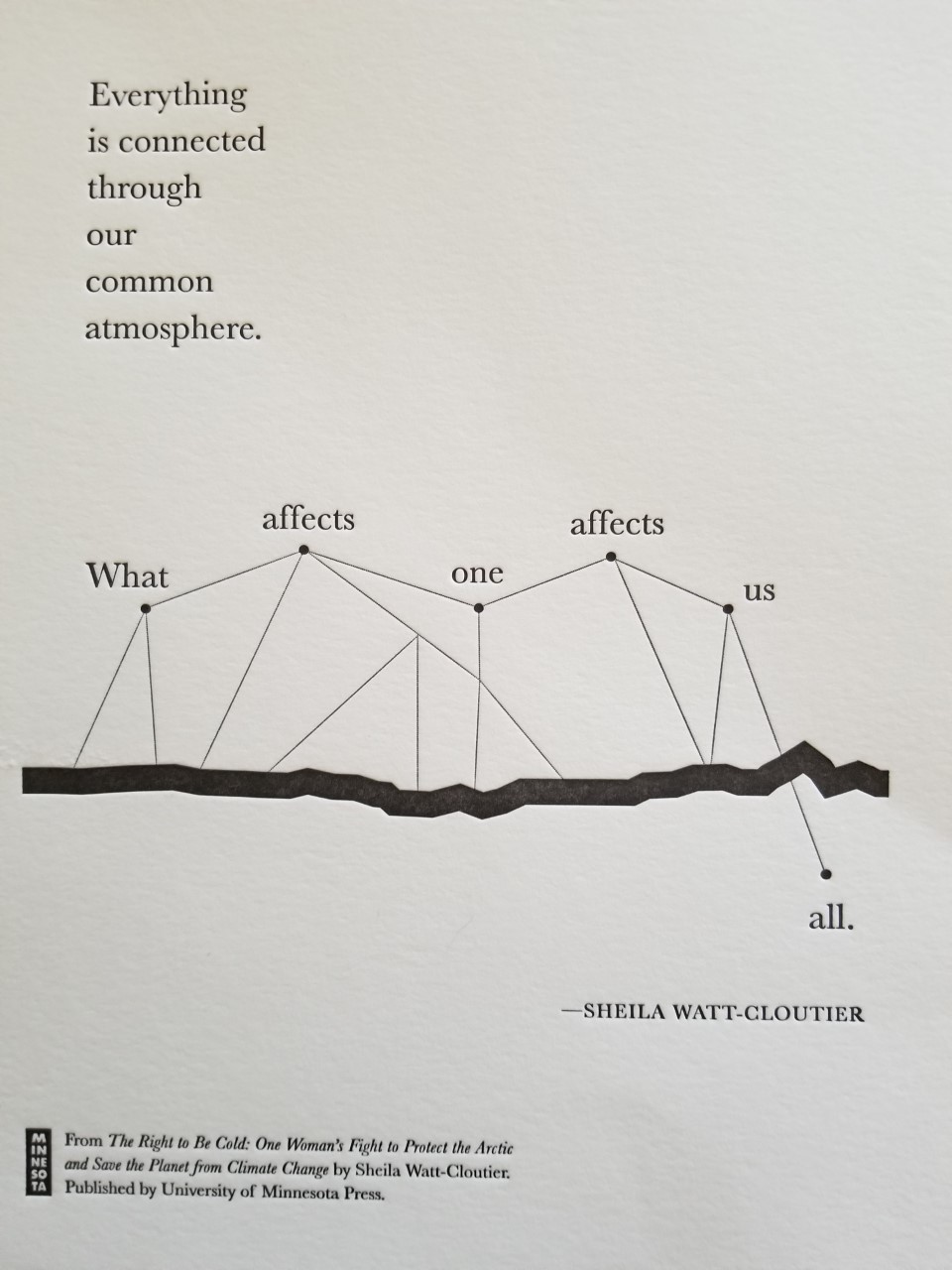
Broadside published by University of Minnesota Press, 2018. 
I received a broadside in the mail this week. A broadside is a printed sheet that promotes a larger work, such as a book. Propaganda broadsides were plastered on walls throughout the colonies during the War for Independence. The London Times distributed broadsides of famous British literary works to soldiers in the World War One trenches. The idea, it seems, was that a bloke absorbed in Shelley or Wordsworth would not notice he was being blown to bits.

Some publishers still print broadsides, mainly of poetry. I have some of those from David Romtvedt and Bill Tremblay, among others. They usually are printed in support of a collection. Flash fiction is suited for broadsides but I don't know if that is a thing or not.

I received a broadside from University of Minnesota Press promoting Sheila Watt-Cloutier's book "The Right to be Cold: One Woman's Fight to Protect the Arctic and Save the Planet from Climate Change." The broadside was a prize offered to like UM Press on Facebook. I liked and I received. See the image above.

This broadside did its job. I did not know Watt-Cloutier's work until the envelope landed in my mailbox. She writes about climate change from an Inuit's point of view. The Arctic nation is almost invisible to us in The Lower 48. My knowledge of people in the Arctic centers around the term "eskimo" and all that it entails: igloos, kayaks, dog sleds, walrus-hunting, "Nanook of the North." My education on Arctic peoples comes mainly from 1950s-era National Geographic magazine which, as we all know now, was a very one-sided view of the world.

I plan on reading Watt-Cloutier's book. I will order it from UM Press. I looked through its catalog and was impressed by the scope of its publications. It includes works on an array of topics, focusing on the culture of the upper Midwest. I know as much as that region as I do about the arctic, although I have walked the intriguing streets of Minneapolis and read a number of books from excellent Twin Cities publishers Graywolf, Coffee House, and Milkweed. 

I watched a TED talk by the author. I read one of the author's postings on the UM Press blog and watched one of her TED talks. She made me see the effects of global warming on humans. We hear a lot about the effect of rising sea levels on coastal populations. When it comes to the Circumpolar Region, we hear more about polar bears than we do about the humans who have lived there for centuries. I live in a high dry climate, albeit one that will be affected by shorter winters. This will impact outdoor recreation and hunting and all of those people that depend on those for their livelihoods. But the Inuit need solid ice for their hunts. As the author says, they risk drowning by falling through the ice that once was solid beneath their feet. And efforts of environmental groups have affected their lives in real ways. It's easy for a city boy in Cheyenne to support bans on seal hunting thousands of miles away. If fact, it's easy for this non-hunter city boy to cast aspersions on hunters of the deer and antelope I see as I travel Wyoming. 

In the days of sailing ships, a naval broadside was meant to get the attention of and possibly demolish another ship. A printed broadside is meant to get your attention and educate you in the process.

This one did its work.

Saturday, April 21, 2018

The biggest surprise of Trump's presidency? Melania tends Michelle's garden

I strolled around the Clay Paper Scissors Gallery last week admiring the "In The Garden" exhibit. It's all about growing things, one of my favorite subjects. It is spring, after all, but the snow falling outside my window annoys me. April showers bring May and June flowers, so let it snow. I will get around to gardening eventually. The anticipation of planting is almost as good as the real thing. I am a spring and summer guy. The warmth is part of it. But I have come to believe that i revel in this act of creation that begins with warming days.

Is there a gardening gene? My father was a grower. He spent his last years tending the gardens at St. Brendan the Navigator Catholic Church in Ormond Beach, Fla., the church where Chris and I were married 36 years ago. His father grew on a farm and tended an impressive garden at his house in Denver's Park Hill. His specialties were roses and tomatoes. If he could have produced a tomato shaped like a rose, he would have been a happy man.

I thought of creation this morning when Venezuelan-born chef  Lorena Garcia was asked what person, living or dead, she would like to share a meal with. Michelle Obama was her answer, a woman who inspired her. I think of Michelle's White House Kitchen Garden. It was meant to be a creative place where Michelle educated children about healthy lifestyles. Veggies and herbs harvested from the garden went to the White House kitchen and local food banks. Grow your own food, eat your own food. The First Lady was a proponent of children's health. She wanted schools to stop serving junk in their cafeterias. She encouraged schools and communities to plant gardens. She wrote a book.

Most of us thought that our junk-food-eating president would rip out Michelle's garden when he took office. We wondered what might go in its place. An oil rig? Golf course? A McDonald's? Surprisingly, the garden remains. First Lady Melania Trump still oversees tending of the garden. School kids come in to help with the harvest. Surprised the hell out of me. It did not surprise me that Melania wore a $1,380 Balmain plaid shirt at a garden harvest last September. I guess you could say she also is growing the market for high-end gardening attire.

But I continue to hope that America's garden will not be destroyed during Trump's presidency. He has, however, done his best to roll back environmental regulations, cannibalize public education, and slash government programs that assist millions. He needs some gardening advice, although I doubt that he will listen.

When you plant a garden, you create new life from the ground up. When you paint a painting, you introduce the world to a new vision, your vision. Creative writing, song composition,  sculpture. All creative enterprises. It takes a long time to become adept in your chosen area. There is little monetary payoff along the way and maybe never. But still you create because that is what you are called upon to do.

In a time when every blessed thing is commodified, I find hope in Melania's garden. Seeds are sprouting today at 1600 Pennsylvania Avenue. Perhaps they will take root someday in the Oval Office, the entire West Wing, all over D.C.

This kind of creation keeps hope alive.

And get over to Clay Paper Scissors at 1513 Carey Avenue in downtown Cheyenne and view garden-themed artwork by artists Win Ratz, Lynn Newman, Wendy Bredehoft and many others. There is some neat mixed-media work by Gillette's Heidi Larsen and some unique felted flowers by Cheyenne's Melanie Shovelski. If you're in the market for a garden furniture, check out Gary Havener's native pine and willow benches. For more of Bredehoft's cut-paper-and-wood "Botanics," see her show at Cheyenne Botanic Gardens gallery.

Saturday, April 14, 2018

Democrats have to ask themselves: When do we get mean?

Wyoming Sen./Dr. John Barrasso is a hyper-partisan ass-kisser.

We see him looming behind Mitch McConnell every time the Senate Majority Leader utters another ridiculous pronouncement. There's Barrasso, nodding and looking somber. Bobble-head Barrasso. This is the same senator that refuses to have public meetings around his state to explain his behavior. The citizenry has conducted congressional town hall meetings around Wyoming. On the stage are chairs with photos of Barrasso, Cheney, Enzi. That's as close as these public servants will come to a face-to-face with the electorate. Some of their peers in other states have been yelled at for their Triumpist policies. Egos have been bruised. Ask Sen. Cory Gardner of Colorado. He's used to fielding softball questions from true believers. Instead he got tough questions. Other people yelled at him for his bad behavior. He retreated back to the safety of the D.C. Beltway.

Wyomingites know how to tell shit from Shinola. You have to be older than me to know that Shinola is a shoe polish popularized by GIs in World War II. Shinola was handy and durable, great for those GI shoes and boots. GIs were adept at coining phrases, especially those that targeted inept officers, the guys sending them out to get killed. Not knowing shit from Shinola was dangerous. Funny, too, a fine play on words.

Wyomingites used to be able to tell shit from Shinola. Not any more. Congressional leaders now blow smoke up our asses and we inhale. That expression comes from cockfighting, where humans used to blow smoke up a rooster's ass to goad him into fighting harder. Cockfighting has fallen out of favor but the phrase remains and comes in handy in the political arena. Trump is a master at blowing smoke up people's asses. It incites his conservative base. Angers his opponents.

What is you can tell shit from Shinola? What if you resent having smoke blown up your ass? You have to find other candidates to vote for.

Try Gary Trauner. I canvassed neighborhoods for Gary when he ran for the U.S. House in 2006 and 2008. Trauner came within 1,000 votes of beating Barbara Cubin the last time she ran. Remember that Cubin's husband was ailing and she spent more time outside the Beltway than within. Even Republicans were irritated at her inattention to her job. Trauner hit the hustings and talked to voters. Lots and lots of voters. Democrats, Republicans, Libertarians, Contrarians. People of many stripes voted for him. They crossed over the line between D and R and voted D.

Those were the days. Now we have an impenetrable wall between D and R. Just look at the 2016 election. Three of our best public servants were defeated by a wave of voters who came to vote for Trump the Savior and pushed all of the R buttons. I speak of Floyd Esquibel, Ken Esquibel, and Mary Throne. The Red Wave elected the bad ones and carried off the good ones. And we Democrats didn't work hard enough to get out the vote. Shame on us all.

Gary Trauner runs in 2018 to unseat Sen./Dr. Barrasso. Trauner drew about 50 people to his "listening session" in Cheyenne. Attendees asked great questions, the candidate had convincing answers.  He said he was going to talk to all people. His philosophy seemed to mirror the Dems' 2016 plan of "when they go low, we go high." One questioner challenged this philosophy, wondering if there isn't a time to "get mean." Republicans, notably out-of-state PACs, serve as unregulated attack dogs for Republican candidates and those candidates can disavow any connection with them. Meanwhile, voters minds are being swayed by right-wing paranoia. You know, the stuff you hear on Fox and talk radio. In 2016, these are the people who showed up at the polls in droves. Dems eagerly anticipated election night victory parties. As a volunteer offering rides to the polls, I picked up and delivered exactly one voter to a polling place. His vote, whatever it was, was overwhelmed by the Red Tide.

Will there be a blue wave in 2018 that lifts all boats? Gary Trauner will be in one of those boats. I will help him row, or paddle, or steer, or sail, or whatever else you do in a boat in this godforsaken windswept desert. But I am just one person.

My advice to you: help us roll with the tide. This should be the ideal year for The Dem Blue Wave. But you have to show up. Take a look at Trauner's web site. He says that this campaign is "all about leadership and integrity." Let's prove him right.

If you'd like to see my blog posts from Trauner's 2006 and 2008 campaigns, go to the search box on my right sidebar and type in Gary Trauner. There are a bunch of them, and not all are masterpieces. I do like this one. But they do give you some perspective on the temper of the times in 2006-2008. Remember 2008? We elected the country's first African-American president. It was only ten years ago but now it seems as if it happened in an alternate reality.

Sunday, April 08, 2018

This isn’t the first time that National Guard units have been sent to the border

1916 cartoon by Clifford K. Berryman, via National Archive Berryman collection. Not sure if the Uncle Sam of 2018 can jump the massive wall that soon will be built at the border. 

Guys in white pajamas shot at my grandfather. That’s the way he told it, anyway. Or maybe it’s just the way I remember his stories. For a few months in 1916-17, Grandpa and his troop of Iowa National Guardsmen faced Pancho Villa’s irregulars across the Rio Grande. He told us that the white-clad Mexican fighters couldn’t shoot straight but Iowans in their spiffy regulation uniforms weren’t much better. They didn’t know it yet, but they were practicing for the big show in France. The U.S. entered the war about a month after Grandpa and his unit returned to Iowa.

Trump isn’t the first commander-in-chief to send National Guard units to the U.S./Mexican border. It’s different this time because Trump is in a snit about not getting enough funding from Congress for his stupid border wall. During the campaign, Trump promised rabid rally crowds that he would build a wall and by gum, he will get his wall, or else your husband or cousin or daughter from the Iowa National Guard will spend the next year trying to snag the caravans of Mexicans that Trump imagines are invading the U.S.

Mexican revolutionary Pancho Villa did invade the U.S. in 1916. His seasoned troops invaded Columbus, New Mexico, and killed 18. Villa lost almost 100 men due to the shiny new machine guns employed by U.S. troops. Villa fled back across the border, leaving Americans in a panic. Pershing’s troops, aided by the first airplanes used by the U.S. in combat, pursued Villa through northern Mexico. They killed a few of his lieutenants but never snagged Villa.

Trooper Raymond Arthur Shay, Iowa National Guard, Iowa City. He and his farm-boy cohorts knew how to ride and care for their horses. They spent most of that southwestern winter dismounted, swatting flies, and taking pot shots at insurgents. Prior to this border expedition, the farthest Grandpa had been from home was basic training at Camp Dodge outside Des Moines. He was a farm boy, oldest of nine kids. Now here he was, hunkered down on the banks of The Big Muddy and the big fool told him to push on – or at least to keep firing at the tiny men in pajamas he could barely see. Their horses weren’t much good either, as this guerilla war was unsuited to cavalry charges. Horses did come in handy for the U.S. Army patrols sent into enemy territory to find Villa. As far as I know, Grandpa never made it across the border.

Four years before, General John J. “Blackjack” Pershing, commander of this Mexican Punitive Expedition had wrapped up another war like this. In 1911-13, he waged what most considered a successful campaign against the Muslim Moros in the Philippines. In Pershing’s view, the Moros were pajama-clad insurgents worth fighting. But not these poor, undisciplined Mexicans. Pershing grew increasingly frustrated. His hands were tied by Congress. Politicians -- always coming to the border on their junkets. Reporters in tow asking stupid questions. There was no winning under these circumstances. This refrain would be echoed decades later by other U.S. generals in other wars. You know, Vietnam.

At the end of January 1917, Pershing abandoned the border foray. The following winter, Grandpa, now a newly minted second lieutenant, found himself in France eyeballing German trenches across a bombed-out moonscape. World War I trench warfare, with its machine guns and barbed wire, rendered obsolete any “Charge of the Light Brigade” operations. Still, the Iowans had shipped over with their horses as cavalry looked fine on parade days. One spring morning, a resurgent General Pershing staged an inspection and picked the unit’s best mount to ride. It belonged to Lieutenant Shay. That was the high point of the war for him, his favorite story, and ours.

Other stories weren’t quite as romantic. Dismounted, in the trenches, poison gas washing over doughboys as they struggled to don their gas masks. Never enough time. Enough of the gas seeped into Grandpa’s lungs to cause some harm, but not enough to get him sent home before the Armistice.

Grandpa’s gas mask and helmet rest in a box in my basement. Photos, too, of him and his troopers in France. Photos of Grandma – his wife -- and her nursing school graduating class. I think about them and their war when I drive down Cheyenne’s Pershing Avenue, as I do almost every day. Cheyenne, a military town, became the adopted home for the globetrotting General Pershing. He married Helen Frances Warren, the daughter of Wyoming’s first U.S. Senator, and served at Fort D.A. Russell, now F.E. Warren AFB. Their home is now a living museum, preserved for future generations. The base itself is a national historic site, home to war trophies from the Philippines and the old airfield where World War I ace Eddie Rickenbacker cracked up his biplane and almost died. It also was the training site for Spaatz’s Flying Circus and the U.S. Army’s airmail service -- Charles Lindbergh was one of its first pilots.

The Pershing family experienced its share of tragedy. If you take a stroll through Cheyenne’s historic Lakeview Cemetery, you will come across a large grave marker for Frances E. Warren and her three daughters, ages 3, 7 and 8. In 1914, Gen. Pershing left his wife and four children at the Presidio in San Francisco to take over command of a brigade at Fort Bliss, Texas. Things were heating up at the border and the general was there to plan for the inevitable. In August of 1915, Pershing received a telegram that his wife and daughters died of smoke inhalation at a Presidio fire. Only his 6-year-old son survived.

Pershing Avenue starts at F.E. Warren AFB and runs straight through town past the Veteran’s Administration Medical Center where the aging Lieutenant Raymond Shay spent some of his last days. The road ends on the east side of town. If you know where to look, you can see Minuteman III missile sites out on the prairie.
     
Combat casualties were minimal in my grandfather’s World War I unit. They were surpassed by deaths from infection and disease, especially from the Spanish flu. Grandpa’s lungs deteriorated from gas attacks. After he returned to the States, he recuperated for months in an Iowa Army hospital. When he took a turn for the worse, the Army transferred him to Army Hospital Number 21 – soon to be renamed Fitzsimons Army Medical Hospital after a hero of the Great War. The dry Denver climate, famous for its healing properties, may have helped his recovery. He really took a turn for the better when he met my grandmother, an Army nurse. He and Florence Green married in 1921, stayed in Denver, raised a family, and lived a good long time.

Now Grandpa and Grandma share a plot at Fort Logan National Cemetery in Denver.

Wonder what they would make of our boy Trump.

Wednesday, March 28, 2018

Writing and gardening -- two peas in a pod

One of my former state government colleagues advised me about retirement. He retired years before I did and was confronted with many volunteer offers. His wife, in a stroke of genius, advised him to take out his appointment calendar and write "No" on each page. She wanted him free to travel and spend time together.

I was tickled to see this same person on the list of volunteers for the Cheyenne Botanic Gardens. It's a long list -- 88 in all, according to volunteer coordinator Amy Gorbey.  She's the energetic person who keeps tabs on us all. I had taken the couples' advice and held off volunteering for my first two years. For the most part, anyway. I did some volunteering for the Democrats leading up to the 2016 election. We all know how that turned out. I was asked to become part of several boards but declined. I wanted time to write and I that's what I got.

Over time, I feel a need to reconnect with humans. I figured I could have my morning writing time, in solitude, and then spend afternoons greeting visitors and otherwise helping out at the new Cheyenne Botanic Gardens and its new Grand Conservatory.

Thus far at the CBG, I've picked up sticks on the grounds, detritus from spring wind and snow storms. I snacked with some of my fellow volunteers. On Saturday, I staffed the front desk. I greeted many people, most from Cheyenne but others from Colorado and elsewhere. Most walked through the conservatory in less than a half hour and exited. Some lingered. One couple brought in their lunch and ate on the second floor that overlooks the many growing things on the main floor. One young woman carried a book as she disappeared into the gardens. One gentleman had a phone photo of a plant on the third floor and asked me what it was. I sent him and his question over to the horticulturalist. One attendee who exited a baby shower with an armful of gifts, said she was from Torrington and loved the CBG, wished her town has something similar. Not likely, considering the work that went into planning the conservatory and getting the voters to approve a sixth penny amendment to fund it. Cheyenne is the only city of its size to have such an amenity. Some might call it a lifestyle enhancement, as it gets bragged about by the Visit Cheyenne and C of C folks. Voters have approved initiatives for the CBG, a new airport facility, the public library. But they keep rejecting a recreation center. There are as many reasons for these issues as there are voters. Maybe I will explore them in a future column.

The CBG has been treasured by residents since it began its life 40 years ago as a simple greenhouse on U.S. Hwy. 30. Almost every growing thing you see in the city was planted by someone. The only naturally occurring plants belonged to the short-grass prairie. Native Americans and settlers found trees along waterways. In fact, you could I.D. a water source when parched travelers sighted trees off on the horizon. Snow-capped mountains lured people to the West but it was snow melt that brought prosperity. How it was harnessed is one of the West's great stories. Sad ones, too.

I like growing things. Not enough to be a farmer but enough to be a fair-weather gardener. That activity has something in common with writing. You prepare the soil, plant seeds, fertilize and water, and eventually harvest. If you don't like each of these steps, then why bother? I can buy tomatoes at the grocery store and farmer's markets. I can check out books at the library and even buy a few at my local neighborhood bookstore. Why grow my own?

I like the act of writing. It's fun, it's frustrating. After I spent a lifetime writing millions of words, i have finally arrived at a time when I'm pretty good at it. This is the harsh truth of any creative endeavor. There is no quick way to become good at something. This is a definite drawback when it comes to selecting college majors and making a living. But if it gives you meaning, you can't avoid the inevitable. Horticulture majors have a leg up on English majors, unless those well-read folks decide to parlay their knowledge of Emily Dickinson and magical realism into a law school admission.

You can grow a book. You can grow a garden. They both take time and attention, both in short supply in 2018.

Get more info on the Cheyenne Botanic Gardens at https://www.botanic.org/. Tips on writing? So many resources. The act of writing is a prerequisite for the other stuff.

Monday, March 19, 2018

Another generation betrayed by those who should know better

This Saturday, thousands of young people will stage the March for Our Lives anti-gun violence rally in Washington, D.C. Expecting huge crowds, officials have changed the opening day of the annual Cherry Blossom Festival to Sunday, March 25. This also marks the beginning of tourist season for D.C. Spring is gorgeous. The cherry blossoms that surround the tidal basin are spectacular. But this year, the weekend's focus will be on ways that we can stop the slaughter of our children in their schools.

I can only guess at the pain that the Marjory Stoneman Douglas students from Parkland, Fla., feel as they watch their elders dither over gun control. These are the results you get from us – hypocrisy and betrayal. The students’ adversaries are monumental. Its structure will have to be dismantled brick by brick.

I imagine what would have happened if a gunman had entered my Florida school 50 years ago and murdered 17 of my classmates and teachers.

The year, 1968. The school, Father Lopez Catholic High School in Daytona Beach. We 17-year-old juniors have Valentine’s Day on our minds. I hoped I had bought just the right thing for my girlfriend. My girlfriend might have been contemplating the very same thing. Basketball season was winding down and it looked like my Green Wave team was going to win the conference. We had all given up something for Lent. Chocolate. French fries. Cussing. Fear of eternal damnation kept us chaste so there was no reason to give up sex, although we joked about it. Spring break was on the horizon, as was summer, and we were thinking about summer jobs and days on the beach.

We had an open campus. Anyone could walk in and did. Moms delivered forgotten lunches and homework. Visitors dropped by at any time. We would have been sitting ducks for a killer.

It never happened at my school and never has. If 17 of my classmates had been killed, I would have known them all – we had fewer than 400 students in four grades. One of the dead or wounded could have been me. I like to think that I would have been a hero no matter what. I have nothing to base that on because I had never faced a shot fired in anger – and I still haven’t. We would all be devastated. We would be looking for solace and answers.

What would adults have told us? Don’t worry. This is an aberration. The gunman was crazy. It will never happen again.

And we would have believed them.

That was our first mistake. It wouldn’t be our last.

On April 4, 1968, Martin Luther King, Jr., would be gunned down in Memphis. Our school’s mostly-black neighborhood would not be safe. Riots would erupt on Second Avenue which, during those segregated times, was where the black population lived.  

On June 6, Robert Kennedy would be murdered by an assassin. I idolized the Kennedys. RFK and JFK were imperfect human beings. But I was a teen looking for some heroes.  

Florida native Charles Whitman murdered 16 people, most of them from a perch at the University of Texas tower, in July 1966. Not the first mass murder but the fact that it was a former Marine sniper made news. And he was a very angry white man.

On Valentine’s Day 1968, the Tet Offensive was just winding down in Vietnam. Surely this meant the end of a failed experiment, one that was claiming the lives of my peers and many Vietnamese. The war dragged on for another seven years. Our elders, “the best and the brightest,” insisted it was the right thing to do.

None of the adults gave us the real facts about sex. Parents and nuns and priests decided that fear was enough of a deterrent. They were mostly correct, although at least one of our female classmates missed part of the senior year with an unplanned pregnancy. You would not be surprised that pregnant teens found the same censure at public schools. It just wasn’t done. The boys were never blamed.

We knew betrayal, we didn’t yet have a name for it. Members of our generation possessed a simmering rage. That was a problem, because the Summer of Love and the Age of Aquarius had dawned. Peace, love, and understanding. If that was true, how come people were filled with anger? Blacks vs. Whites. Cops vs. pot smokers. Rednecks vs. hippies. Viet Cong vs. the U.S.A. Irish Catholics vs. Protestants. Jews vs. Arabs and almost everyone else.

Flash forward to the present. Seventeen killed and a dozen wounded at a Florida high school. The only ones making sense are 16- and 17-year-old classmates of the dead at Douglas High School. Adults in positions of power are dangerous fools. They spout nonsense that get their children killed.

Betrayed. It’s déjà vu all over again.

It may have its roots in the betrayal that ignited our generation. That was never resolved, or forgotten, just buried as the years passed. We weren’t the first. It’s possible that adults of every generation betray their children. Over time, we lose touch with our values and our kids pay the price. You can say that every generation needs to experience hardships to find out the true nature of the world. Center for Disease Control figures come up with 1.55 million deaths from firearms in the U.S. from 1968-2016. This includes the span of many generations. Wouldn’t a smart, caring community have come up with some solutions by now?

Good people do bad things. Bad people do bad things. That’s an old story. But why do we make it easier for anyone to buy an AR-15, walk into a school, and shoot down 17 people? Haven’t we learned our lessons by now? Columbine, Aurora, Sandy Hook, Orlando, Las Vegas. The list goes on and on. If we don’t do something about it, we betray our children. If we do something about it, we betray only the NRA and our thick-headed politicians.

The choice should be clear. More betrayal, the generational rite of passage? Or do we do something new and different and constructive?

Which will it be?

Friday, March 16, 2018

"Lincoln in the Bardo" explores the gap between tragedy and comedy

George Saunders' novel "Lincoln in the Bardo" is eerie and hilarious. The novel is written by an experienced short story writer and is structured as a series of scenes set in the cemetery where Abraham Lincoln visits the resting place of his 11-year-old son, Willie. Saunders has constructed an excellent novel from snatches of dialogue from dead people and swatches from books about he Civil War era in Washington, D.C. You can be excused for getting lost amidst the first few pages and wondering where the book was going. I did. But I persevered, as you sometimes have to do with a challenging literary work.

At the core of the story is a man mourning the untimely death of his son. How do you cope with such a loss? You could write a book about Lincoln's monumental depression. We have seen public figures deal with the death of their offspring. Joe Biden publicly mourned the death of his son Beau and Beau was a seasoned adult and war veteran. But mourning a young son or daughter is a special kind of hell, one that doesn't require a belief in the actual Hell of the Bible or religious iconography or even Dante. It's a hell on earth.

First, what is a bardo? From Merriam-Webster Online:
The intermediate or astral state of the soul after death and before rebirth.
As is true with all online research, you can use this dictionary definition as a launching pad into a universe of references. Bardo is a Tibetan term that's found in the Bardo Todol in the Tibetan Book of the Dead. Bardo Todol is translated as "Liberation in the Intermediate State Through Hearing."

Here's a quote from a Lion's Roar piece from April 2017:
More generally, the word bardo refers to the gap or space we experience between any two states. The lesser-known bardos described in the traditional texts include the bardo of dreaming, the bardo of meditating, and even the bardo of this life—which is, after all, the intermediate state between birth and death. 
A bardo can even be seen as the pause between one thought and another. I experience bardos on a daily basis but didn't realize it.  Once you know that, the shades that inhabit the cemetery where Willie Lincoln is buried take on a new dimension. They are not ghosts, really, or those dead people with unfinished business who haunt old hotels and abandoned mental asylums. You know, the ones who get the attention of the guys on TV's "Ghost Adventures." These souls in the bardo make up a compelling cast of characters who comment on Willie's funeral and Lincoln's nighttime foray to his son's final resting place. The two main narrators are printer Hans Vollman and Roger Blevins III, an eternally young man with some secrets.

In the reader's guide that follows the novel (Random House trade paperback), Saunders describes the core question in the novel this way: "How do we continue to love in a world in which the objects of our love are so conditional?"

Heartbreak is at the heart off "Lincoln in the Bardo." Lincoln is so heartbroken by Willie's death that he can barely go on, that he forgets he has another young son at home in a sickbed. Some of the most amazing lines in the book happen when each of the spirits admits he/she is dead and transforms into the next life. As they depart, onlookers get a glimpse into their lives before death and the lives they could have led had they lived to a normal life span. I was reminded of the graveyard scenes in "Our Town," when the dead comment on the fragility -- and ignorance -- of the living. Life is a mystery and a tragedy. Heartbreak is our destiny. The ones we love leave us and we are challenged to keep going in this sphere. Lincoln lost a son, lived with an off-kilter wife, and had a war to run. We often hear of "Lincoln the Emancipator" and "Lincoln the Rail-Splitter." The mythic Lincoln. In recent years, we have heard more about the Lincoln with crippling depression. I can hear R.E.M.'s Michael Stipe wailing "Everybody Hurts" as Lincoln makes his way home from the cemetery.

One note about Saunders as short story writer: I hadn't read a Saunders story in awhile. Not sure why. I picked up a 2016 Random House paperback reissue of "CivilWarLand in Bad Decline" at my local bookstore. I read the title story and beheld intimations of what would appear in "Bardo." We meet the "ghostly McKinnon family" who occupied the CivilWarLand site back during the Civil War. They met a bad end at the hands of Mr. McKinnon, who was never the same after the Battle of Antietam. The daughter, Maribeth, is "a homely sincere girl who glides around moaning and pining and reading bad poetry chapbooks. Whenever we keep the Park open late for high-school parties, she's in her glory." Maribeth is more real than the narrator's two bratty sons. Saunders makes the real absurd and the absurd real. As Joshua Ferris notes in the intro, it's the latter skill "is a much harder trick to pull off" but it moves Saunders from the pigeonhole of satirist and "into the open air of the first-rate artist."

In "Lincoln in the Bardo," Saunders skill as a writer helps us see that the human tragedy is also the human comedy. Maybe that's a bardo, too, the gap between tragedy and comedy.

Sunday, March 11, 2018

What kind of horse gets depicted in public art -- and who decides?

Donal O'Toole wrote a fine piece for Studio Wyoming Review last week. It critiqued the public art on the University of Wyoming campus and found it wanting. Too many bucking broncos. I agree. Enough with the bucking broncos. Cowboys riding horses out of a rodeo chute is just one small aspect of Wyoming life (for a different look at rodeo, check out RoseMarie London's photographs). Almost every community has a rodeo. Fine. What other aspects of the rodeo can be depicted in public art? Rodeo has a history but I see few representations of that. What about the Hispanic roots of rodeo? Where are our vaquero statues? What about Native Americans on horseback? UW has one sculpture of Chief Washakie. What is that tradition? Hispanics and Native Americans have long histories with the horse.

The horse itself has a long history in Wyoming. I was amazed to learn that an ancient genus of horse, now labeled Haringtonhippus francisci, roamed Wyoming for thousands of years, until about 17,000 years ago. Then it disappeared from the fossil records. DNA extracted from bones at Wyoming's Natural Trap Cave have shown that this horse is a separate genus from Equus, the one that includes the horses depicted in UW sculptures. The line that includes the North American horse, also called the New World Stilt-legged horse, apparently diverged from Equus 4-6 million years ago, according to a 2017 article in Science Daily.  Here is an artist's rendering from phys.org:

This illustration depicts a family of stilt-legged horses (Haringtonhippus francisci) in Yukon, Canada, during the last ice age. Credit: Jorge Blanco.

As interesting as it would be to see these horses in the wild, it would still be interesting to see artistic renderings of this Ice Age creature on the UW campus. Our history as a geographic place predates the beginnings of cowboys and rodeos. Millions of years of history is explored in science courses at UW. Let's put some examples on display for all to see. There is a funky T-Rex in front of the UW Geology Building. That's so predictable, isn't it? But why not represent all of the flora and fauna that now exists as dirt and shards and fossils (and coal, oil, and gas) underneath our feet? In this era of Climate Change Deniers, wouldn't it be educational to see what sort of life forms led to the eons-long formation of coal deposits which we have burned for fuel which loaded up the atmosphere with CO2 and caused global warming which will melt the polar ice which will then cause the oceans to reclaim some of its ancient territory which includes Wyoming?

Perhaps that is too educational. Chris Drury's "Carbon Sink" at UW tried to represent this and look what happened to that. You have to believe in the values of education to actually make this work. Our current crop of Know Nothing Republicans in the legislature despise higher education because it offers more expansive views of the world than their narrow minds can cope with. These same people fear non-representational art for its ability to challenge assumptions about time and space and imagination.

A different look at a horse: Deborah Butterfield's "Billings" was part of the "Sculpture: A Wyoming Invitational" at UW. From the UW Art Museum blog.

One of my favorite public art installation at UW was the multi-year "Sculpture: A Wyoming Invitational" that began in 2008. UW Art Museum Susan Moldenhauer and staff decided to take art outside during the museum's interior renovation. UW hosted 17 works by 16 artists of international renown. Some were on the UW campus, others scattered around Laramie. I fondly recall walking the campus on a warm summer day to view the artwork and then tooling around town to see the rest. One of my favorites was Patrick Dougherty's "Shortcut," an assemblage of Wyoming sticks and branches that, over the course of several years, was allowed to change with the elements. Students helped the artist, which gave them some real-world experience in alternative sculpture. Then the wind and the rain and the snow took over.

We all learned a valuable lesson about power in Wyoming when energy interests persuaded UW leaders to dismantle and remove "Carbon Sink" on one dark and stormy night. Public art is OK, they seemed to say, as long as it doesn't interfere with the interests of international conglomerates that reap a bountiful harvest from Wyoming. That may be one of the reasons that public art at UW has become so predictable in the Trump era.

The artists continue to make relevant art and the combine, as Chief Broom might say in an inner dialogue, keeps churning along.

My latest art review appeared Friday in Wyofile's Studio Wyoming Review. Read "Worth a thousand words: the work of Laramie photographers."

Keep reading -- and keep making art.