November 16, 1918
Got up at 6am breakfast in our room, got a taxi and made our train 6K, arrived at Chaumont 3pm. Found on arriving, P had been here, out of luck again tried to get him on the phone but no success. Went to the dance in the hut at night.
November 17
Orders have not arrived yet, took a walk in the afternoon, met several officers that Miss M knew, so we were invited out to dinner, had a very dry time.
November 18
Afraid to leave the grounds because I felt sure Peany would come today and he really did, was I glad to see him. I’ll sure say so. Took him over to tea and then brought me to 42 in his car, had a puncture getting here and too late for mess so we went to a villa nearby in a quaint old room you know and enjoyed myself.
November 19
Stayed in bed late, didn’t sleep at all, too much excitement. Had lots of mail, sure was good to be home once again. Peany came in the afternoon, just had a short while, came in the evening, a dance near by, so we rode over, had a dandy time, eats were good, fried chicken, sandwiches, doughnuts, cocoa and punch.
November 20
Went to Neuf Chateau with Ruth, and then I had a disappointment, met Peany and he has to go away for a few days such luck, as I do have. He came in the afternoon and we went out for dinner, in his motorcycle this time, he leaves in the morning.
November 21
Some good news, P doesn’t have to go away at all, I am tickled to death, went over to #79 to a dance, had a wonderful time.
November 22
Haven’t been put on duty yet, I don’t really mind, made some fudge for P in the morning, he said it was awfully good. He came about 300pm. Had a dance here with the good old jazz, best music I ever heard but I am afraid I am going to too many dances, this has been some week for me.
November 23
We had tea in our recreation room, P came over, he and Colonel, Miss McAfee and I went out to dinner, some good time.
November 24
Had a nice long walk with P. He came over in the afternoon we had a great tea party including fudge. We afterwards went over to his mess, some good feed I’ll tell you. Miss Saxelby and the colonel went too.
November 25
Am to go on duty tomorrow. I sure had a good rest. Peany was here twice today but for a short while. I certainly missed him tonight.
November 26
Was on duty but the ward is very easy. P came at night and we had a dandy walk.
November 27
The whole day off today made some fudge for P and had a nice ride in the motorcycle going to a dance tonight.
November 28
Had a dandy time at the dance last night, went out to dinner with P, had Thanksgiving dinner here but P first always.
November 29
P went up to the front on a wild chore, and of course our big dance is tonight, promised to get back but he didn’t; I went to the dance at 930 and had a good time.
November 30
P showed up about 2pm, had trouble with his motorcycle, now it is broken, hard luck again. He and I walked to Neuf Chateau, he bought me the dearest watch. In the evening, Colonel Lyesby, Miss Costello, P and I went to dinner.
December 1
Another day for P at the front, landed in here about 7pm, sick as he could be and had to walk home, poor fellow, I sure am sorry about 6 kilos too.
December 2
Got a note from P, he is ill. I just thought so but I am going over to see him tomorrow night. Miss Leach has fixed our room up darling, went to Neuf in the morning and did a lot of purchasing. Had a time to get home but we found a friend.
December 3
Walked all the way to Frenille, Miss Costello and I, had dinner there. Peany is convalescing. Came home in a Dodge.
December 4
Made some fudge for P, he was over in the morning. Afternoon, he came we went out to dinner.
December 5
Had a half day off and did not expect it. Goldie and I walked to Frenille, of course P was out but got back about 430p. Captain McDonald, Leah, P and I went on a party to Hareyville, but never again.
December 6
Peany left quick today and no wonder, we almost came to blows but we made up.
December 7
Sad news. P has to go Hopkins to a dinner and dance, said he simply can not get out of it, he was over in the afternoon and a while in the evening
December 8
P came in the afternoon, got me all frustrated, said the car was waiting to take him, but it was not so thank goodness. He had a rotten time at the dance and I am glad of it. We went to H to dinner, had a dandy time.
December 9
The 346 gave us a dance at night, I was dressing, Leah ran over to me, and told me P had had an accident and was over in 46H with a fractured arm, you can see me run all excited, did you know it was untrue, he had sent her with that tale. Well anyhow the dance was great.
December 10
P arrived at 3pm, said he was to leave tomorrow. We went out to dinner. My, I would be happy if he did not have to go.
December 11
Today has been one of the most miserable days I have ever had. Received a note from P at 200p, he left at 100pm, I don’t know what on earth I will do. He wrote the dearest letter, I also got an old letter from him today. I wrote him a long letter tonight and then went to bed.
December 12
Still miserable, and expect to be for some time. Got the picture today that P had sent me ages ago, bless his heart, wish he were here. To bed at 830, such a life.
December 13
Wrote to P, my I miss that man. Went over to a French dance at night for a while.
December 14
Went to Neuf with Leah, coming back the driver was slightly stoned. I did not think we would make it. To bed at 830pm.
December 15
Wrote to P. Took a walk at night with Nell. Was talking to Ray for a while.
Monday
December 16
This life is getting rather monotonous. Wrote P; played cards this afternoon with Goldie and 2 officers, they were both married though. I won all the games too, me and my partner.
December 17
Some mail yesterday for a change but none from P. Wrote some letters, went to bed.
December 18
Played cards with some of the girls, nothing exciting happened.
December 19
To bed early, nothing new.
December 20
No mail, no nothing, rather blue, homesick, and tired.
December 21
There was a dance here last night, I heard it was a failure. To bed early as usual.
December 22
Made Xmas ornaments for the tree, out of silver foil and colored cardboard with red ink, better the day, better the deeds. Leah wanted me to play cards with her but refused.
December 23
Lt. Wood came over and invited me to their Xmas eve dance. I accepted. Made fudge the entire day for the boys for Xmas. Got my package and some letters, rather pleased.
December 24
Trimmed our tree which looked rather nice and the ward looked great, decorated with greens and things made out of absolutely nothing. Went to the dance at night, had an awfully good time.
December 25
Got up at 12noon, blue as could be. Had a good Xmas dinner, went on the ward at 2pm, the patients sure had a good day; I wanted to dance but relaxed instead. Got several sweet handkerchiefs, perfume, etc.
Friday, December 18, 2015


Tuesday, December 15, 2015
Part VII: Mudder's World War I diary
As she notes in her diary, Florence was sent to evacuation Hospital number 8 during the end of the Meuse Argonne Offensive in late October, after stints at Evacuation Hospitals 1 and 4. Evacuation Hospitals were nearer the front than base hospitals. Green served near the front during the final push of the war and was part of a group regularly exposed to large artillery fire and aerial bombardments.Here's Dr. Shipley writing about the details of evacuation hospitals:
Evacuation Hospital No. 8 and its wartime operations were also described in detail by Dr. Arthur Shipley, a prominent professor of Surgery at the University of Maryland, in a series of articles published in the Bulletin of the University of Maryland School of Medicine between 1919 and 1920. Florence mentioned meeting Shipley and working with him in her Oct. 26th diary. [Frederick] Pottle worked under him as an orderly. He later wrote a supplement to Pottle's book, The Officers and Nurses of Evac. No. 8. Although Green only served at this hospital for a short time, Shipley lists her in the supplement.
The Evacuation Hospitals were usually up to 10 miles from the front. They were well out of reach of the light artillery but within the range of the "heavies" and, of course, were subject to bombing. The difficult thing was to place them along the lines of communication, and at the same time far enough away from ammunition dumps and rail heads not to invite shelling or bombing. They were plainly marked with big crosses made of different colored stone laid out on clear space, so as to be easily seen from the observation planes and to show up in photographs. If there were buildings in the hospital group, red crosses were often painted on the roofs. This was most important, as wounded men in large numbers could not be moved into dugouts if the hospitals were subjected to much shelling. During the Argonne offensive, we were at the top of our strength. We had about 1000 beds for patients, 410 enlisted personnel, 65 medical officers and 75 nurses.Florence Green of Baltimore was one of those nurses. Her diary continues....
October 26
Dr. Shipley from the University of Maryland here. I made myself known to him, several other Baltimore people here. Worked all day.
October 27
Nothing exciting to relate, worked the entire day.
October 28
Goldie came to see me today, brought me four letters all from home too. Miss Martin made some good taffy, the best I have had for many a day.
October 29
Not so busy today.
October 30
The girls are trying to have a party for tomorrow night, it is Halloween. I hope they succeed. Made some real good fudge.
October 31
Had a wonderful ride today in a Cadillac and with a Lieutenant Colonel, but not the one I would of liked to of been with. Also had a dandy walk. Halloween night, but no dance.
November 1
Cleaned house today and wrote a pile of letters. Had a very nice walk. I think patients will soon come in by the barge this am.
November 2
War news is encouraging if it only keeps up. Heard today that Evac#4 had been shelled, poor Goldie, I bet she was scared to death.
November 3
Today is Sunday, but I never know one day from the other. Worked all day.
November 4
Well, Austria is out of the war; I do believe it will be over soon.
November 5
Nothing new, the war is still on.
November 6
No mail, no nothing, wish I was in Baltimore, tonight. Rain for a change.
November 7
Heard today, the war was over, another wild rumor I suppose but if it is true, how wonderful it will be.
November 8
Had the whole day off today, went about 3-5 miles from here, rode in four different vehicles, had a good lunch and dinner and a dandy ride in a Cadillac, a dandy time.
November 9
The Germans have until Monday 11am, am crazy to know how every thing is going to turn out. Am waiting to go on a candy making party but looks like we won’t go tonight as the officers can’t come, such as life, just full of disappointments.
November 10
Busy as could be today, tomorrow is the day which decides about the war, am so anxious to hear the return.
November 11
Am some happy tonight to think the war is really over. I cannot believe it. Haven’t heard a gun since 11am. Great celebrating everywhere. Can almost hear the city hall in Baltimore ringing, and what a wonderful time for Paris.
November 12
Nothing exciting happened, patients coming in slowly. Took a walk. Our orders came. We go Evac to #15, hope from there to #2.
November 13
Gee, but I had a good time today, went to Verdun and then way up to the front, saw lots of sights. Came back and went to Evac #3, since they are having no work there at all. A dandy little Lieutenant took us there and then later met us later and took us to Evac #4 where I saw Goldie, some mud there. On arriving home, we hear there is to be a big dance in the Citadel at Verdun, went up in a huge truck, just had lots of fun. Got home about 1am. The most exciting thing happened during the day I forgot to relate, met Captain R from the 346 and now I know where Lieutenant Colonel S is, hope I see him soon.
November 14
Stayed in bed late and at 11am, the chief came in to give us our orders; we left at 2pm, to take the train. It only takes 5 hours so Miss Martin and I thought we could make it quicker. We got permission from Captain Cahill so we beat it. A colonel was delighted to take us; I think we made it in ¾ of an hour. 30 miles at least, but we enjoyed it, but don’t say it was not cold. Had a dandy dinner and met the train from B. Oh yes, we are going to Paris, am tickled to death, took the night train and oh the ride, no sleep, about 9 people in the compartment.
November 15
Such a wonderful day, arrived at the Continental, got a beautiful room had breakfast in our boudoir. Went to the Red Cross, did some shopping, from there to the Marlboro Tea Room and such a good lunch, soup the best chicken, first I had had in France and real ice cream, well it was delicious. Did some more shopping. Eva met a captain from her home, so he went around with us, bought a dandy looking pair of shoes, had my suit pressed, I feel very much dressed up, to dinner and theater tonight with Captain Hinton and K, we saw ‘Tales of Hoffman’ mighty good show.
Musical interlude: Violinist Mery Zentay: Melodie in F and Barcarolle from "Tales of Hoffmann" (1917), https://youtu.be/OvJcjiDNZpo. A pupil of Jenö Hubay, Mery Zentay successfully toured Europe 1910-1914. She made her American debut in 1915 and became a popular recitalist as well as an Edison recording artist. She died on Oct. 3, 1918, at the age of 21, a result of the flu epidemic.
 |
| L’Infirmière (The Nurse), 1914–1918, by René Georges Hermann-Paul. Collection of Spencer Museum of Art, The University of Kansas. Gift of Professor Eric Gustav Carlson. This work was part of the exhibition “The Second Battlefield: Nurses in the First World War” at the National World War I Museum and Memorial in Kansas City, 2015-2016. |
Sunday, December 13, 2015
Part VI: Mudder's World War I diary
September 25
Orders came almost 1030am for us to move, we came up in ambulances took about 8 hours, to Fleury. On the way up met Dr. Mores, talked to him almost a 1/2 hour.
September 26
Worked all day, in the G Room, lots of cases came in.
September 27
Nothing exciting, worked all day in the GR.
September 28
Same old thing, worked forty two hours without any sleep, such is life but I don’t mind.
September 29
Really didn’t know today was Sunday, we were so very busy, but we are hearing good news, so why worry.
September 30
The boys sure are coming in, and oh the condition, poor things, it is dreadful. Well I hear we move tomorrow. Thank goodness for that.
October 1
We all moved up here, the teams came up in ambulance, and we had a pretty good barracks to sleep in, the French loaned it to us, out in tents for us in the morning. I don’t know where we are, near Rheims, somewhere.
October 2
The Huns sure were flying over us last night. No bombs dropped on us. Took a long walk, saw a French cemetery, had 2 Americans in them. We line up for our food, great life.
October 3
Gee, I sure thought we were goners last night, the shells just whizzed past us, I thought the next one would hit us. Same barrage during the night too. I hear the Americans went over the top this morning, the patients are starting to come in.
October 4
Been awfully busy, no time to write.
October 5
Worked at night, and plenty of it to do.
October 6
Never knew it was Sunday,
October 7
Not so busy, made some good fudge about 4am.
October 8
Worked hard last night
October 9
Am on fifth calls, doubt if we work, had a fudge party, 3 officers, Miss Martin and I, was it good.
October 10
Had a ride to Chalons today, one of the boys picked us up, had a dandy ‘ride’ in a Dodge.
October 11
Working, nothing much is happening.
October 12
Great talk about peace, if it would only be true.
October 13
Went to Chalons today, had an awfully good dinner. Go to bed mighty early these nights. No mail from home, blue I do feel.
October 14
Peace seems a long way off, oh for me home, so blooming much fuss in this organization, one of the nurses in the guard house, I suppose I’ll be next.
October 15
A dreary old day, no mail, and I sure feel blue tonight; will be satisfied to get back to my base, such a life. We did have some good cake tonight.
October 16
Sure am getting old, am 26 today, had lunch at Chalons, Miss Hurst gave me 4 birthday cards, which were so pretty.
October 17
Worked all day in the Pneumonia ward. To bed early as usual
October 18
Orders to move, but they were changed in a few hours, so I suppose will stay here awhile.
October 19
In bed all day with a bad cold, chill blains, my feet nearly kill me.
Oct 20
Went to Chalons to take a sick nurse, she is going to Paris. Came home, made some good fudge and at night received a letter from P., sure was happy. To bed at 7pm. Such a life. I went to church.
Oct 21
Took a walk, found a commissary, which was supplied with chocolate, such a treat. At night, went out with a captain.
October 22
Oh, I was so happy when the C.O. said I could go to my base. I packed all my things, because we are moving. Well, I had to change cars at Toul and my train was four hours late, so I had to stay all night at the place as there were no trains to Baz, such an experience, had a time getting a place to sleep, finally did.
October 23
My train left at 530pm, of course it was late. Traveling in France isn’t the most pleasant thing alone, especially if you don’t speak French. I arrived at my base in time for breakfast, was rather hungry, as I had no dinner the night before. Everyone was so glad to see me, it made me feel real happy, was just like going home to see your people. Just think, another one of our nurses has died. It is just dreadful. The stack of mail I did get, 25 letters, and five newspapers. I left that night. Ray W took me to the train; it was only 1 hour and 15 minutes late. Had another night to spend in Toul.
October 24
Arrived at my destination about 3pm, and there were orders for our team to proceed to Evac 8, Verdun section. Had all Miss Martin’s packing to do, as she was not well. We left at almost 5pm and arrived at midnight.
October 25
Went to breakfast, had a good meal. Found out we were not going to work so we started out for Evac #4 to see Miss Leach. Instead of getting to 4, we were taken to Evac #6, Dr. Moses was there, so I stayed there for lunch, had quite a nice time. He seemed sort of glad to see me. Back to #8, then to #4, saw Goldie, she was tickled to death to see me, only had a short time there, she was scrubbed up, and working hard, went on duty 8pm, came off at midnight to go on day duty.
"Worked forty two hours without any sleep." What was keeping Nurse Green and her colleagues so busy at the evacuation hospitals in Sept.-Oct., 1918?
This comes from the History Channel's "This Day in History:"
Poetry, as always, gets the last word. From the Poetry Foundation web site:
Orders came almost 1030am for us to move, we came up in ambulances took about 8 hours, to Fleury. On the way up met Dr. Mores, talked to him almost a 1/2 hour.
September 26
Worked all day, in the G Room, lots of cases came in.
September 27
Nothing exciting, worked all day in the GR.
September 28
Same old thing, worked forty two hours without any sleep, such is life but I don’t mind.
September 29
Really didn’t know today was Sunday, we were so very busy, but we are hearing good news, so why worry.
September 30
The boys sure are coming in, and oh the condition, poor things, it is dreadful. Well I hear we move tomorrow. Thank goodness for that.
October 1
We all moved up here, the teams came up in ambulance, and we had a pretty good barracks to sleep in, the French loaned it to us, out in tents for us in the morning. I don’t know where we are, near Rheims, somewhere.
October 2
The Huns sure were flying over us last night. No bombs dropped on us. Took a long walk, saw a French cemetery, had 2 Americans in them. We line up for our food, great life.
October 3
Gee, I sure thought we were goners last night, the shells just whizzed past us, I thought the next one would hit us. Same barrage during the night too. I hear the Americans went over the top this morning, the patients are starting to come in.
October 4
Been awfully busy, no time to write.
October 5
Worked at night, and plenty of it to do.
October 6
Never knew it was Sunday,
October 7
Not so busy, made some good fudge about 4am.
October 8
Worked hard last night
October 9
Am on fifth calls, doubt if we work, had a fudge party, 3 officers, Miss Martin and I, was it good.
October 10
Had a ride to Chalons today, one of the boys picked us up, had a dandy ‘ride’ in a Dodge.
October 11
Working, nothing much is happening.
October 12
Great talk about peace, if it would only be true.
October 13
Went to Chalons today, had an awfully good dinner. Go to bed mighty early these nights. No mail from home, blue I do feel.
October 14
Peace seems a long way off, oh for me home, so blooming much fuss in this organization, one of the nurses in the guard house, I suppose I’ll be next.
October 15
A dreary old day, no mail, and I sure feel blue tonight; will be satisfied to get back to my base, such a life. We did have some good cake tonight.
October 16
Sure am getting old, am 26 today, had lunch at Chalons, Miss Hurst gave me 4 birthday cards, which were so pretty.
October 17
Worked all day in the Pneumonia ward. To bed early as usual
October 18
Orders to move, but they were changed in a few hours, so I suppose will stay here awhile.
October 19
In bed all day with a bad cold, chill blains, my feet nearly kill me.
Oct 20
Went to Chalons to take a sick nurse, she is going to Paris. Came home, made some good fudge and at night received a letter from P., sure was happy. To bed at 7pm. Such a life. I went to church.
Oct 21
Took a walk, found a commissary, which was supplied with chocolate, such a treat. At night, went out with a captain.
October 22
Oh, I was so happy when the C.O. said I could go to my base. I packed all my things, because we are moving. Well, I had to change cars at Toul and my train was four hours late, so I had to stay all night at the place as there were no trains to Baz, such an experience, had a time getting a place to sleep, finally did.
October 23
My train left at 530pm, of course it was late. Traveling in France isn’t the most pleasant thing alone, especially if you don’t speak French. I arrived at my base in time for breakfast, was rather hungry, as I had no dinner the night before. Everyone was so glad to see me, it made me feel real happy, was just like going home to see your people. Just think, another one of our nurses has died. It is just dreadful. The stack of mail I did get, 25 letters, and five newspapers. I left that night. Ray W took me to the train; it was only 1 hour and 15 minutes late. Had another night to spend in Toul.
October 24
Arrived at my destination about 3pm, and there were orders for our team to proceed to Evac 8, Verdun section. Had all Miss Martin’s packing to do, as she was not well. We left at almost 5pm and arrived at midnight.
October 25
Went to breakfast, had a good meal. Found out we were not going to work so we started out for Evac #4 to see Miss Leach. Instead of getting to 4, we were taken to Evac #6, Dr. Moses was there, so I stayed there for lunch, had quite a nice time. He seemed sort of glad to see me. Back to #8, then to #4, saw Goldie, she was tickled to death to see me, only had a short time there, she was scrubbed up, and working hard, went on duty 8pm, came off at midnight to go on day duty.
"Worked forty two hours without any sleep." What was keeping Nurse Green and her colleagues so busy at the evacuation hospitals in Sept.-Oct., 1918?
At 5:30 on the morning of September 26, 1918, after a six-hour-long bombardment over the previous night, more than 700 Allied tanks, followed closely by infantry troops, advance against German positions in the Argonne Forest and along the Meuse River.
Building on the success of earlier Allied offensives at Amiens and Albert during the summer of 1918, the Meuse-Argonne offensive, carried out by 37 French and American divisions, was even more ambitious. Aiming to cut off the entire German 2nd Army, Allied Supreme Commander Ferdinand Foch ordered General John J. Pershing to take overall command of the offensive. Pershing’s American Expeditionary Force (AEF) was to play the main attacking role, in what would be the largest American-run offensive of World War I.
After some 400,000 U.S. troops were transferred with difficulty to the region in the wake of the U.S.-run attack at St. Mihiel, launched just 10 days earlier, the Meuse-Argonne offensive began. The preliminary bombardment, using some 800 mustard gas and phosgene shells, killed 278 German soldiers and incapacitated more than 10,000. The infantry advance began the next morning, supported by a battery of tanks and some 500 aircraft from the U.S. Air Service.
By the morning of the following day, the Allies had captured more than 23,000 German prisoners; by nightfall, they had taken 10,000 more and advanced up to six miles in some areas. The Germans continued to fight, however, putting up a stiff resistance that ultimately forced the Allies to settle for far fewer gains than they had hoped.
Pershing called off the Meuse-Argonne offensive on September 30; it was renewed again just four days later, on October 4. Exhausted, demoralized and plagued by the spreading influenza epidemic, the German troops held on another month, before beginning their final retreat. Arriving U.S. reinforcements had time to advance some 32 kilometers before the general armistice was announced on November 11, bringing the First World War to a close.Wikipedia sums it up this way: "The battle cost Pershing 26,277 killed and 95,786 wounded, making it the largest and bloodiest operation of the war for the American Expeditionary Force."
Poetry, as always, gets the last word. From the Poetry Foundation web site:
Epitaph On My Days in Hospital
BY VERA MARY BRITTAIN
I found in you a holy place apart,Source: Verses of a VAD (1918). Brittain served as a nurse with the British Voluntary Aid Detachment (VAD) during the war. Her only brother and her fiance both were killed in action.
Sublime endurance, God in man revealed,
Where mending broken bodies slowly healed
My broken heart
 |
| Map of the Meuse-Argonne offensive. From Wikipedia, public domain. |
Friday, December 11, 2015
Part V: Mudder's World War I diary
Took a trip to Nancy, had a dandy time. Bought a few things, came home in an ambulance. A date at night, a Calvary officer.
September 6
A date in the evening with Lt. B, nothing exciting to report.
September 7
To the Officer’s Club for breakfast, hot waffles gee but they are good. A big dance tonight. The dance was a great success, almost eighteen couples, a coon* band and they sure could play. We all went up in a big truck; had loads of fun.
September 8
Horseback riding in the afternoon, my second experience, I did enjoy it so much, went with Captain Taylor, Lieutenant Peabody and K. Afterwards, we went to dinner, had a short ride in a flier with four officers.
September 9
Felt just a little stiff this am but I did enjoy the ride so much. Went machine riding in the afternoon. At night, a date with an infantry lieutenant.
September 10
To the dentist in the a.m., sure did hurt me too. Miss Martin, two officers and I went out for dinner, had a dandy time.
September 11
Miss Martin and I got up a dance, and it sure was a success. Cleaned one of the wards, fixed the floors, had the best sandwiches and lemonade. Two of the boys played for us, one the violin, the other the piano, which we borrowed next door. I think everyone had a real good time. Met Captain Thomas, who knows a lot of people I know from the University of Maryland.
September 12
I imagine our pleasure is at an end for a while as the guns kept up the whole night, so look out for patients. I really thought we were going to be killed, the guns illuminated the whole sky, and someone said they thought it was an ammunition dump destroyed. Did do some work today, the patients just rolled in, poor boys, they are ready to go back to lines again.
September 13
Nothing of importance, I was sick all day, feeling rotten. Beaucoup patients arriving, hear that Mt. Seu has been taken. A letter from the major today, delighted I’ll say.
September 14
Feeling better today but not on duty, callers in the evening. War news is very encouraging.
September 15
On duty again, and some work to do, believe me. Had a date with Captain D at night.
September 16
Served with K today, she peeves me occasionally. Rumors of us moving, it is about time, we have been here in Toul longer than any place.
September 17
We are to move, no more patients are to be admitted, talk of a dance tomorrow night, I hope so. Made up with K, we are just as happy.
September 18
Packing up to move, got to dinner with K and two officers. In the afternoon we (K and I) went over to one of the officer’s homes. There were 2 French officers there, one of our boys played and we had the best time dancing. The French didn’t dance like we do but they will learn.
September 19
Oh we had a wonderful time at the dance last night, the best band and refreshments. Sure am tired today. The nurses are going over to #45 and the men are going on. We will join them soon.
September 20
Evac #14 gave us a dance last night; I went but am sure sick today, influenza.
September 21
Sick
September 22
Sick
September 23
Sick
September 24
Much better, went out to Evac #1, Goldie had lots of mail for me, one from Percy, dear old soul. Steve is near here, we all took a walk last night, went for a short joy ride. To bed early.
*Definition of coon as in “coon band” comes from the Slang Dictionary: “offensive term for a black person; (racist) dark-skinned person, as a Negro or Aborigine (originally US slang (mid-19th C.); shortening of raccoon).”
My sister and I were a bit shocked to find this term in our grandmother’s diary, since we never heard her say anything similar during her lifetime. We thought it deserved a definition. An explanation? Florence Green was a woman of her times. She grew up among white people in Baltimore which was drawing a large number of black immigrants from the traditional South, an immigration tide that would only accelerate after the two world wars, as African-American soldiers returned home and found better opportunities and, possibly, better treatment, “up north.” Thing is, Baltimore and the entire state of Maryland are located south of the Mason-Dixon line. Its racist past recently grabbed headlines with the Freddie Gray murder and police over-reaction.
One question I had: Why was a black band playing for a dance for a hospital unit in Toul, France? What I found both surprised and amazed me. Twenty-seven African-American regiments from the U.S. served in World War I. Of these, all had regimental bands. Young jazz musicians were recruited from Chicago, New York, New Orleans and elsewhere. Some were drafted as Selective Service began in 1917 and blacks and whites were put into segregated units, with black soldiers doing all the heavy lifting. Here’s a great resource: Black US Army Bands and Their Bandmasters in World War I by Peter M. Lefferts, University of Nebraska-Lincoln.
Quote from the manuscript:
By the time of the Armistice on November 11, 1918, the regiments had been abroad for anywhere from one to eleven months, and in some cases their bands had never left the side of the troops. After the Armistice, the majority of bandsmen faced an additional three months or more of camp life in mud and rain alongside all the other doughboys, with boredom, pneumonia, and the flu epidemic as unpleasant companions, before transport home.Lefferts writes that
much of their wartime activity is extremely hard to trace. In the combat zone, when they were playing at all rather than ducking artillery shells and helping the wounded, they were not going to get much if any press due to a news blackout on account of the need for secrecy about unit whereabouts “Somewhere in France.” Such accounts as do turn up in the US press could be printed months after the fact due to censorship and transportation delays for mail. An article in the New York Herald (Paris ed.), quoted in a New Jersey paper after the Armistice, reveals how band activities could be sensitive news: “The appearance of the band of the 350th Field Artillery Regiment in Nancy for a concert was the first notice here that the only brigade of negro artillery every organized had been defending Nancy by holding the Marbache sector, south of Metz.”My grandmother could have been dancing to the 350th. Or maybe it was the 368th:
And we know that the band of the 368th played concerts “in Toul, Saizerais, Nancy, Brest, Le Mans and other places,” but also had to put down their instruments to become stretcher bearers in the Argonne fighting in September.Or maybe it was the Baltimore’s own 808th:
Baltimore's 808th Pioneer Infantry band under Native American “Chief” Wheelock was proclaimed for bringing ”the real America Jazz, as it should be played, over here,” to France and was celebrated for staying close to the troops: "This band of colored musicians has indeed upheld the tradition of its race, for their music contributes much to make the name of the 808th Pioneer Infantry popular at the front. To begin with, they are right at the front being only a few kilometers behind the line, and although in danger of attracting the attention of hostile forces, they realize that the spirit of the boys must be kept cheerful and refreshed. So, often they assemble in a well- protected spot and play for the constant line of khaki as it moves along the road toward the enemy." After the Armistice, when the bands of the black combat regiments had embarked for home, Wheelock’s unit remained in camp and garnered all the prizes: the band of the 808th was judged the best infantry band in the A.E.F., white or black, in a contest held at Camp Pontanezen, Brest, France, on June 2, 1919. Additionally, it won the signal honor of playing for President Wilson's departure for home from Brest on June 29, 1919.Whichever band played at Mudder's dance, many black musicians came back to the States and embarked on music careers:
The new jazz was the special thing most distinguishing these bands musically, and everyone claimed it as their own. It was not just Jim Europe's band [369th Infantry Regiment, “Harlem Hell Fighters”] that brought jazz to the continent; rather, it was something on the order of two dozen bands. Moreover, they played the jazz of Kansas City, Chicago, Philadelphia, Baltimore, and Washington as well as of New York City. Upon the return of the bands from the war, touring back in the States brought the new jazz music to dozens of smaller cities and towns, and to white audiences who had never before heard these exotic, lively sounds. The response was strong and positive. By one report, “Since the return of colored military bands from France to these shores the country simply has gone wild about jazz music.”
 |
| This map provides some perspective as to where the action was as the war drew to a close. The town of Toul, which Mudder visited often, is located just to the west of Nancy, not far from the offensives of St. Mihiel and Meuse-Argonne in Sept.-Nov. 1918. |
 |
| 803rd Pioneer Infantry Band, A.E.F. |
Saturday, December 05, 2015
Part IV: Mudder's World War I diary
The guns sure did run all night. I heard this morning that 88th Division went over the top about 4am. Howard came over in the afternoon, mighty good to have callers way out here. Went on duty 7pm, only had two cases.
August 16, Friday
Some hot day, I was beginning to think that France did not have any summer but my mind has changed, Nothing of interest happened.
August 17, Saturday
My, some air raid. The German aero plane was directly over our tent, the anti-aircraft was might busy shooting, of the noise lasted quite a while but not much success did either have. Had a date with a captain tonight.
August 18, Sunday
Started out about 10am to Evac #4. Went up in a huge U.S. truck went about fifteen miles. Saw a couple nurses I knew at camp. On arriving back who should whiz by in a machine but Bob Gill, I recognized him, he stopped and we talked for quite awhile, we were both glad to see each other. In the afternoon, a Baltimore lad sat under the tree after dinner with some of the officers, to bed early.
August 18, 1918
Took a walk up to one of the camps, the officers showed us around had to rush home for mess, came back in a Dodge. Nothing exciting happened. Only we are to move tomorrow, can you beat it. The guns sure sound loud today.
August 20, Tuesday
Laid around under the trees all day, waiting for orders, left about 8pm in trucks for Crezancy. The train left there about 1030pm, not much sleep for us sitting up all night.
August 21
Arrived, stayed there long enough for us to go the Red Cross for breakfast was real good too. Traveled all day. The train went about 10 miles an hour, arrived at Toul 8pm, went to Evac #1. Sebastopol in ambulances, there we were given a bed, and did I sleep. I’ll say I did, I never have been quite so tired.
August 22
Breakfast at 8am, and what a treat, a different meal than I had been used to for a long while. Called on the Quarter Master; he gave a dandy box of chocolates. In the evening four of us girls and one officer went to town in truck, came back in a large car. Toul is not such a bad place. We hear the Boche planes every night, put on our helmets, that’s all.
August 23
Got up late, went to Toul to lunch and we had a mighty good one too. Hurried back because we are to move again. To Toul this time but not until tomorrow. We visited a really old cathedral, talked to some officers at the Y.M.C.A and then came home in an ambulance.
August 24
Moved from Sebastopol to Toul. Went out to lunch and afterward took a long ride in an ambulance, nearly went to the front. After dinner, took a walk with two officers and another nurse.
August 25
Went to church, looked for the Y.M.C.A. but landed in a Catholic Church. Had dinner in town, came home in a truck.
August 26
Went downtown for a short while, In the evening took a walk with Captain B, went calling across the street had some music there so we and a little dance and it was great too.
August 27
Nothing exciting happened. Went to town in the afternoon, took a walk with some officers. Went to bed very early.
August 28
Went down to officers’ Y.M.C.A , had some breakfast including hot waffles. Coming back, met Captain Ackley, sure was glad to see him.
August 29
Went out to dinner with Lt. Booker, very nice time. August 30 Went to Bazoilles in a large sedan with a captain and lieutenant, some good time, believe me and so unexpected. Heard a Boche plane at night but no damage. The guns did some running during the night.
August 30
Met Dr. Skilling in town today and was surprised to see him. Took a walk in the evening, nothing exciting happened.
September 1
Went to church, Lieutenant took us down in his machine, little trouble in finding the place. After the service Miss Martin and I walked up to the station. (Miss Coleman from #42 told me that Goldie was coming from Base #15 on a team), well I met old Leach sitting on a suitcase and was so pleased to see her. The three offices from MD Unit and the rest of us went out to dinner; I was given two letters, one from home, so glad to get it. Nothing else exciting happened except three officers from #45 say they were going to give us a dance soon.
September 2
If we have many more air raids I am afraid my hair will turn white. No bombs struck our place but oh my. Walked into town, had a dinner engagement but the machine the officers were in turned over, they were late so did not wait.
September 3
Went over to Evac #1, I think we were in five different machines getting there. We also visited an aviation field, surely was interesting, almost had the promise of a flight. Two of the officers are coming over to call tomorrow night.
September 4
Another air raid, do I like them? The further away the better I like them. Went out for dinner. Cora K sure did doll up. I don’t know who for unless it was the Mess Officers. Oh you aviators.
 |
| Florence Green with other nurses at a hospital in France, 1918. |
Thursday, December 03, 2015
Part III: Mudder's World War I diary
No patients as yet, we breakfasted at 8am. Heard this morning that Dr. Wood, an M.G.H friend of ours was very near. Goldie and I went over and looked him up. Sure was good to see him, and he was sure surprised to see us. The Hopkins Unit is also very close to ours. Played ball with some of the nurses and officers including Roy Wolford. Heard our trunks had arrived and went down to the station to see if all were here.
In the afternoon, Peg, Goldie and I went over to 116, the Y.M.C.A , to buy some chocolate. On our way back, we met three very nice American officers, we talked awhile, it started to rain, but we did not go for a little thing like that.
August 4, 1918
Did not get up for breakfast.
We all went over to the Y.M.C.A , to church, very nice service. On returning we found out that Goldie, Peg, Steve Beauman and I are to go to Base #15, about four hour ride in the train. Unpack and repack again but sort of glad, am sure tired of loafing. Took a long walk in the evening and on our return, we had company from #46, Lt. Wood.
August 5, 1918
We have arrived at Base #15 and such a homesick crowd. In a dormitory with thirteen other girls, but eight from #42. I did not know how much I loved our own base. We had a short train ride, then a ride in an ambulance. This is the Roosevelt Unit -- has stone buildings, ours are wooden but are good enough for me. The girls are very dismaying to us; they seem to think we will never get back to our base. Took a long walk in the country, passed General Pershing’s chateau. This county is really more beautiful than up at our place.
August 6, 1918
No one has yet told us to report for duty, but I suppose we will know about that soon. The Red Cross or rather the Y.M.C.A. serves hot cocoa to the nurses at 1030am, tasted mighty good too. After lunch we went to Chaumont and should we pass in their large machine but General Pershing, he waved and smiled and we were tickled to death. He looks just like his picture, we knew it was his car coming; there was four stars on the front. After, we got to town we met two officers that we had met on the ship, Captain Madden and Lt. Smith. Glad to see them, we had not seen any one we knew for such a long while.
After tea, we took a long walk, went to General Pershing’s chateau and went through the grounds, oh everything was so pretty, the grounds were kept so well, a duck pond and some beautiful flowers. I picked a rose, will try to keep it. Don’t say I did not eat a big dinner after that walk and I’ll tell you the food is great here, to bed at 8pm.
August 7, 1918
About 8am, the assistant came in our dormitory and told us to get ready for duty, I told her we had to have our carryalls first, so about 10am, they arrived, I went on duty. We were not yet so busy today, most patients up. We have a little French boy, with a mastoid, not yet six years old, awfully cute chap.
August 8, 1918
Well, a convoy in during the night, and such a crowd of injured boys. Poor things, it sure is the most pitiful sight, they suffer so.
Nothing unusual happened. Steve made some of the best caramels, but they did not get real hard so could not send them to Chris. We sure did enjoy them.
August 9, 1918
Still at Base #15, oh to be back home, Had last hours, after dinner, Peggie and I took a walk, met a major we knew, he walked home with us. There was a dance on at the Red Cross, but I did not go, too lazy I suppose. Played a joke on one of the girls, there were only eleven in the room, I put an enormous pitcher and some clothes and a hat in her bed. She thought someone was in it. We had lots of fun.
August 10, 1918
Nothing of importance happened today. Met an officer downtown that asked us if we would help him buy some lace for his wife. We were only too glad, of course.
August 11, 1918, Sunday
Another convoy in, those Huns sure are doing our poor boys up. After met three officers that wanted us to take a ride, did we refuse, I guess not, in a seven passenger Winten, and some car too.
August 12, Monday
The sad news came was broken to me about 1230, Poor Goldie in tears, I was to be ready at 2pm to go to the Front. I did not say anything, no use, I was pretty blue over the fact. We started on our journey, 4 officers, 2 nurses and 2 orderlies, we landed in Paris at 7pm, to the Chatham, and then some dinner, after that took a walk with the officer. Paris sure is a dark place. We went to bed early, had a wonderful room, all white with a bath.
August 13, Tuesday
Got up rather early, went out to do a little shopping (Miss Martin) the girl I came with paid only $20.00 for a pair of tan shoes. I had my hair shampooed. I think the man poured a whole bottle of toilet water in it. The French sure believe in Perfumery.
After lunch we were to take the 1pm train to Chateau Thierry but my luggage was lost (found later) so we waited for the 525 train, while waiting we decided to go to the Red Cross. Went up in a taxi and by the way, if you are struck by a taxi in Paris, you are arrested, think of it. The Red Cross gave us each a jersey dress, grey, very nice looking too. After we arrived back at the station we met an officer who wanted some ice cream nearly as bad as I did, so we took a taxi and located the Chinese Umbrella, where we really did find some, the first I had for four weeks. We arrived at Chateau Thierry about 10pm. Some officers had a large truck so they were good enough to take us to Thierry, no lights in the truck and the number of them we had to pass, dark as it could be. When we arrived at Mobile #1, they were are torn up, ready to move, They finally found a place for us to sleep, just an army cot with a blanket, we had something to eat and then a good sleep. Could hear the guns very plain but did not disturb me.
August 14, Wednesday
After breakfast, who should I meet but Howard Moses, never was so surprised in my life, and I really believe he was shocked. We took a long walk through Chateau Thierry over the main river bridge, the town was in an awful condition, nearly every house was shelled or bombed. The people were just moving in that had been run out, such a sight; we hailed an ambulance and rode back.
On arriving, I found that our team was to be moved to Evac #3, about four miles away, Crezancy, I just live to pack and move so much fun. This place is not so awfully bad, living in tents and the eating, oh my. The flies and bugs are dreadful. Howard C. came over in the afternoon. Left about 7pm. We are to be a night team, hardly think any work will be in tonight.
The war from an orderly's point of view...
Frederick Pottle was the author of the 1929 book, Stretchers: the Story of a Hospital Unit on the Western Front, published by Yale University Press. Pottle served as an orderly at the hospital complex, and, as later happened to our grandmother, Florence Green, was sent to Evacuation Hospital No. 8. Stretchers describes everyday life for U. S. medical teams near the front.
Here's an excerpt from Pottle's book:
An extract from a diary will serve to indicate the mixed spirit of idealistic altruism and matter-of-factness which characterized the greater part of our war work. Caring for wounded men becomes a job just like everything else, and to carry on this job efficiently for a long period of time demands a reasonable attention to one's own physical and mental health. The diary was, of course, never intended for public inspection. But the naivete of its entries is therefore all the more illuminating.
Monday, July 15. Played tennis until 11.00 A.M. [This man was on night duty.] Beaten once, but did not play to finish. Holiday for all the boys. Took shower and got ready for a dance. Alas! 7.00 P.M. Evac 8 luck. Dance called off on account of a big drive. From 8.00 P.M. carried our boys from Battle of Marne to operating room and then to ward.
Tuesday, July 16. 4.45 A.M. Carried the last poor mate to operating room. News said Huns had crossed Marne, but were pushed back./ Slept 5.00 to 7.00 A.M., then [I suppose after eating breakfast] slept all day, as I was very tired. Got up for dinner and supper. Reported at 7.30 P.M. Carried a few patients, then slept after supper [at midnight] of pork, bread and butter, lettuce and cocoa. [This midnight mess was prepared by the sisters and served in the refectory of the College itself.]
Wednesday, July 17. Up at 7.00 A.M. Sat around and talked. Germans at Marne had advanced ten miles, but losses were great. and victory conceded to U.S. To bed after dinner and slept until 6.00 P.M. Reported for duty. Nothing to do. Slept until 12.00 Then supper. 1.30 AM. called and helped with man in A Ward. He died, then I slept until 7.00 A.M.
Thursday, July 18. Played tennis with B and lost 6-3, 6-2, 6-4. Slept well until 4.00 P.M. Company had dance but did not go, account of big rush of our boys. Some had legs amputated , and litter bearing in an operating room is surely some job. Took delight in helping to make the boys comfortable. Had supper at midnight, beef, lettuce, and bread. Then back to work.
Friday, July 19. Reported off at 7.30 A.M. and was surely tired, sick at stomach, etc., and went right to bed. Good news says we drove the Huns back six or eight miles. Up at 6.00 P.M. Worked hard all night carrying. Saw some mean wounds. Had nothing for supper at midnight. Court filled with wounded.
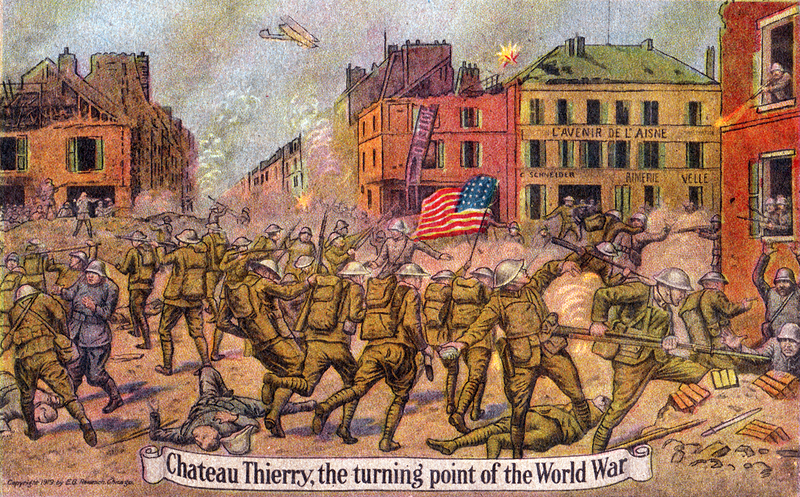 |
| “Chateau Thierry, the turning point of the World War." Postcard published by E.B. Remenson, Chicago, 1919, Public domain image. |
 |
| Stretcher bearers carrying wounded from ambulances at Evac 8. From Frederick Pottle's book, "Stretchers." |
Sunday, November 29, 2015
Part II: Mudder's World War I diary
July 27, 1918, Saturday
Breakfast at 5am, can you beat it. Just an hour of so with Peany, my but I hate to see him go; but he promised to see me in Southampton tonight. We rode eight hours on a train, and so different from ours, four in a compartment. We were given a ration in the boat; we are to eat it for lunch, coffee served at Birmingham, with our sugar. We arrive at the Southampton hotel just in time for dinner. Goldie and I started out for a walk, got the funniest looking trolley, had trouble about money, some of the English don’t want to take our American money, others great for it. Goldie happened to have three pennies, which was enough. We were afraid we would have to walk back but we met two majors, not the one I wanted to meet though. We took a taxi ride got back about ten thirty. Met two Lieutenants of the 346 Artillery, had some ginger ale and took another taxi ride.
July 28, Sunday
Peany said he was very angry with me, I don’t know whether he meant it or not, he acted angry anyhow, he came around about ten thirty this am, stayed about an hour and a half. He left for France today. Saw him flying by in a large car he waved. Goldie said I sure was acting funny, I did feel rather blue. Went to bed about 930pm, homesick, the first time since I had left the states.
July 29, Monday
Goldie and I went shopping in Southampton today, bought some stationary and found some wonderful candy. We thought we should leave today, forty of the girls did go; but I am doomed for another night. To bed early again after we had some cake and ginger ale.
July 30, Tuesday
We have been getting up very late, eating breakfast at 10am, my that will never do. Up town again, went in an old church that is 1,000 years old, the second oldest in England. Surely was antique looking. We also went to Tudor Hall, lots of old curios that were mighty interesting. The most beautiful garden you ever saw. Rushed home to dinner and heard the good news, we are to leave at 3pm, thank goodness. We rushed around packed our suitcases, and ran back up town again, there we met two strange US officers who were so glad to see some American people. We told them we were going in to buy a diary book and some stationary. They insisted on going along and treated us to the purchases, which was so sweet of them. We got on a hospital ship at Southampton, only nine state rooms, so 31 of us had Ward A, a great large room with lots of beds in it. We had to be in bed at nine thirty but before going we donned our life belts and had a drill. We were quite used to them at this time. I did not sleep much, the channel was not rough but the ship seemed to tilt so much and the pillows, were they hard; I should say so.
July 31, Wednesday
4am, some man poked his head in our window and told us we had arrived safely. We were anchored out until 2pm. Such a dry old trip, one man on board and he married. Me, Goldie, Miss Kaufman, and Miss Monroe played 500 all morning. Reached Havre at 330pm, and mighty glad to see the place. We were received by American officers, put in great large US trucks and escorted to another hotel (“Moderne”), this life is so tiresome. Goldie and I were given a room alone; we rushed out then for a stroll. Lots of Americans here, and they never pass without speaking or saluting, oh it is so good to meet your own people and they are all so pleasant. On our way back we met Major Pesego, he insisted on us having something to drink, chairs and tables are all out in front of the hotel enclosed with shrubbery, rather nice looking too. Well I took ginger ale, whether the Major played a joke on me or not, I would not drink; it tasted so queer. We then took a ride, not in a machine, gas is very difficult to get, but we had a one-horse vehicle, only out an hour, rather nice ride, home in time for dinner. Nothing exciting happened at night, it is 9pm, I am blue so will retire; I heard the 346 had left Havre the day before, how disappointing.
Thursday August 1, 1918
What an exciting night, awakened at 1am by the falling of bombs. Was I scared, I should say. The first time Havre had ever had an air raid. The French people were all running for the stairs, I could not make anyone understand me, I told Goldie I thought we were supposed to go to the first floor, we found our kimonos and slippers, did not take time to put them on, and we ran down stairs, could not find one American person, and oh such a dark place. We remained down for about an hour. I don’t think we had much sleep afterwards. Was delighted to see daybreak, that was our first experience with bombs, I am sure there are a great many ahead of us. We all left the hotel in large trucks, on arriving at the station, we were put six in a compartment, given a ration for the following day consisting of canned tomatoes, salmon, beans and jam, we had white bread which was a treat. We did not sleep very well that night, as we had no berths, and we arrived in Paris at 5am. We only remained there two hours.
August 2, 1918
We went to the American Red Cross in Paris and they gave us coffee, bread and cheese. It tasted very good and then we got on another train and had a very pleasant journey nearly every station we met a lot of American boys and also a great many in cars along the road. We played 500 all morning, tried to take a nap in the afternoon, but impossible, so many interesting things. The country was wonderful. I really saw such beautiful scenery. We reached Bazoilles at 9pm. There we met several officers we knew, talked a while and then had supper. Goldie and I were given a room together, which is real nice, needs a little fixing up.
Here’s some background history, courtesy of Dr. Marian Moser Jones, assistant professor of family science at the University of Maryland School of Public Health. Dr. Jones wrote this description of the Bazoilles-sur-Meuse hospital complex:
Breakfast at 5am, can you beat it. Just an hour of so with Peany, my but I hate to see him go; but he promised to see me in Southampton tonight. We rode eight hours on a train, and so different from ours, four in a compartment. We were given a ration in the boat; we are to eat it for lunch, coffee served at Birmingham, with our sugar. We arrive at the Southampton hotel just in time for dinner. Goldie and I started out for a walk, got the funniest looking trolley, had trouble about money, some of the English don’t want to take our American money, others great for it. Goldie happened to have three pennies, which was enough. We were afraid we would have to walk back but we met two majors, not the one I wanted to meet though. We took a taxi ride got back about ten thirty. Met two Lieutenants of the 346 Artillery, had some ginger ale and took another taxi ride.
July 28, Sunday
Peany said he was very angry with me, I don’t know whether he meant it or not, he acted angry anyhow, he came around about ten thirty this am, stayed about an hour and a half. He left for France today. Saw him flying by in a large car he waved. Goldie said I sure was acting funny, I did feel rather blue. Went to bed about 930pm, homesick, the first time since I had left the states.
July 29, Monday
Goldie and I went shopping in Southampton today, bought some stationary and found some wonderful candy. We thought we should leave today, forty of the girls did go; but I am doomed for another night. To bed early again after we had some cake and ginger ale.
July 30, Tuesday
We have been getting up very late, eating breakfast at 10am, my that will never do. Up town again, went in an old church that is 1,000 years old, the second oldest in England. Surely was antique looking. We also went to Tudor Hall, lots of old curios that were mighty interesting. The most beautiful garden you ever saw. Rushed home to dinner and heard the good news, we are to leave at 3pm, thank goodness. We rushed around packed our suitcases, and ran back up town again, there we met two strange US officers who were so glad to see some American people. We told them we were going in to buy a diary book and some stationary. They insisted on going along and treated us to the purchases, which was so sweet of them. We got on a hospital ship at Southampton, only nine state rooms, so 31 of us had Ward A, a great large room with lots of beds in it. We had to be in bed at nine thirty but before going we donned our life belts and had a drill. We were quite used to them at this time. I did not sleep much, the channel was not rough but the ship seemed to tilt so much and the pillows, were they hard; I should say so.
July 31, Wednesday
4am, some man poked his head in our window and told us we had arrived safely. We were anchored out until 2pm. Such a dry old trip, one man on board and he married. Me, Goldie, Miss Kaufman, and Miss Monroe played 500 all morning. Reached Havre at 330pm, and mighty glad to see the place. We were received by American officers, put in great large US trucks and escorted to another hotel (“Moderne”), this life is so tiresome. Goldie and I were given a room alone; we rushed out then for a stroll. Lots of Americans here, and they never pass without speaking or saluting, oh it is so good to meet your own people and they are all so pleasant. On our way back we met Major Pesego, he insisted on us having something to drink, chairs and tables are all out in front of the hotel enclosed with shrubbery, rather nice looking too. Well I took ginger ale, whether the Major played a joke on me or not, I would not drink; it tasted so queer. We then took a ride, not in a machine, gas is very difficult to get, but we had a one-horse vehicle, only out an hour, rather nice ride, home in time for dinner. Nothing exciting happened at night, it is 9pm, I am blue so will retire; I heard the 346 had left Havre the day before, how disappointing.
Thursday August 1, 1918
What an exciting night, awakened at 1am by the falling of bombs. Was I scared, I should say. The first time Havre had ever had an air raid. The French people were all running for the stairs, I could not make anyone understand me, I told Goldie I thought we were supposed to go to the first floor, we found our kimonos and slippers, did not take time to put them on, and we ran down stairs, could not find one American person, and oh such a dark place. We remained down for about an hour. I don’t think we had much sleep afterwards. Was delighted to see daybreak, that was our first experience with bombs, I am sure there are a great many ahead of us. We all left the hotel in large trucks, on arriving at the station, we were put six in a compartment, given a ration for the following day consisting of canned tomatoes, salmon, beans and jam, we had white bread which was a treat. We did not sleep very well that night, as we had no berths, and we arrived in Paris at 5am. We only remained there two hours.
August 2, 1918
We went to the American Red Cross in Paris and they gave us coffee, bread and cheese. It tasted very good and then we got on another train and had a very pleasant journey nearly every station we met a lot of American boys and also a great many in cars along the road. We played 500 all morning, tried to take a nap in the afternoon, but impossible, so many interesting things. The country was wonderful. I really saw such beautiful scenery. We reached Bazoilles at 9pm. There we met several officers we knew, talked a while and then had supper. Goldie and I were given a room together, which is real nice, needs a little fixing up.
Here’s some background history, courtesy of Dr. Marian Moser Jones, assistant professor of family science at the University of Maryland School of Public Health. Dr. Jones wrote this description of the Bazoilles-sur-Meuse hospital complex:
This was a large hospital complex originally designed to handle up to 13,000 patients. It included Base Hospital 18 (the Johns Hopkins Unit), Base Hospital 42 (the Maryland Unit), Base Hospital 46, Base Hospital 60 (from Bismarck Hospital, North Dakota), and Base Hospital 116, from New York. Base Hospitals 79 and 81, organized from the Army at large, arrived in October at the complex. (See The Medical Department of the United States Army in the World War, Chapter 24, Army Office of Medical History website.)Dr. Jones found that "the nurses, orderlies, and doctors from the Bazoilles-sur-Meuse were moved around" quite often. Some of the reasons can be found in the 1929 book by orderly Frederick Pottle, Stretchers: the Story of a Hospital Unit on the Western Front:
When the American Army arrived in France, there was a good deal of disagreement as to the status on which it should operate. General Pershing naturally wished for the American armies to preserve their identity, and be assigned a sector of the front as their own particular project. The other Allied generals would have preferred to use the American troops as replacement battalions for the French and British lines, which were already holding the trenches. In the end, General Pershing prevailed, and chose, or was assigned, as the American sector, the line east of Verdun, a part of the front which was then quiet. Back of this area a vast and complicated service of supplies was being built up, including the necessary hospital centers. Bazoilles-sur-Meuse was one of the places where it was intended to concentrate the resources of several hospital organizations. For this purpose a considerable number of wooden barracks had been erected, and were awaiting companies to take them over. In the normal course of things, we should have encamped there, equipped our operating rooms and wards, and held ourselves in readiness for the moment when General Pershing thought the time had come to order a general advance.
But these plans were roughly upset. In the spring of 1918, as everyone knows, the Germans launched a series of furious and successful drives against the French and British lines. On May 27 [the Germans'] third drive broke the French line, swept across the Aisne and the Vesle, and pressed on to the Marne, a gain of thirty miles in three days. The peak of the advance rested at Château-Thierry on the Marne, forty miles east and slightly north of Paris. General Foch asked Pershing for his best available troops. Pershing at once sent in the Third Division to hold the bridges at Château-Thierry and to prevent the Germans from penetrating farther south, and the Second to stop any German advance westward on Paris. Since June 1, while we had been jaunting across France, the Second had been suffering fearful casualties in the memorable battle of Belleau Woods. No American hospital service had been organized back of this part of the line, and the French, because of their great loss of hospitals and materials in the German advance, found themselves unable to care adequately even for their own wounded. An evacuation hospital was urgently needed back of Château-Thierry. Although we were far away in the Vosges, we were the only evacuation hospital in France then available. We had hardly reached Bazoilles-sur-Meuse before the order arrived for us to go back and set up our hospital somewhere northeast of Paris.Again, here's Dr. Jones:
Dr. Arthur Shipley, a prominent professor of surgery at the University of Maryland, was featured in a series of articles published in the Bulletin of the University of Maryland School of Medicine; between 1919 and 1920. Florence Green mentioned meeting Shipley and working with him in her Oct. 26 diary entry. Frederick Pottle worked under him as an orderly. He later wrote a supplement to Pottle's book, The Officers and Nurses of Evac. No. 8. Although Green only served at this hospital for a short time, Shipley lists her in the supplement.Here's Dr. Shipley describing Paris at about the time of Nurse Green's visit:
"During June and until July 15 Paris was being shelled almost every day and every clear night the German bombing planes went over us toward the French capital. Sometime between the last of June and the beginning of the Second Battle of the Marne had occasion to go to Paris number of times. I had seen something of Paris twelve years before. It was very changed. Not much so in mere outward appearances; the boulevards, the bridges, the churches, the open spaces and monuments were the same, but the crowds, the movement, the boulevard life were all gone. Sad and deserted, and waiting for its doom; doom that seemed at that time not far off. During this time there were no leaves granted. Soldiers were everywhere with their commands, and saw practically no officers or men in Paris. It was time of great anxiety and still greater watchfulness. Everyone was wondering where the big drive would take place."
 |
| Florence Green ("Mudder") arrived on Aug. 2, 1918, at U.S. Army Base Hospital No. 42, Bazoilles-Sur-Meuse, France, University of Maryland Nursing School Alumni Association Collection. |
Wednesday, November 25, 2015
Part I: Mudder's World War I diary
Here’s a puzzler that could be on the Travel Channel’s “Mysteries at the Museum:”
The object, almost 100 years old, measures four inches by seven inches. It has a black cover that’s falling apart and is held together by a strip of duct tape. Its inside pages are turning brown and are filled with tiny, hard-to-read handwriting.
What is it? Answer: Mudder’s diary.
The diary belonged to our paternal grandmother, Florence Green Shay. She’s called “Mudder” because her eldest grandchild, me, couldn’t pronounce Grandmother or Grandma and shortened it to Mudder. The name stuck. She looked more like a Florence than a Mudder. She was a bespectacled bridge-playing Denver matron when we grandkids got to know her as we grew up in the 1950s and 1960s. She screeched for joy and hugged us soundly when we came to visit, especially after we moved away from Denver in 1960.
A Baltimore native, she was a devoted baseball fan who loved her hometown Orioles. She took my brother and me to Denver Bears games even though they were a farm team for the Orioles arch-nemesis, the New York Yankees. When she died in 1980, she had been married to her husband Raymond for almost 60 years.
The two shared a common bond. They were both World War I veterans when they met at Fitzsimons Army Hospital in Aurora, Colo., in 1921. She was an officer in the U.S. Army Nurse Corps. He had mustered out as a cavalry officer in the Iowa National Guard. They are buried together in Fort Logan National Cemetery in southwest Denver. We can’t hear any more stories in person from our grandparents. But Mudder’s diary survives, and it tells tales. We knew little about the diary. Mudder occasionally mentioned it when she was alive. It wasn’t until my sister Eileen Shay Casey in Winter Park, Fla., got her hands on it after our father died that I had a chance to read it. Eileen, also a trained nurse but now working for a private foundation, transcribed the diary. No small task, as our grandmother’s handwriting is cramped and sometimes difficult to read. And – 96 years after the final entry – these inked memories are fading. This transcript gives us all a peek into the life of one of our ancestors cast into a far-off war.
I’ll post excerpts (along with photos) every few days on this blog. I appreciate any comments, although I’ll only print those that have some bearing on the subject at hand. At the end, those interested will be able to order a print transcript from blog2print.com – more about that later.
My sister and I would like to thank Dr. Marian Moser Jones, assistant professor of family science at the University of Maryland School of Public Health, who provided some of the background information about Florence’s experiences, which I will intersperse among the diary excerpts. She is a passionate researcher who has written extensively on the subject of World War I nurses. Thank you, Dr. Jones.
The following is the transcript of the diary Florence Green Shay kept while in the U.S., England and France, 1918-1919:
July 12, 1918, Hotel Bristol
We were all very much pleased when Miss Sarin told us today that we would leave the hotel the following day. Of course we felt a little blue to think we were going so far from home. Goldie and I proceeded to a first class restaurant and had a last good meal. We also thought of a half dozen things we wanted. We went to Keith’s at night but did not enjoy it very much, shows were becoming quite boring.
July 13, Saturday
I was quite excited waiting for the anxious moment. Before going on ship, I decided I must have a certain record for the Victrola, Baby’s Prayer at Twilight. Did some tall rushing to get it too. The staterooms were wonderful. May Callaway, Goldie and I am occupying #30. We all went to bed early the first night. Everything was strange, but only the first day.
July 14, Sunday
Before sailing, we had our first boat drill. Seemed very funny to carry life preserver`s around every place we went, but towards the last we felt lost without them. Sunday was not a very exciting day. The hands played some music but not popular songs. We sailed on the Balticand had twelve other ships in the convoy. Destroyers and aero planes were with us for a day and a half. Felt funny when they left.
July 15, Monday
We started to get acquainted this day; I think there were about 200 officers on board and 100 nurses. We had a good time. Danced from five to seven, the jazz played for us, some music too. July 16, Tuesday The ship seemed to rock more this day. I did not tarry in the dining room long. Seasick, I should say not, I would never be guilty.
July 17, Wednesday
Met some dandy people, everybody seemed so nice. Would buy candy, but to think I refused it from Sunday until today and only one piece. They needn’t think I am going to get seasick. July 18, Thursday We are still having our boat drill every day or I should say twice a day. So often we are called at a most inopportune time, but no difference, get your life jacket on, and run. I am eating a little more candy today.
July 19, Friday
Rather foggy and raining. The sun is also rather rough but did not affect me any. We had our dance just the same, lots of fun too. The 62nd Coast Artillery gave a dandy entertainment, was mighty good, and closed the evening by playing the Marseillaise, God Save the King, and The Star Spangled Banner.
July 20, Saturday
Nothing special happened. We had the Victrola out in the morning, danced a few dances. This is my bath night, and to think it is Saturday, so much the nicer. The bath steward will be in, in a moment, he does want us to keep clean.
July 21, Sunday
Went to church in the afternoon, quite different then the services I usually go to. After dinner we all went back in the 2nd class dining room where the troops were and helped them sing some songs. After this, I met a very interesting man, Major Gay - only talked to him a few minutes. Heard a few rumors about submarines, but have not worried about them much.
July 22, Monday
Met the major this morning. His girl went back on him, so I promised to stick. He nicknamed me “Pinky” an awfully nice man. We had a dance and believe me, the major is some dancer.
July 23, Tuesday
Seeing a good deal of the major. Had a big scare today. They say there is a nest of submarines in our course, but our convoy has changed its route now. Believe me, it is sure cold too, only 700 miles from Iceland.
July 24, Wednesday
Rather thrilling to see about twelve destroyers around us on this day, we feel so safe now. Our cruiser left us last night and oh how lonely we did feel.
July 25, Thursday
This is the most dangerous of days, as we are wearing our life preservers all the time now. We are in the real war zone now, but not too much danger to keep from dancing. I forgot to say we had to be in our staterooms every night at 900pm, lights out at 10pm. The Red Cross furnished us with rubber suits the funniest looking things; they are supposed to keep us up in water for three days. I will try to have mine handy tonight with a little chocolate handy. We have been told it would be better to sleep in part of clothes.
July 26, Friday
Well we are safe and sound; I have not seen a submarine yet. To think we are looking at land once more. It looks wonderful! Liverpool looks good to me. We are to anchor out tonight, the lights will be all lighted and a great celebration, a big dance. Peany, the major, asked his old girl for a dance, it made me jealous but him very foolish. We are allowed to stay out until 11pm. To think it is our last night on the ship, I feel real sad.
Editor’s Note: Listen to Henry Burr’s 1918 rendition of “A Baby’s Prayer at Twilight (for her daddy over there)” at https://youtu.be/nfuZ4rT1j88
The object, almost 100 years old, measures four inches by seven inches. It has a black cover that’s falling apart and is held together by a strip of duct tape. Its inside pages are turning brown and are filled with tiny, hard-to-read handwriting.
What is it? Answer: Mudder’s diary.
The diary belonged to our paternal grandmother, Florence Green Shay. She’s called “Mudder” because her eldest grandchild, me, couldn’t pronounce Grandmother or Grandma and shortened it to Mudder. The name stuck. She looked more like a Florence than a Mudder. She was a bespectacled bridge-playing Denver matron when we grandkids got to know her as we grew up in the 1950s and 1960s. She screeched for joy and hugged us soundly when we came to visit, especially after we moved away from Denver in 1960.
A Baltimore native, she was a devoted baseball fan who loved her hometown Orioles. She took my brother and me to Denver Bears games even though they were a farm team for the Orioles arch-nemesis, the New York Yankees. When she died in 1980, she had been married to her husband Raymond for almost 60 years.
The two shared a common bond. They were both World War I veterans when they met at Fitzsimons Army Hospital in Aurora, Colo., in 1921. She was an officer in the U.S. Army Nurse Corps. He had mustered out as a cavalry officer in the Iowa National Guard. They are buried together in Fort Logan National Cemetery in southwest Denver. We can’t hear any more stories in person from our grandparents. But Mudder’s diary survives, and it tells tales. We knew little about the diary. Mudder occasionally mentioned it when she was alive. It wasn’t until my sister Eileen Shay Casey in Winter Park, Fla., got her hands on it after our father died that I had a chance to read it. Eileen, also a trained nurse but now working for a private foundation, transcribed the diary. No small task, as our grandmother’s handwriting is cramped and sometimes difficult to read. And – 96 years after the final entry – these inked memories are fading. This transcript gives us all a peek into the life of one of our ancestors cast into a far-off war.
I’ll post excerpts (along with photos) every few days on this blog. I appreciate any comments, although I’ll only print those that have some bearing on the subject at hand. At the end, those interested will be able to order a print transcript from blog2print.com – more about that later.
My sister and I would like to thank Dr. Marian Moser Jones, assistant professor of family science at the University of Maryland School of Public Health, who provided some of the background information about Florence’s experiences, which I will intersperse among the diary excerpts. She is a passionate researcher who has written extensively on the subject of World War I nurses. Thank you, Dr. Jones.
The following is the transcript of the diary Florence Green Shay kept while in the U.S., England and France, 1918-1919:
July 12, 1918, Hotel Bristol
We were all very much pleased when Miss Sarin told us today that we would leave the hotel the following day. Of course we felt a little blue to think we were going so far from home. Goldie and I proceeded to a first class restaurant and had a last good meal. We also thought of a half dozen things we wanted. We went to Keith’s at night but did not enjoy it very much, shows were becoming quite boring.
July 13, Saturday
I was quite excited waiting for the anxious moment. Before going on ship, I decided I must have a certain record for the Victrola, Baby’s Prayer at Twilight. Did some tall rushing to get it too. The staterooms were wonderful. May Callaway, Goldie and I am occupying #30. We all went to bed early the first night. Everything was strange, but only the first day.
July 14, Sunday
Before sailing, we had our first boat drill. Seemed very funny to carry life preserver`s around every place we went, but towards the last we felt lost without them. Sunday was not a very exciting day. The hands played some music but not popular songs. We sailed on the Balticand had twelve other ships in the convoy. Destroyers and aero planes were with us for a day and a half. Felt funny when they left.
July 15, Monday
We started to get acquainted this day; I think there were about 200 officers on board and 100 nurses. We had a good time. Danced from five to seven, the jazz played for us, some music too. July 16, Tuesday The ship seemed to rock more this day. I did not tarry in the dining room long. Seasick, I should say not, I would never be guilty.
July 17, Wednesday
Met some dandy people, everybody seemed so nice. Would buy candy, but to think I refused it from Sunday until today and only one piece. They needn’t think I am going to get seasick. July 18, Thursday We are still having our boat drill every day or I should say twice a day. So often we are called at a most inopportune time, but no difference, get your life jacket on, and run. I am eating a little more candy today.
July 19, Friday
Rather foggy and raining. The sun is also rather rough but did not affect me any. We had our dance just the same, lots of fun too. The 62nd Coast Artillery gave a dandy entertainment, was mighty good, and closed the evening by playing the Marseillaise, God Save the King, and The Star Spangled Banner.
July 20, Saturday
Nothing special happened. We had the Victrola out in the morning, danced a few dances. This is my bath night, and to think it is Saturday, so much the nicer. The bath steward will be in, in a moment, he does want us to keep clean.
July 21, Sunday
Went to church in the afternoon, quite different then the services I usually go to. After dinner we all went back in the 2nd class dining room where the troops were and helped them sing some songs. After this, I met a very interesting man, Major Gay - only talked to him a few minutes. Heard a few rumors about submarines, but have not worried about them much.
July 22, Monday
Met the major this morning. His girl went back on him, so I promised to stick. He nicknamed me “Pinky” an awfully nice man. We had a dance and believe me, the major is some dancer.
July 23, Tuesday
Seeing a good deal of the major. Had a big scare today. They say there is a nest of submarines in our course, but our convoy has changed its route now. Believe me, it is sure cold too, only 700 miles from Iceland.
July 24, Wednesday
Rather thrilling to see about twelve destroyers around us on this day, we feel so safe now. Our cruiser left us last night and oh how lonely we did feel.
July 25, Thursday
This is the most dangerous of days, as we are wearing our life preservers all the time now. We are in the real war zone now, but not too much danger to keep from dancing. I forgot to say we had to be in our staterooms every night at 900pm, lights out at 10pm. The Red Cross furnished us with rubber suits the funniest looking things; they are supposed to keep us up in water for three days. I will try to have mine handy tonight with a little chocolate handy. We have been told it would be better to sleep in part of clothes.
July 26, Friday
Well we are safe and sound; I have not seen a submarine yet. To think we are looking at land once more. It looks wonderful! Liverpool looks good to me. We are to anchor out tonight, the lights will be all lighted and a great celebration, a big dance. Peany, the major, asked his old girl for a dance, it made me jealous but him very foolish. We are allowed to stay out until 11pm. To think it is our last night on the ship, I feel real sad.
Editor’s Note: Listen to Henry Burr’s 1918 rendition of “A Baby’s Prayer at Twilight (for her daddy over there)” at https://youtu.be/nfuZ4rT1j88
 |
| May 11, 1915: Florence Green (far left, second row) graduated from Maryland General Hospital Training School for Nurses. MGH Training School operated as a nursing school from 1891 until 1987, when it closed. Maryland General Hospital now operates under the name University of Maryland Medical Center Midtown Campus. |
 |
| Maryland General Hospital Training School for Nurses in Baltimore. |
 |
| The Baltic, the ship that took Mudder's Unit to Europe. |
Subscribe to:
Posts (Atom)