Showing posts with label vegetables. Show all posts

Monday, November 22, 2021

Just what are the origins of that tuna casserole my Mom used to make?

CBS Sunday Morning was all about food and drink. An historic Mexican cafe in San Bernardino, a Yemini coffee speakeasy, the origin of Ranch dressing, the rise and fall of NYC Automats, the art of making Italian Orecchiette pasta, the refined tongues of taste testers, and so on.

It caused me to think about my food traditions. I have none. I cook Mexican enchiladas, Asian stir-fry, Kansas City-style barbecue, U.S.-style Thanksgiving dinner. Typical American diet, right -- a sampler of cuisine from elsewhere. Or a smorgasbord, a Swedish type of cafeteria that was a thing back in the 1950s. Because Americans come from everywhere, so does our food. 

I should have Irish-American foodways. If only I knew what those were. Corned beef and cabbage? Irish oatmeal? Irish Stew? Rashers? Soda bread? Guinness-infused desserts? Irish coffee? 

No idea. My mother passed along recipes for Jello molds and tuna casserole. My father made his Scots-Irish mother's spaghetti and meatballs. One could live off of that I suppose, but would you want to?

The anti-tuna-casserole stance involves a bit of food snobbery. I began to think of my Mom in the kitchen, faced with the hungry stares of her many children, and I realized that a couple cans of tuna, a can of cream of mushroom soup, a dash of milk, and a handful of corn flakes for crunchiness made dinner for eight for a few bucks. All she needed was a can opener and a stove (no microwaves yet). Many "homemakers" of the 1950s faced the same challenge. Bless you Mom. Sorry I made such a fuss. 

I Googled tuna casserole recipes and there are thousands. Still. Heather Arndt Anderson wrote a witty "Brief History of the Tuna Casserole" for Taste Magazine. In it, she traces the origins of the dish to a traditional German noodles and fish casserole. The first recipes in the U.S. show up in the 1930s. It started in the Pacific Northwest and then migrated to Middle America. Modern conveniences such as COMS and canned Charley the Tuna was all that was needed to feed hungry groups of fledgling Baby Boomers. That led eventually to Tuna Helper and a recipe for tuna casserole that's "not for wimps." 

As an American, I come from nowhere and I leave no food traditions for my offspring. A sad state of affairs. My daughter Annie will help me cook Thanksgiving dinner. The recipe is a 16-pound roasted turkey, mashed potatoes and turkey gravy, stuffing, green bean casserole, and pumpkin pie. I bought cranberry sauce but use it on my turkey sandwiches. I like sweet potatoes but the family does not. I have a childhood memory of my Aunt Ellen's sweet potato casserole topped with marshmallows. It was a revelation -- marshmallows on taters? What wondrous world is this? I brought the recipe home to my mom but she never made it. I never have either. 

My parents and my wife's parents were meat and potato people. Who could blame them? Growing up in the 1930s, they were lucky to eat regularly. The Depression cast a pall on my parents' generation. That's why food companies found a willing populace for beef roasts, hamburgers, hot dogs, and, eventually, TV dinners. What miracle is this, an entire meal in an aluminum tray? Mystery meat, whipped potatoes, green beans, and an apple crisp dessert hot enough to burn away the roof of your mouth. We loved them. Mostly, though, we lived on casseroles, macaroni/cheese, hot dogs and burgers. Cereal for breakfast. Baloney sandwiches for lunch. 

I continue these non-traditions. Sure, I try new things from other cultures but keep returning to the tried-and-true. We eat a lot of stews and chilis in the cold months, many kinds of salads in the summer. But if I was asked about traditional foods, I would draw a blank. Why do I cook chicken on the gas grill? Why do I use a certain marinade? When I make Irish stew, how Irish is it really? Research shows that stew is a catch-all for whatever you have around the house. Hobos cook Irish stew from veggies they scrounge in the fields. Who invented the chili  make and why? I cook Italian sausages made in Boulder, Colorado. How Italian are they anyway? The Tex-Mex dishes I make are not the same ones you find in El Paso and Mexico City. I do not like corned beef and cabbage and have no ideas about its origins. The most Irish thing I imbibe is beer, usually stouts like Guinness which is made in Dublin and now in a Baltimore brewery. 

Now I'm rambling. But the same question remains: what am I eating and why? One of the reports on CBS today was about the rise of plant-based diets. Vegan and vegetarian restaurants have been a thing for awhile but there's a rise in popularity. You can assemble a vegan meal at most restaurants in Cheyenne but there isn't an all-vegan one. Closest WYO vegetarian restaurant is Sweet Melissa's in Laramie and quite a few in Fort Collins.

I do not want to go vegan but I do grow vegetables and eat them. Fruits, too, but all of mine comes from Colorado, California, and Texas. I eat less red meat but I eat a lot of chicken. There's a company called Daring Foods making veggie-based chicken and I plan to try it if I can find it in Wyoming stores. Tabitha Brown grew up in the meatcentric South but now is vegan and wrote a vegan cookbook, "Feeding the Soul." Her reasons for changing her diet is to stop chronic pan and fatigue. A very good reason. My heart condition makes it crucial to cut down on bad cholesterol and its tendency to cause inflammation that upsets the heart. 

My goal is modest. Replace a few meat-based meals with plant-based. Some practice Meatless Mondays which sounds reasonable. Alliterative, too. I also want to track the origins of the food I eat. I like to lose myself in the maze of research. It's habit-forming. Like bacon.

Saturday, August 01, 2015

Farmer's markets are for fresh produce -- and for dithering

The drive from Palisade, Colorado, to the Cheyenne Farmer's Market is eight hours.

I'm glad that Red Fox Run Orchards made the trip for the first time. Juicy peaches. Tree-ripened. The vendor tells me that most growers pick their peaches green because it's easier. He lets them ripen on the tree so they taste better. My daughter Annie and I ask for a sample. He plucks two peaches out of a "Palisades Peaches" box. He rinses them off and hands them over with a couple paper towels. "You'll need these -- they're juicy." I look at the whole peach. Most vendors cut off a slice and hand it over. Not this guy. I bite. Juice dribbles down my chin. The paper towel comes in handy.

I buy a large bag. "Keep them in a refrigerator for a week -- they'll keep fresh," says the vendor. I always thought that putting peaches in the fridge was a no-no. But it makes sense if they're already ripe.

I thank him. Grab my peaches and my "This Side of Paradise" canvas bag Annie and I walk on to the next table. At the farmer's market, I gather produce and stories. Food has stories, as do I. I don't take it as far as the characters on "Portlandia," who want to know the name and background of the free range chicken they're about the eat. But I ask every vendor where they're from, as it usually carries a story. The young man selling roasted chilis is from Wellington and drives up to Cheyenne every weekday to wire new houses as an electrician. He's roasting and selling chilis on weekends. Building Cheyenne during the week. He rattled off the names of housing developments going up around the county. One on Four Mile Road. A big apartment complex on Fox Farm Road. He's working at The Pointe just north of us, wiring two to three houses a week.

The family-run Canning Crows from Cheyenne does what you'd expect from the name. Well, their goods are in jars but when people talk about preserving harvests they usually says they are "canning" cukes and tomatoes. Not "jarring," which is what it really is. It is jarring to me when they say canning. I buy a jar of Soldier Jam. "You can tell we're a military family," says the vendor with a smile. She points to a loaf of bread. "Survival Bread," she says. "My son was deployed." She tells me that a quarter of every sale of Soldier Jam goes to send jam to GIs overseas. "Or they can come by and pick it up here," she adds. I buy a jar of Soldier Jam and a loaf of Survival Bread. I also buy a big jar of dill pickles because I am a pickle fanatic. Dill pickle brine has loads of salt so after my heart attack, I cut back. Does pickling demand salt? A question for the Internet. I look forward to my lunch of bread and jam and pickles.

My dithering drives Annie crazy. She's 22 and prone to action. I tell her that farmer's markets are for lingering and conversation and learning about foods. The vendors have at least some interest in their products, or they wouldn't be here. They also are making a living. I can tell when my dithering makes them impatient. So I pay and move on. The coffee lady from Fort Collins sells me some nitro dark roast for my iced coffee. The last time I had nitro it was Odell's Cutthroat Porter from behind the bar at Peppermill's. The porter had a nice head on it. The coffee did not, which kind of surprised me. But it was tasty with some Half & Half and sugar.

We end of morning by buying some Colorado corn, although it seems early for corn. We get some local salsa and then head home to snack.

Saturday, May 18, 2013

Return to the Victory Garden

I expect to harvest at least a double handful of tomatoes from my Victory Garden this summer.
Feels good to be back in the garden letting the dirt flow through my fingers and get caught under my fingernails. I let the patch go fallow last year as I was healing from a bout with depression. You'd think that gardening would be good for melancholia and maybe it is for some people. I just looked at my modest plot and saw a weed-choked north 40 spread out in front of me. Seemed like too much work instead of fun, which is how I usually look at it.

I dug out the weeds this week. This is the least fun part of the exercise but it didn't seem that way. I hauled the weeds to my garden recycling bin. I do all of this while hooked up to my LifeVest, which is an external defibrillator. I get my implanted one in June. Can't say I'll miss the vest, although I've worn it since January. I gardened all week without it beeping. Sometimes I can't walk out to my car without alarms sounding. "Danger, Will Robinson! Danger! Your ticker's about to blow!" I loved that robot...

About half of my strawberries made it through the winter, and my perennial flowers are coming up. This morning, I drove down to the annual Master Gardeners Plant Sale at Depot Plaza downtown. I was there a bit early. They thought that I was a volunteer but I bugged out before they put me to work. I meandered over to a nearby vendor's tent that belonged to Dawn Thiesen and her Thrive Nursery. She gardens up neat Horse Creek with the help of a greenhouse. I lingered mainly because she had some healthy looking plants and they had cool names. This is a failing of mine, as I tend to buy things more by name and description than by looks or price. These plants were all made in Wyoming, USA, which is always another selling point for me. Local! Local! Local!

As for tomatoes, I bought a Tolstoi, a German Extreme, Ailsa Craig, Silver Tree and Early Cherry. Dawn has a mini-catalog that has a paragraph written about each variety. I didn't read about the Tolstoi but figured it is a very literary plant that will grow to War and Peace size by the end of the summer. I expect fruits the size of the master's head, which reportedly was quite large.

I planted the German Extreme in a large pot. Dawn said it only grows about a foot high but spreads out with maturity. I suppose it's best it's in a pot as anything German does tend to encroach on neighboring territory. The Ailsa Craig is a Scottish blend named after an island in the Clyde of Firth, no doubt a single malt tomato. I bought some broccoli plants. One if called Packman which I imagined a Pac Man -- hope it doesn't gobble up the rest of the garden. If it does, I should get a free game out of it.

As the day progresses, I feel my muscles revolting from the bending and stooping and raking and digging and watering. I hear a beer calling my name.

Wednesday, February 06, 2013

Rep. Sue Wallis's Food Freedom Act makes sense

Hummingbirdminds supports Rep. Sue Wallis's Food Freedom Act (from Wyoming Business Report):
This week, the Wyoming House of Representatives passed the Food Freedom Act.
The sponsor of that House Bill 108, Rep. Sue Wallis, a Republican from Recluse, said the legislation will open up local commerce and help small business. 
HB 108 would deregulate the sale of homemade foods at such things as farmers markets and in individual transactions between producers and consumers.
Wallis said if all 200,000 or so households in Wyoming spent just $20 a week on locally grown food, more than $200 million would be pumped into the Cowboy State economy. That money will turn over at least three or four times in the economies of cities, towns and counties, she said economic studies show.

Saturday, January 28, 2012

Tropical heat wave strikes Cheyenne


I got tomatoes out the ying-yang and it's only January 28!

I exaggerate. But not by much. Cheyenne is now officially in a warmer zone in the USDA's "Plant Hardiness Zone Map." Our high-and-dry-and-cold climate once was in zone 4, which could be described this way: "Don't put your mater plants in the ground until after Memorial Day. And be prepared for frost the day after Memorial Day. And raging hailstorms the day after the day after Memorial Day."

Now we're in zone 5. Planting before Memorial Day is now permitted, even encouraged. Not so fast, says Shane Smith at the Cheyenne Botanic Gardens. This is from the CBG web site: 
Cheyenne used to be solidly in zone 4 is now one full zone warmer, zone 5. “Because this map is mostly based upon temperature, it doesn’t account for Cheyenne’s extreme winds and lack of winter snow cover. Therefore, I would caution people to not jump blindly into growing zone 5 plants and instead look at what is proven to do well here,” said Cheyenne Botanic Gardens Director Shane Smith. Cheyenne gardeners should instead stick to following the colder, zone 4 designation especially when selecting trees and shrubs, stated Smith.
I trust Shane's judgement. High Plains gardeners have to be cautious. However, as global warming continues -- and if I live long enough -- outdoor tomatoes in January may be possible.

Sunday, September 18, 2011

Grant Family Farms hosts painting party Sept. 24 to erase hate speech vandalism


From today's Denver Post:
Mobile chicken coops on the Grant Family Farm in Wellington were vandalized with messages of hate last week. Swastikas and anti-gay messages were scrawled on the sides of three buses the farm uses as mobile chicken coops. Sometime between Sept. 7 at 9 p.m. and Sept. 11 at 11 a.m. vandals entered the farm passing clearly marked private land and defaced the buses, said Angela Simon, chef for Grant Family Farms and representative of Boulder Community Supported Agriculture.

"It's a blunt reminder there are individuals who think that way and want to promote their message," Simon said.

The all-organic farm fosters an open community with a diverse staff, she said. The colorful buses add an element of mobile art with messages of peace and love to the utility as a chicken coop.

The buses are taken to different areas on the more than 2,000 acre farm to allow the chickens to roam free and help with fertilizing and weed control.

The Larimer County Sheriff's office is investigating the vandalism and trespassing as a hate crime, Simon said.

The chicken buses are decorated at painting parties hosted at the farm.

Sept. 24, there will be a painting party open to the public to cover up the vandalism and to paint two new coops.

Simon said she hopes they will have a gracious donor provide paint for the party. which will start at 9 a.m.

"It will take some work to cover it up," Simon said."We will do the best we can."
In July, Hummingbirdminds wrote about the 30th anniversary of the Grant Family Farms store here in Cheyenne. It's been a real boost to locavores and gardeners in southeast Wyoming. And my daughter had a summer job there two years ago. I'll be at a literary conference in Casper for the Sept. 24 (9 a.m.-noon) painting party. But if you're around, get down to Wellington and support Grant Farms. Activities will be happening at the field near Cuca's Kitchen, just to the west of the farm offices at 1020 WCR near Wellington. Wear your painting clothes, bring water for drinking and any extra house paint suitable for covering swastikas and anti-gay slogans.

Here's a better photo courtesy of towleroad at http://www.towleroad.com/2011/09/peace-loving-colorado-farm-hit-by-anti-gay-neo-nazi-vandal.html

Monday, September 12, 2011

Monday morning gardening: Ripe strawberry alert!

My Victory Garden was almost defeated this year.

I began the season with high hopes. Despite the late start to summer (or perhaps because of it) my lettuce leafed out early and grew wildly into the heat of July. Spinach too. My third-season strawberries yielded many ripe fruits. Nothing like getting up in the morning and grabbing a few garden strawberries to much on or add to pancakes. I'm getting a new crop mow that cooler September weather has arrived. I snacked on a few new ripe ones this morning.

Only half of my strawberries survived the back-to-back hailstorms. Ditto for my tomatoes, squash and bean plants. Terrible to see the damage that a golf-ball-sized hailstone can do to a green leaf. Rips it to shreds. I was late getting home that mid-July day and only had time to cover the plants closest to the porch before I got pelted. Like getting smacked in the arm with an errant drive by an old duffer. After 15 minutes, there were thousands of ice balls in my yard. Young green tomatoes mixed in with the ice white. Would have been pretty if not so sad.

I was so busy with the garden that I didn't even think about my car and my roof. They both need replacing. 

Another hailstorm arrived a week later, right in the middle of our annual Frontier Days celebration. The nerve!  This one brought pea-sized hail, which wouldn't have been too bad, but it brought a lot of it. The storm that kept on giving. Again I covered the plants closest to the house but couldn't reach the rest of my pole beans and pumpkin plants. 

I did end up with a few servings of green beans and crookneck squash. I may get a few more squash if the frost holds off. I've only had a few vine-ripened tomatoes but I will have a bunch of green ones to ripen inside. Not quite the same, but they'll be good for a few salads and the football chili of October and November.

What's the lesson here?

I looked out my office window and spied a strawberry I missed during this morning's rounds. I am rising from my chair right now to go outside and eat said ripe fruit. It is red and inviting. 

Saturday, July 23, 2011

Grants Farms Store celebrates 30 fruitful (and veggieful) years in Cheyenne

My daughter has worked at the Grant Farms Store in Cheyenne and I have purchased many of my seedlings and seeds there. Great place. Happy birthday:
Thirty years ago in early August, Andy Grant opened this store to sell the veggies from the farm. The store has evolved over the last 30 years and is now a beautifully eclectic home and garden store with bedding plants and some of the most beautiful flowers out there! 
Come out on August 6 from 10-7 p.m. to celebrate with us. Entrance is free. There will be music, dancing, food, beverages, and good times for all!
2120 East Lincolnway
Cheyenne Wyoming
(307) 635-2676
August 6th
10:00AM-7:00PM 
Call for Talent
Do you have a band, or know of someone you would love to see play at our 30th Anniversary Celebration? Email amy@grantfarms.com.
We look forward to seeing you there!

Thursday, July 14, 2011

Not nice to fool Mother Nature -- or the Internet

On Monday, I was musing about my garden and telling you folks out home about my wonderful high plains strawberries. I ended the post with this: "Now if we can just keep the hail at bay..."

You know what happened on Tuesday. A torrent of golfball-sized hail destroyed gardens and roofs and cars. Nobody hurt, thank goodness.

Except for the strawberries. They were shredded. I have a few plants with leaves and blossoms remaining. I plucked a half-dozen ripe fruits from the wreckage. As I surveyed the carnage, I thought about how it's not nice to fool Mother Nature. Or tempt her with a hail challenge.

Maybe it was the Internet's fault. Perhaps we have underestimated its power.

From now on, this blog will only spell out things like h-a-i-l and t-o-r-n-a-d-o.

Monday, July 11, 2011

High Plains gardening is a waiting game

Ogallala strawberries (mine kind of look like these)
Something to say about picking fresh Ogallala and Quinalt strawberries in the garden, combining them with a handful of fresh mint, and passing this around to your guests.

Hand-picked dessert.

Washed down with an Old Belgium Ranger IPA. A Belgian White like White Rascal, the one made by Avery of Boulder, might be better -- maybe even a red wine. But I don't know my wines like I know my beers.

The garden grows well. Tomatoes appearing on the vine and they'll be ripening eventually. Lettuce and rocket and spinach galore. Wait for the rest. That's what high-plains gardeners do a lot of -- waiting.

I'm a gardener in training, spending every summer learning more about what grows best. I'm also nurturing my soil with lots of compost -- can't have too much of that. Soon my soil will be comparable to those in the more hospitable growing climes, places like eastern Iowa and Missouri. I'll live so long...

The rains have been a Godsend but my garden needs a bit more hot days to really produce. That's what we lack -- long, hot days for the tomatoes and beans and squash. I wither under that kind of heat but mid-summer garden veggies thrive.

Now if we can just keep the hail at bay...

Friday, April 01, 2011

Author and place-based foods guru Gary Paul Nabhan coming to Fort Collins May 23


From Be Local Northern Colorado:

We are bringing a special dinner guest -- Gary Paul Nabhan -- an inspiring author/ advocate best known for his Place-Based Foods work, for a Be Local Community Potluck on May 23.

Gary Paul Nabhan is an internationally-celebrated nature writer, seed saver, conservation biologist and sustainable agriculture activist who has been called “the father of the local food movement” by Mother Earth News. Gary is also an orchard-keeper, wild forager and Ecumenical Franciscan brother in his hometown of Patagonia, Arizona near the Mexican border.
He is author or editor of twenty-four books, some of which have been translated into Spanish, Italian, French, Croation, Korean, Chinese and Japanese. For his writing and collaborative conservation work, he has been honored with a MacArthur “genius” award, a Southwest Book Award, the John Burroughs Medal for nature writing, the Vavilov Medal, and lifetime achievement awards from the Quivira Coalition and Society for Ethnobiology.
He works most of the year as a research scientist at the Southwest Center of the University of Arizona, and the rest as co-founder-facilitator of several food and farming alliances, including Renewing America’s Food Traditions and Flavors Without Borders.
More about Gary and all his “Place-Based Foods” work and books.
  • LIVE MUSIC & DANCING! LOCAL FOOD & CONVERSATION!
    Location:  Fort Collins Senior Center

    Date: May 23
  • Yes, a great chance for eaters, cooks, gardeners, farmers, and localization advocates to share a meal and dreams for our community.

  • Yes, bring an appetizing dish to share, full of local flavor and specialities.  We’ll send full details once you’ve registered.

  • Yes, advanced ticketing is REQUIRED so we can plan seating/serving. (Fee covers speaker and room rental; any extra proceeds will benefit Eat Local)

  • Yes, pre-register by paying at www.belocalnc.org. Or send a check to Be Local NC, 215 W Magnolia, #204 FC8051. DEADLINE MAY 16

Friday, November 26, 2010

City boy says: Let food freedom ring!

Today, I'm thinking about food.

No surprise. Yesterday was our annual eating extravaganza. I enjoyed Thanksgiving -- always do -- although I didn't do much beside cook two pies and take them to our friends' house where the rest of the goodies resided.

I didn't ask any annoying foodie questions, such as "were these sweet potatoes raised within 100 miles of Cheyenne?" That's the problem with foodies -- always asking annoying questions while we're trying to eat.

I ate some root crops: sweet potatoes, potatoes and onions. I ate wheat: dinner rolls, gravy and stuffing. I ate nuts: pecan topping on the mashed sweet potatoes. I ate turkey, of course, and cranberries. Green beans from the usual casserole. I ate apples and pumpkin in the pies. Olives.

Most of this could have been grown or raised in the general vicinity. Wyoming is known more for cattle and sheep than for its turkey ranching. But you could do it on a small scale. If not, maybe it's time to switch our local Thanksgivings to beef or lamb or elk or goose. You can get those locally. Alas, turkey is traditional and usually comes from big turkey farms located far away.

According to an article by Keith Goetzman in Utne Reader, more than 50 percent of Thanksgiving turkeys come from the Willmar Poultry Farm in Willmar, Minn. The Humane Society recently screened a video filmed secretly at the plant. Not a pretty picture. If you have the stomach for it, you can see it at http://www.utne.com/Politics/Where-Turkeys-Come-From.aspx.

Goetzman also recounts how meat-eaters and vegetarians square off across the Turkey Day table. He ends his piece by making a case for squash lasagna as a holiday main course.

Sounds good. My 17-year-old daughter, the vegetarian, would like it. So would I. But, alas, my daughter also likes the traditions of the day which include the succulent odors of cooking turkey. Good smells make good memories. And let's face it -- vegetarians have plenty of choices on the traditional table. Turkey and gravy are the only items that they can't eat. Dressing isn't stuffed into the bird any more and, if you don't add giblets to it, it's O.K. for vegetarians.

I strive to eat locally produced foods. My garden provides some during the warm season. It probably could provide more, according to the University of Wyoming Extension Service. And not by expanding my acreage. I could get additional growing time by taking advantage of my yard's microclimates. I also could invest in a small high tunnel or a small greenhouse. These people know their biz. They even have a magazine called Barnyards & Backyards which features farm/ranch/garden tips and interesting articles. You can subscribe by going to http://www.barnyardsandbackyards.com/.

A couple more food-related items. For one, I think it's time to invest in Community Supported Agriculture (CSA). We now have a half-dozen farms within 100 miles which offer CSAs. I've been putting off joining because I thought I could grow all of my own but that isn't possible. I was checking out the web page for Meadow Maid Foods in Yoder, which is in Goshen County. The Ridenour family grows natural veggies and raises grass-fed beef. I've bought veggies and beef at the farmer's market and all of it was great. Meadow Maid has also leaped on the agri-tourism bandwagon, with tours of the property and workshops. Some places, such as Grant Farms in Wellington, Colo., bring their CSA customers in to help plant and weed and harvest. Agri-tourism could join the ranks of ranches offering hands-on experiences in trail drives and branding. This trend could eventually be huge in rural Wyoming.

And then there's Wyoming Food Freedom. In its proposed legislation, terms such as agri-tourism and farmers' markets come up often. WFF proposes to do away with onerous state and federal regulations that prevents "informed consumers" buying directly from "trusted producers." I support this. In fact, I find it a place where libertarians and liberals can meet without yelling and screaming. WFF realizes that Big Ag products are making us sick. I want to buy more products from local farmers and ranchers. I want to spend less time at the grocery store. I'm not sure about this whole raw milk thing. That seems to be a big issue -- buying unpasteurized milk directly from small dairies. Some of the rhetoric around this issue harkens back to "poisoning of our precious bodily fluids" days. But there may be some truth in what the raw-milkers say.

Our family bought raw goat's milk from a local producer for years. It was great, but I don't drink much milk so, when our milk-consuming son moved away, we stopped getting it. But there are many who swear by the stuff. We also know that pathogens can breed in milk if it's not handled correctly.

Meanwhile, I'm going to support Rep. Sue Wallis and WFF. On its web site, WFF contends that freeing up food commerce can add a billion dollars worth of stimulation to the state's ag economy. It would really beef up rural areas hit hard in the past few decades. It also might regenerate family farms, which are disappearing fast.

At yesterday's dinner, a man my age -- a local pharmacist -- spoke about the small family farm he grew up in in Scotts Bluff County, Nebraska, which is just across the border from Goshen County, Wyoming. The family ran the farm until it grew too expensive. His parents both got jobs in town. They sold some of the land to the railroad. They leased out the rest. Pretty soon they weren't farming any more. He said that he loves the way he grew up but that it's almost impossible to do so now.

It should be possible. So says this city boy.

Monday, November 22, 2010

Connecting culture and agriculture in rural Wisconsin

Fascinating info and video about the Wormfarm Institute in rural Wisconsin. One of the winners of this year's Wisconsin Governor's Awards in Support of the Arts, residencies at the Wormfarm include 15-18 hours per week of growing and cultivating and harvesting in the institute's vegetable garden. The rest of the time, artists can cultivate their own art. Veggies, fruit and art is sold at Roadside Culture Stands. There's also a gallery in the local town.

FMI: Connecting culture and agriculture

Thanks to The Artful Manager's blog for this.

After watching the video about the Wormfarm produced for the awards, I am in love with this place. Although I am a city boy, I've planted my own veggie gardens in three states since 1974, with time off for various reasons. My Cheyenne, Wyoming, garden has been expanding the past three years. I do not have grandiose plans, but prefer to grow my own because it is fun and the results are so tasty. As a writer, I get ideas while gardening -- and sometimes mull over my latest story while plucking weeds from beneath he tomatoes. I'm now working on a gardening story. Wait, don't run away. It's a very exciting story involving sexual hijinks -- and I'm not just talking about botanical pollination, although that can be very stimulating for gardeners. I'll see where it goes...

Thursday, August 19, 2010

Reviving Victory Gardens by growing veggies and art


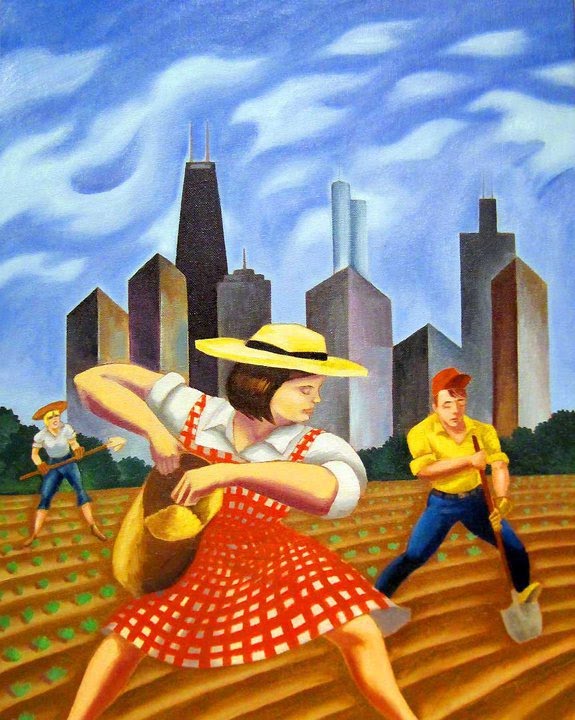
This is a 1940s-style poster for the Peterson Garden Project, which encompasses "vegetable gardening, history, seed diversity and community... all in a day's work as we revive a World War II Victory Garden in Chicago's 40th Ward." This 2010 growing season poster was designed by E. Karl Fresa Fine Art. Signed limited edition prints were sold at an Aug. 5 fund-raiser geared to collect money for a documentary film on the project. Cool idea. Where were the WWII Victory Gardens located in Cheyenne? Time for some research... Thanks to Red, White and Grew's Facebook page for the tip-off about this effort. Read the latest posts on Red, White and Grew making a case for Victory Gardens as folk art.

Thursday, May 13, 2010

Master Gardeners' Plant Sale and Gardening Fest May 15 at Cheyenne Depot

Mike Ridenhour sent this:

Put away the snow boots and dust off the gardening boots. Spring arrives in Cheyenne with the annual Master Gardeners' Plant Sale and Gardening Festival. Come get supplies to grow your own local food, and get some early season goodies from some of the Wyoming Fresh Market vendors.

Saturday, May 15, 9 a.m.-4 p.m.

Historic Train Depot Plaza, Downtown Cheyenne

At the Garden Festival:

Annual and perennial flowers, vegetables, herbs, a limited number of small trees and shrubs. Also look for gently-used tools, a garden boutique and books and magazines on gardening. Brief, free lectures and workshops under the tent will cover designing a productive vegetable garden (including meeting the challenge of Wyoming’s climate).

Wyoming Fresh Farmers Market will preview their market season at the Festival. The market booth will include the following local products:

Heirloom tomato plants and bedding plants from Local Roots (formerly Wolf Moon Farms)
Gourmet Pasta from Pasta Pazza
Grassfed Beef, Jerky, and Eggs from Meadow Maid Foods
Grassfed Bison and Jerky from High-Point Bison
Natural Emu-oil Soaps and Lotions from Rabbitt Creek Enterprises
Cheyenne Honey
Pioneer BBQ

Wyoming Fresh Farmers Market starts its regular season on Tuesday, June 8, 3-7 p.m. on North Yellowstone, in front of Smart Sports.

Saturday, December 05, 2009

Locavore and localart and even localit

I did my Christmas shopping in Chugwater.

Actually, Chugwater came to Cheyenne in the form of Sage Hill Fiber Arts and Baker Farms On-Farm Bakery. They were just two of the vendors at the Winter Farmers Market at the Historic Depot in downtown Cheyenne.

My first purchase was a loaf of homemade rye bread from Baker Farms. The farm grows winter red wheat up on the bluffs east of Chugwater, about 40 miles north of Cheyenne on I-25. Some of their crop is organic, which goes into their breads and pastries. I tried a sample of their Granola pie, which is a flat granola bar the siez of a monster cookie. Very tasty. Then I tasted their onion bread. Finally settled on a big round loaf of the rye.

The couple that owns Baker Farms (sorry -- didn't get their first names) said that the wheat crop got hammered with hail over the summer. But they did harvest some, and made some bread which I took home and had a few slices until my daughter and her friends came home and ate their way through the groceries like a locust swarm. They were gone almost as quickly as they had arrived.

The bread was good while it lasted. And I have a standing invitation to go up to Chugwater and take a ride on one of the two Baker Farms' combines which, the couple said, "are really old." Who can pass up a ride on an historic combine? They could tell I was a city boy. They don't have a web site yet, but you can e-mail them for more info at dwbaker@vcn.com.

I bought a Christmas present for a loved one who shall remain nameless at the Sage Hill Fiber Arts booth. Carol Eckhardt, shepherd and spinner and fiction writer (two of her books were for sale next to the fiber arts), and her daughter run the company. Carol weaves beautiful scarves and hats and shawls from the wool of her own sheep. Most of her items are natural colors instead of dyes, the whites and tans and browns and blacks courtesy of sheep like Ebony. Carol wove Ebony's wool into a multiple-patterned bed jacket. I knew that my wife Chris would love this particular item as she sat up and read in bed or watched "The Office" on a frigid night in which she reminded me that she required such an item to get her through the winter.

However, the item was a bit pricey for my budget. Although I could see it on a future shopping list.

Therein lies the difficulty with "buying locally." We are used to paying bargain basement prices at retailers. Often we are buying goods made far from home. China or the Dominican Republic, for instance. These goods are cheaply made and they travel long distances before they're stocked on the Wal-Mart shelves. Prices dictate longevity. Your scarf made by cut-rate labor in China may survive one winter. But probably not.

I don't have enough time or energy or knowledge to talk here about the politics of shopping. But when you buy locally, you support your neighbors. When you buy at Wal-Mart, you support Wal-Mart.

But it is difficult for most of us to afford $100 scarves and $75 baskets. Our money goes elsewhere: mortgage payments, utility bills, car payments, food for the little ones and, yes, shopping for necessities at big-box stores. Our society is now structured around low prices. Since all our other costs are going up, we have less to spend for sturdy, handmade items.

I spent several hours prowling the indoor market. Linda Behrens of Cheyenne makes beautiful baskets from willows. As we spoke, she was weaving Christmas ornaments. Her baskets are remarkable. She has to work with the willow when it's green so it's malleable. This is especially important because she leaves the bark on. E-mail Linda at anubisbehrens@yahoo.com.

I have to keep in mind that the artists and artisans in this building today spend many hours on each artifact. There were many craft fairs going on around Cheyenne on this December Saturday. The YMCA hosted one, as did Alta Vista and Miller Schools, among many others. It shows the importance of handmade arts and foods.

Meadow Maid Foods in Yoder, owned by Mike and Cindy Ridenhour, offers grass-fed beef, homemade jerky, vegetables and flowers, and vegetable CSA shares. Other farms in the vicinity that offer CSA shares are Wolf Moon Farms in Ft. Collins, Colo., and Grant Farms in Wellington, Colo. Sara Burlingame, one-time owner of Sara's Breads, now is the Cheyenne contact for Wolf Moon Farms CSA drop-offs. You can get more info about signing up for the 2010 growing season by e-mailing Karen at wolfmoonfarms@gmail.com.

WindHarvest Farms in located in Morrill, Nebraska, about 11 miles east of Torrington and about 90 miles from Cheyenne. Diane and Jeff Edwards run the farm. Jeff is also works in the agricultural extension office for Goshen County, Wyo. Not only does he advise Wyoming farmers and harvest his own organic veggies. He's also received a grant to run workshops on building high tunnels for year-round growing in high wide and lonesome Wyoming.

Jeff says that these workshops will take place over the next couple years. He'll build a high tunnel on someone's property, providing hands-on experience for those who sign up. That means getting your hands dirty putting up the 16-feet-by-32-feet structures. Some are already up and providing shelter to tomatoes and berries around southeastern Wyoming and western Nebraska. Jee says that interest in high tunnels is booming.

I could have spent my entire Christmas budget at the market. I gathered info and will save up for later. I did drop by the Rock, Paper Scissors Gallery down the street from the Depot. The gallery offers working space for local artists and exhibits work of artists from the region. Potter Paulette Rasmussen was minding the store. I persued the works on exhibit, and pledged to come back. I bought Chris a hippo etching by Abby Paytoe Gbayee at the gallery when it opened during the summer. More to come...

Friday, December 04, 2009

Wyoming locavores strive to be creative

This comes from the Northern Colorado Food Incubator:

Cheyenne will host two winter farmers' markets this fall, patterned after the Fort Collins Winter Market model. One was held Nov. 7; the next one will be held indoors on Saturday, December 5, 10 a.m.-2 p.m., at the Cheyenne Depot Museum in downtown Cheyenne. Please note, due to careful planning, the Cheyenne and Fort Collins market dates do not conflict so that vendors may attend all markets. FMI: click here

The flyer for the event advertised "local foods grown, raised or created within 150 miles of Cheyenne, Wyoming." Often, you hear locavores talking about food grown, raised or created within 50 miles of home. But in high, dry and cold Cheyenne, you have to boost the radius 100 miles in all directions. Mainy south, toward the Front Range breadbaskets of Wellington, Fort Collins, Denver and almost all the way to Colorado Springs. It also includes the northeastern Colorado wheat and corn fields of Sterling and Fort Morgan into cornhusker territory in western Nebraska. Food crops are grown in some of eastern Wyoming's lower elevations around Torrington and Lusk and Wheatland.

You get the picture -- Cheyenne locavores have to forage far and wide for our food. I've written before about some of Laramie County's food producers (see http://hummingbirdminds.blogspot.com/2009/08/stiory-to-go-with-every-zucchini-and.html). We do better in the meat department than we do in fruits and veggies. At our summer and fall farmers markets, fruit comes in from northwestern Colorado and Utah. That's way beyond the locavore radius, but it's hard to dwell on semantics when you have the juice of a Wasatch Front peach dribbling down your chin.

Vegetarian locavores have one hell of a time in Cheyenne. It's a different story for meat-eaters, especially if you're a locavore and a hunter. Several hunters I know stick close to home, hunting elk and deer and antelope in the Medicine Bows and Snowy Range and down into Colorado's Roosevelt National Forest. When they "harvest" an animal, its edible parts go into to freezer for locavoring throughout the winter. I know that many people who actually use the term "locavore" don't approve of hunting. In fact, I've heard that it's on the list of the NRA's forbidden words list, along with "vegetarian," "liberal" and "Obama." But some hunters may be a lot more "The L Word" that I am. That's "L" as in locavore. What did you think I meant?

I like the fact that the Cheyenne and Fort Collins farmers market dates do not conflict. That's an encouraging sign and shows that the Northern Colorado Food Incubator includes southeast Wyoming in its planning. I also like the fact that the CWFM lists a bundle of sponsors, including the Wyoming Farmers Market Association (I didn't know there was such a thing) and several individual sponsors "who believe in the local food movement."

Get down to the Depot tomorrow for some bison and salsa and local honey and pumpkins and eggs from free range hens and baked goods from organic Wyoming wheat.

Sunday, August 30, 2009

Saturday morning at the farmer's market

In honor of slow food, I took my time this morning perusing the wares at the farmer's market at the Cheyenne Depot Plaza.

Trees and bushes lined the entrance. I would love to buy more trees and bushes, but will wait for spring. I spent most of the spring and summer growing things with middling success. I also discovered that the crabapple tree I've nurtured from a sapling for four years is actually a plum tree. I ate one of the fruits, and it was more sour than sweet. I'm just chagrined that I didn't know it was a plum tree. Perhaps I should have known something was up when it never produced crabapples. My horticultural skills still need polishing.

My first stop was the Heritage Hills booth. This organic farm is located a few miles east of Cheyenne. I wrote about it after it was featured in a Wyoming Tribune-Eagle article about eating locally. I bought some spaghetti squash, two bunches of carrots and a bunch of beets. I told the young guy behind the counter that I'm not a beet fan and haven't been since eating too many canned beets as a kid -- and crappy salad bar beets as an adult. But he vouched for his beets, said they would turn me into a beet lover. Also said I should eat the leaves. "Toss 'em in a salad -- they're great." I'll let you know about the beets later.

I know it's corn season, but I passed up hundreds of good-looking ears. I'm sorry -- I know that this jeopardizes corn farmers who need to sell all their corn so they they can carve their fields into spooky Halloween mazes. But last time at the market, I bought three-dozen ears and we couldn't eat them fast enough. My cat liked it, though. I accidentally left out a bowl of shucked corn ears and in the morning found three ears gnawed down to the cobs and my cat passed out on the floor. A sad sight. Perhaps I would have reconsidered but I didn't see any of the Olathe, Colo., sweet corn that usually shows up this time of year.

I rounded out my purchases with a big basket of Palisade peaches, some Japanese eggplant from Monroe Organic Farms near Lasalle, Colo., a loaf of homemade cinnamon-raisin bread from Baumann's Bakery and a bag of Costa Rican coffee beans from Jackie at Jackie's Java in Fort Collins. I had a couple reasons for buying the coffee. First, Jackie's a fellow CSU grad and started her business while still a student. Second, the cover on the coffee bag told an interesting story. I'm a sucker for good stories, especially ones about food and beverages.

The bad showed a photo of Jackie among the coffee plants when she visited La Amistad Estate last March. Here's the copy: "Located inside a Costa Rican National Reserve, La Amistad is a finca like no other. Powered 100% by hydro electricity, shaded by banana trees dispersed amongst the natural rainforest, and processed completely on the farm to keep quality control at its peak."

Damn. That sounded so good that I wanted to open the bag right then and eat some of the beans. I didn't. I'll brew some of the java in the morning. I'm a coffee snob, that's true. But I also know how coffee was grown for so many decades. Big plantations owned by U.S. firms in cahoots with Latin American dictators. Peasants picking coffee for pennies a day. Coffee in the U.S. was cheap -- and horrible. Now it's expensive and very good. Grown in self-sustaining fincas that deal directly with small vendors and roasters in places like Fort Collins.

Bottom's up, coffee fans.

Why am I at the farmer's market when I have a garden of my own? Good question. I'm still waiting for most of my tomatoes to vine ripen. I've harvested some nice squash and zucchini and green beans and broccoli. But I don't have a peach orchard. I do have one plum tree. Who knew?

Saturday, August 22, 2009

A story to go with every zuke and tomato

Who put the loca on locavore? Dinner tonight was tomato sauce from homegrown tomatoes, steamed green beans and BBQ zucchini from the Shay garden and pasta from a package. Vegetarian too, which pleased my daughter Annie. Beer from Fort Collins (for me) rounded out the meal.

By the way, Jodi Rogstad's cover story, "Goal: Make a 100 percent local meal," in last Sunday's Wyoming Tribune-Eagle was great. She scrounged up almost all the makings of a meal from local farmers and ranchers. No easy task in this windswept high-altitude place with a short growing season. She found veggies at Lucas Loetscher's huge garden off Railroad Avenue between Cheyenne and Burns. Lucas is 23 and sells his veggies each Saturday at the Cheyenne Farmer's Market. His great-grandfather homesteaded the land in 1918.

That was one of the great things about the article. A story to go with every foodstuff.

Clair Schwan is a self-sufficient Libertarian who lives north of Cheyenne. He calls himself a "thrivalist" instead of a "survivalist." Schwan gives Jodi a bag of summer squash and allows her to harvest some eggs from his chickens. Later, Jodi goes to Catherine Wissner's Wild Winds Sheep Company near Carpenter. Wissner, a horticulturalist for the UW Cooperative Extensive Service, raises lamb and turkeys and grows her veggies in a high tunnels which "makes life here on Mars possible." "Life on Mars" -- I like that.

Jodi wrapped up her article with recipes and a list of food for locavores. Some of the growers were down in Wellington and Fort Collins, Colo., within the 50-mile radius preferred by locavores.

Sunday, July 19, 2009

Midsummer day's Victory Garden blogging

If mid-summer is mid-July, then we're already past it. If it's actually 45 days into cosmological summer, we're not quite there, as that's sometime in early August.

But if we're talking growing season, we've reached the halfway mark, at least in Wyoming. First frost can come any time after Labor Day, but may not arrive until late September. But once August merges into the school year, the best growing days are gone.

I've harvested spinach, leaf lettuce and some broccoli. Spinach is gone but lettuce still leafing and broccoli still heading. Just ate the first zucchini of many more to come. Three inches long and the size of my pointer. Tasty. No yellow squash yet and the lone brookneck is not looking so good. Wonder what I did wrong there. All tomato plants are fruiting and next weekend should bring lots of cherry tomatoes. I have six house guests from Tennessee and maybe it's time to call on them for fried green tomatoes. But not crazy about that, although the Fannie Flagg book was good as was the Hollywood film. Green tomato recipes are best for the tail-end of the season, when I'm snapping the greenies off the plants in advance of north winds.

Pole beans are raging on the south side of the house where they share space with wildflowers. marigolds, and a red crabapple tree that's made it through five winters and is as high as the top of the kitchen windows.

This week, the "victory" in Victory Garden is for the triumph of the Democrats' public-option health care plan over the ignorance of the Know Nothings (you know who you are Sen. Enzi and Sen. Barrasso and Montana's confused Sen. Baucus and Nebraska's compromised Sen. Ben Nelson) and the greedheads at the insurance companies.