Thursday, December 03, 2015

Part III: Mudder's World War I diary

August 3, 1918 
No patients as yet, we breakfasted at 8am.  Heard this morning that Dr. Wood, an M.G.H friend of ours was very near. Goldie and I went over and looked him up. Sure was good to see him, and he was sure surprised to see us. The Hopkins Unit is also very close to ours. Played ball with some of the nurses and officers including Roy Wolford. Heard our trunks had arrived and went down to the station to see if all were here. 

In the afternoon, Peg, Goldie and I went over to 116, the Y.M.C.A , to buy some chocolate. On our way back, we met three very nice American officers, we talked awhile, it started to rain, but we did not go for a little thing like that.


August 4, 1918 

Did not get up for breakfast. 

We all went over to the Y.M.C.A ,  to church, very nice service. On returning we found out that Goldie, Peg, Steve Beauman and I are to go to Base #15, about four hour ride in the train.  Unpack and repack again but sort of glad, am sure tired of loafing.  Took a long walk in the evening and on our return, we had company from #46, Lt. Wood.


August 5, 1918 

We have arrived at Base #15 and such a homesick crowd.  In a dormitory with thirteen other girls, but eight from #42. I did not know how much I loved our own base. We had a short train ride, then a ride in an ambulance. This is the Roosevelt Unit -- has stone buildings, ours are wooden but are good enough for me. The girls are very dismaying to us; they seem to think we will never get back to our base. Took a long walk in the country, passed General Pershing’s chateau. This county is really more beautiful than up at our place.

August 6, 1918 

No one has yet told us to report for duty, but I suppose we will know about that soon. The Red Cross or rather the Y.M.C.A. serves hot cocoa to the nurses at 1030am, tasted mighty good too. After lunch we went to Chaumont and should we pass in their large machine but General Pershing, he waved and smiled and we were tickled to death. He looks just like his picture, we knew it was his car coming; there was four stars on the front.  After, we got to town we met two officers that we had met on the ship, Captain Madden and Lt. Smith. Glad to see them, we had not seen any one we knew for such a long while. 

After tea, we took a long walk, went to General Pershing’s chateau and went through the grounds, oh everything was so pretty, the grounds were kept so well, a duck pond and some beautiful flowers. I picked a rose, will try to keep it. Don’t say I did not eat a big dinner after that walk and I’ll tell you the food is great here, to bed at 8pm.


August 7, 1918 

About 8am, the assistant came in our dormitory and told us to get ready for duty, I told her we had to have our carryalls first, so about 10am, they arrived, I went on duty. We were not yet so busy today, most patients up. We have a little French boy, with a mastoid, not yet six years old, awfully cute chap.

August 8, 1918 

Well, a convoy in during the night, and such a crowd of injured boys. Poor things, it sure is the most pitiful sight, they suffer so. 

Nothing unusual happened. Steve made some of the best caramels, but they did not get real hard so could not send them to Chris. We sure did enjoy them. 


August 9, 1918 

Still at Base #15, oh to be back home, Had last hours, after dinner, Peggie and I took a walk, met a major we knew, he walked home with us. There was a dance on at the Red Cross, but I did not go, too lazy I suppose. Played a joke on one of the girls, there were only eleven in the room, I put an enormous pitcher and some clothes and a hat in her bed. She thought someone was in it. We had lots of fun.

August 10, 1918 

Nothing of importance happened today. Met an officer downtown that asked us if we would help him buy some lace for his wife. We were only too glad, of course.

August 11, 1918, Sunday 

Another convoy in, those Huns sure are doing our poor boys up. After met three officers that wanted us to take a ride, did we refuse, I guess not, in a seven passenger Winten, and some car too.

August 12, Monday 

The sad news came was broken to me about 1230, Poor Goldie in tears, I was to be ready at 2pm to go to the Front. I did not say anything, no use, I was pretty blue over the fact. We started on our journey, 4 officers, 2 nurses and 2 orderlies, we landed in Paris at 7pm, to the Chatham, and then some dinner, after that took a walk with the officer. Paris sure is a dark place. We went to bed early, had a wonderful room, all white with a bath.

August 13, Tuesday

Got up rather early, went out to do a little shopping (Miss Martin) the girl I came with paid only $20.00 for a pair of tan shoes. I had my hair shampooed. I think the man poured a whole bottle of toilet water in it. The French sure believe in Perfumery. 

After lunch we were to take the 1pm train to Chateau Thierry but my luggage was lost (found later) so we waited for the 525 train, while waiting we decided to go to the Red Cross. Went up in a taxi and by the way, if you are struck by a taxi in Paris, you are arrested, think of it. The Red Cross gave us each a jersey dress, grey, very nice looking too. After we arrived back at the station we met an officer who wanted some ice cream nearly as bad as I did, so we took a taxi and located the Chinese Umbrella, where we really did find some, the first I had for four weeks. We arrived at Chateau Thierry about 10pm. Some officers had a large truck so they were good enough to take us to Thierry, no lights in the truck and the number of them we had to pass, dark as it could be. When we arrived at Mobile  #1, they were are torn up, ready to move, They finally found a place for us to sleep, just an army cot with a blanket, we had something to eat and then a good sleep. Could hear the guns very plain but did not disturb me.


August 14, Wednesday 

After breakfast, who should I meet but Howard Moses, never was so surprised in my life, and I really believe he was shocked. We took a long walk through Chateau Thierry over the main river bridge, the town was in an awful condition, nearly every house was shelled or bombed. The people were just moving in that had been run out, such a sight; we hailed an ambulance and rode back. 

On arriving, I found that our team was to be moved to Evac #3, about four miles away, Crezancy, I just live to pack and move so much fun.  This place is not so awfully bad, living in tents and the eating, oh my. The flies and bugs are dreadful. Howard C. came over in the afternoon. Left about 7pm. We are to be a night team, hardly think any work will be in tonight.


The war from an orderly's point of view...

Frederick Pottle was the author of the 1929 book, Stretchers: the Story of a Hospital Unit on the Western Front, published by Yale University Press. Pottle served as an orderly at the hospital complex, and, as later happened to our grandmother, Florence Green, was sent to Evacuation Hospital No. 8. Stretchers describes everyday life for U. S. medical teams near the front.


Here's an excerpt from Pottle's book:
An extract from a diary will serve to indicate the mixed spirit of idealistic altruism and matter-of-factness which characterized the greater part of our war work. Caring for wounded men becomes a job just like everything else, and to carry on this job efficiently for a long period of time demands a reasonable attention to one's own physical and mental health. The diary was, of course, never intended for public inspection. But the naivete of its entries is therefore all the more illuminating.
Monday, July 15. Played tennis until 11.00 A.M. [This man was on night duty.] Beaten once, but did not play to finish. Holiday for all the boys. Took shower and got ready for a dance. Alas! 7.00 P.M. Evac 8 luck. Dance called off on account of a big drive. From 8.00 P.M. carried our boys from Battle of Marne to operating room and then to ward. 
Tuesday, July 16. 4.45 A.M. Carried the last poor mate to operating room. News said Huns had crossed Marne, but were pushed back./ Slept 5.00 to 7.00 A.M., then [I suppose after eating breakfast] slept all day, as I was very tired. Got up for dinner and supper. Reported at 7.30 P.M. Carried a few patients, then slept after supper [at midnight] of pork, bread and butter, lettuce and cocoa. [This midnight mess was prepared by the sisters and served in the refectory of the College itself.] 
Wednesday, July 17. Up at 7.00 A.M. Sat around and talked. Germans at Marne had advanced ten miles, but losses were great. and victory conceded to U.S. To bed after dinner and slept until 6.00 P.M. Reported for duty. Nothing to do. Slept until 12.00 Then supper. 1.30 AM. called and helped with man in A Ward. He died, then I slept until 7.00 A.M.
Thursday, July 18. Played tennis with B and lost 6-3, 6-2, 6-4. Slept well until 4.00 P.M. Company had dance but did not go, account of big rush of our boys. Some had legs amputated , and litter bearing in an operating room is surely some job. Took delight in helping to make the boys comfortable. Had supper at midnight, beef, lettuce, and bread. Then back to work.
Friday, July 19. Reported off at 7.30 A.M. and was surely tired, sick at stomach, etc., and went right to bed. Good news says we drove the Huns back six or eight miles. Up at 6.00 P.M. Worked hard all night carrying. Saw some mean wounds. Had nothing for supper at midnight. Court filled with wounded.
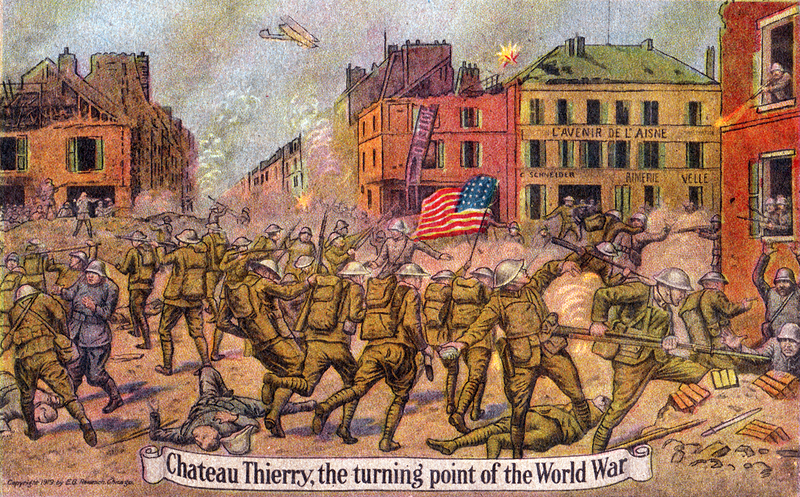
“Chateau Thierry, the turning point of the World War." Postcard published by E.B. Remenson, Chicago, 1919, Public domain image.
Stretcher bearers carrying wounded from ambulances at Evac 8. From Frederick Pottle's book, "Stretchers."

Sunday, November 29, 2015

Part II: Mudder's World War I diary

July 27, 1918, Saturday
Breakfast at 5am, can you beat it. Just an hour of so with Peany, my but I hate to see him go; but he promised to see me in Southampton tonight. We rode eight hours on a train, and so different from ours, four in a compartment. We were given a ration in the boat; we are to eat it for lunch, coffee served at Birmingham, with our sugar. We arrive at the Southampton hotel just in time for dinner. Goldie and I started out for a walk, got the funniest looking trolley, had trouble about money, some of the English don’t want to take our American money, others great for it. Goldie happened to have three pennies, which was enough. We were afraid we would have to walk back but we met two majors, not the one I wanted to meet though. We took a taxi ride got back about ten thirty. Met two Lieutenants of the 346 Artillery, had some ginger ale and took another taxi ride.

July 28, Sunday
Peany said he was very angry with me, I don’t know whether he meant it or not, he acted angry anyhow, he came around about ten thirty this am, stayed about an hour and a half. He left for France today. Saw him flying by in a large car he waved. Goldie said I sure was acting funny, I did feel rather blue. Went to bed about 930pm, homesick, the first time since I had left the states.

July 29, Monday
Goldie and I went shopping in Southampton today, bought some stationary and found some wonderful candy. We thought we should leave today, forty of the girls did go; but I am doomed for another night. To bed early again after we had some cake and ginger ale.

July 30, Tuesday
We have been getting up very late, eating breakfast at 10am, my that will never do. Up town again, went in an old church that is 1,000 years old, the second oldest in England. Surely was antique looking. We also went to Tudor Hall, lots of old curios that were mighty interesting. The most beautiful garden you ever saw. Rushed home to dinner and heard the good news, we are to leave at 3pm, thank goodness. We rushed around packed our suitcases, and ran back up town again, there we met two strange US officers who were so glad to see some American people. We told them we were going in to buy a diary book and some stationary. They insisted on going along and treated us to the purchases, which was so sweet of them. We got on a hospital ship at Southampton, only nine state rooms, so 31 of us had Ward A, a great large room with lots of beds in it. We had to be in bed at nine thirty but before going we donned our life belts and had a drill. We were quite used to them at this time. I did not sleep much, the channel was not rough but the ship seemed to tilt so much and the pillows, were they hard; I should say so.

July 31, Wednesday
4am, some man poked his head in our window and told us we had arrived safely. We were anchored out until 2pm. Such a dry old trip, one man on board and he married. Me, Goldie, Miss Kaufman, and Miss Monroe played 500 all morning. Reached Havre at 330pm, and mighty glad to see the place. We were received by American officers, put in great large US trucks and escorted to another hotel (“Moderne”), this life is so tiresome. Goldie and I were given a room alone; we rushed out then for a stroll. Lots of Americans here, and they never pass without speaking or saluting, oh it is so good to meet your own people and they are all so pleasant. On our way back we met Major Pesego, he insisted on us having something to drink, chairs and tables are all out in front of the hotel enclosed with shrubbery, rather nice looking too. Well I took ginger ale, whether the Major played a joke on me or not, I would not drink; it tasted so queer. We then took a ride, not in a machine, gas is very difficult to get, but we had a one-horse vehicle, only out an hour, rather nice ride, home in time for dinner. Nothing exciting happened at night, it is 9pm, I am blue so will retire; I heard the 346 had left Havre the day before, how disappointing.

Thursday August 1, 1918
What an exciting night, awakened at 1am by the falling of bombs. Was I scared, I should say. The first time Havre had ever had an air raid. The French people were all running for the stairs, I could not make anyone understand me, I told Goldie I thought we were supposed to go to the first floor, we found our kimonos and slippers, did not take time to put them on, and we ran down stairs, could not find one American person, and oh such a dark place. We remained down for about an hour. I don’t think we had much sleep afterwards. Was delighted to see daybreak, that was our first experience with bombs, I am sure there are a great many ahead of us. We all left the hotel in large trucks, on arriving at the station, we were put six in a compartment, given a ration for the following day consisting of canned tomatoes, salmon, beans and jam, we had white bread which was a treat. We did not sleep very well that night, as we had no berths, and we arrived in Paris at 5am. We only remained there two hours.

August 2, 1918
We went to the American Red Cross in Paris and they gave us coffee, bread and cheese. It tasted very good and then we got on another train and had a very pleasant journey nearly every station we met a lot of American boys and also a great many in cars along the road. We played 500 all morning, tried to take a nap in the afternoon, but impossible, so many interesting things. The country was wonderful. I really saw such beautiful scenery. We reached Bazoilles at 9pm. There we met several officers we knew, talked a while and then had supper. Goldie and I were given a room together, which is real nice, needs a little fixing up.

Here’s some background history, courtesy of Dr. Marian Moser Jones, assistant professor of family science at the University of Maryland School of Public Health. Dr. Jones wrote this description of the Bazoilles-sur-Meuse hospital complex:
This was a large hospital complex originally designed to handle up to 13,000 patients. It included Base Hospital 18 (the Johns Hopkins Unit), Base Hospital 42 (the Maryland Unit), Base Hospital 46, Base Hospital 60 (from Bismarck Hospital, North Dakota), and Base Hospital 116, from New York. Base Hospitals 79 and 81, organized from the Army at large, arrived in October at the complex. (See The Medical Department of the United States Army in the World War, Chapter 24, Army Office of Medical History website.)
Dr. Jones found that "the nurses, orderlies, and doctors from the Bazoilles-sur-Meuse were moved around" quite often. Some of the reasons can be found in the 1929 book by orderly Frederick Pottle, Stretchers: the Story of a Hospital Unit on the Western Front:
When the American Army arrived in France, there was a good deal of disagreement as to the status on which it should operate. General Pershing naturally wished for the American armies to preserve their identity, and be assigned a sector of the front as their own particular project. The other Allied generals would have preferred to use the American troops as replacement battalions for the French and British lines, which were already holding the trenches. In the end, General Pershing prevailed, and chose, or was assigned, as the American sector, the line east of Verdun, a part of the front which was then quiet. Back of this area a vast and complicated service of supplies was being built up, including the necessary hospital centers. Bazoilles-sur-Meuse was one of the places where it was intended to concentrate the resources of several hospital organizations. For this purpose a considerable number of wooden barracks had been erected, and were awaiting companies to take them over. In the normal course of things, we should have encamped there, equipped our operating rooms and wards, and held ourselves in readiness for the moment when General Pershing thought the time had come to order a general advance. 
But these plans were roughly upset. In the spring of 1918, as everyone knows, the Germans launched a series of furious and successful drives against the French and British lines. On May 27 [the Germans'] third drive broke the French line, swept across the Aisne and the Vesle, and pressed on to the Marne, a gain of thirty miles in three days. The peak of the advance rested at Château-Thierry on the Marne, forty miles east and slightly north of Paris. General Foch asked Pershing for his best available troops. Pershing at once sent in the Third Division to hold the bridges at Château-Thierry and to prevent the Germans from penetrating farther south, and the Second to stop any German advance westward on Paris. Since June 1, while we had been jaunting across France, the Second had been suffering fearful casualties in the memorable battle of Belleau Woods. No American hospital service had been organized back of this part of the line, and the French, because of their great loss of hospitals and materials in the German advance, found themselves unable to care adequately even for their own wounded. An evacuation hospital was urgently needed back of Château-Thierry. Although we were far away in the Vosges, we were the only evacuation hospital in France then available. We had hardly reached Bazoilles-sur-Meuse before the order arrived for us to go back and set up our hospital somewhere northeast of Paris.
Again, here's Dr. Jones:
Dr. Arthur Shipley, a prominent professor of surgery at the University of Maryland, was featured in a series of articles published in the Bulletin of the University of Maryland School of Medicine; between 1919 and 1920. Florence Green mentioned meeting Shipley and working with him in her Oct. 26 diary entry. Frederick Pottle worked under him as an orderly. He later wrote a supplement to Pottle's book, The Officers and Nurses of Evac. No. 8. Although Green only served at this hospital for a short time, Shipley lists her in the supplement.
Here's Dr. Shipley describing Paris at about the time of Nurse Green's visit:
"During June and until July 15 Paris was being shelled almost every day and every clear night the German bombing planes went over us toward the French capital. Sometime between the last of June and the beginning of the Second Battle of the Marne had occasion to go to Paris number of times. I had seen something of Paris twelve years before. It was very changed. Not much so in mere outward appearances; the boulevards, the bridges, the churches, the open spaces and monuments were the same, but the crowds, the movement, the boulevard life were all gone. Sad and deserted, and waiting for its doom; doom that seemed at that time not far off. During this time there were no leaves granted. Soldiers were everywhere with their commands, and saw practically no officers or men in Paris. It was time of great anxiety and still greater watchfulness. Everyone was wondering where the big drive would take place."
Florence Green ("Mudder") arrived on Aug. 2, 1918, at U.S. Army Base Hospital No. 42, Bazoilles-Sur-Meuse, France, University of Maryland Nursing School Alumni Association Collection.

Wednesday, November 25, 2015

Part I: Mudder's World War I diary

Here’s a puzzler that could be on the Travel Channel’s “Mysteries at the Museum:”

The object, almost 100 years old, measures four inches by seven inches. It has a black cover that’s falling apart and is held together by a strip of duct tape. Its inside pages are turning brown and are filled with tiny, hard-to-read handwriting.

What is it? Answer: Mudder’s diary.

The diary belonged to our paternal grandmother, Florence Green Shay. She’s called “Mudder” because her eldest grandchild, me, couldn’t pronounce Grandmother or Grandma and shortened it to Mudder. The name stuck. She looked more like a Florence than a Mudder. She was a bespectacled bridge-playing Denver matron when we grandkids got to know her as we grew up in the 1950s and 1960s. She screeched for joy and hugged us soundly when we came to visit, especially after we moved away from Denver in 1960.

A Baltimore native, she was a devoted baseball fan who loved her hometown Orioles. She took my brother and me to Denver Bears games even though they were a farm team for the Orioles arch-nemesis, the New York Yankees. When she died in 1980, she had been married to her husband Raymond for almost 60 years.

The two shared a common bond. They were both World War I veterans when they met at Fitzsimons Army Hospital in Aurora, Colo., in 1921. She was an officer in the U.S. Army Nurse Corps. He had mustered out as a cavalry officer in the Iowa National Guard. They are buried together in Fort Logan National Cemetery in southwest Denver. We can’t hear any more stories in person from our grandparents. But Mudder’s diary survives, and it tells tales. We knew little about the diary. Mudder occasionally mentioned it when she was alive. It wasn’t until my sister Eileen Shay Casey in Winter Park, Fla., got her hands on it after our father died that I had a chance to read it. Eileen, also a trained nurse but now working for a private foundation, transcribed the diary. No small task, as our grandmother’s handwriting is cramped and sometimes difficult to read. And – 96 years after the final entry – these inked memories are fading. This transcript gives us all a peek into the life of one of our ancestors cast into a far-off war.

I’ll post excerpts (along with photos) every few days on this blog. I appreciate any comments, although I’ll only print those that have some bearing on the subject at hand. At the end, those interested will be able to order a print transcript from blog2print.com – more about that later.

My sister and I would like to thank Dr. Marian Moser Jones, assistant professor of family science at the University of Maryland School of Public Health, who provided some of the background information about Florence’s experiences, which I will intersperse among the diary excerpts. She is a passionate researcher who has written extensively on the subject of World War I nurses. Thank you, Dr. Jones.

The following is the transcript of the diary Florence Green Shay kept while in the U.S., England and France, 1918-1919:

July 12, 1918, Hotel Bristol 
We were all very much pleased when Miss Sarin told us today that we would leave the hotel the following day. Of course we felt a little blue to think we were going so far from home. Goldie and I proceeded to a first class restaurant and had a last good meal. We also thought of a half dozen things we wanted. We went to Keith’s at night but did not enjoy it very much, shows were becoming quite boring.  

July 13, Saturday

I was quite excited waiting for the anxious moment. Before going on ship, I decided I must have a certain record for the Victrola, Baby’s Prayer at Twilight.  Did some tall rushing to get it too. The staterooms were wonderful. May Callaway, Goldie and I am occupying #30.  We all went to bed early the first night. Everything was strange, but only the first day.

July 14, Sunday

Before sailing, we had our first boat drill. Seemed very funny to carry life preserver`s around every place we went, but towards the last we felt lost without them. Sunday was not a very exciting day. The hands played some music but not popular songs. We sailed on the Balticand had twelve other ships in the convoy. Destroyers and aero planes were with us for a day and a half. Felt funny when they left.

July 15, Monday

We started to get acquainted this day; I think there were about 200 officers on board and 100 nurses. We had a good time. Danced from five to seven, the jazz played for us, some music too. July 16, Tuesday The ship seemed to rock more this day. I did not tarry in the dining room long. Seasick, I should say not, I would never be guilty.

July 17, Wednesday

Met some dandy people, everybody seemed so nice. Would buy candy, but to think I refused it from Sunday until today and only one piece. They needn’t think I am going to get seasick. July 18, Thursday We are still having our boat drill every day or I should say twice a day. So often we are called at a most inopportune time, but no difference, get your life jacket on, and run. I am eating a little more candy today.

July 19, Friday

Rather foggy and raining. The sun is also rather rough but did not affect me any. We had our dance just the same, lots of fun too. The 62nd Coast Artillery gave a dandy entertainment, was mighty good, and closed the evening by playing the Marseillaise, God Save the King, and The Star Spangled Banner.

July 20, Saturday

Nothing special happened. We had the Victrola out in the morning, danced a few dances. This is my bath night, and to think it is Saturday, so much the nicer.  The bath steward will be in, in a moment, he does want us to keep clean.

July 21, Sunday

Went to church in the afternoon, quite different then the services I usually go to. After dinner we all went back in the 2nd class dining room where the troops were and helped them sing some songs. After this, I met a very interesting man, Major Gay - only talked to him a few minutes. Heard a few rumors about submarines, but have not worried about them much.

July 22, Monday

Met the major this morning. His girl went back on him, so I promised to stick. He nicknamed me “Pinky” an awfully nice man. We had a dance and believe me, the major is some dancer.

July 23, Tuesday

Seeing a good deal of the major. Had a big scare today. They say there is a nest of submarines in our course, but our convoy has changed its route now. Believe me, it is sure cold too, only 700 miles from Iceland.

July 24, Wednesday

Rather thrilling to see about twelve destroyers around us on this day, we feel so safe now. Our cruiser left us last night and oh how lonely we did feel.

July 25, Thursday

This is the most dangerous of days, as we are wearing our life preservers all the time now. We are in the real war zone now, but not too much danger to keep from dancing. I forgot to say we had to be in our staterooms every night at 900pm, lights out at 10pm.  The Red Cross furnished us with rubber suits the funniest looking things; they are supposed to keep us up in water for three days. I will try to have mine handy tonight with a little chocolate handy. We have been told it would be better to sleep in part of clothes.

July 26, Friday

Well we are safe and sound; I have not seen a submarine yet. To think we are looking at land once more. It looks wonderful! Liverpool looks good to me. We are to anchor out tonight, the lights will be all lighted and a great celebration, a big dance. Peany, the major, asked his old girl for a dance, it made me jealous but him very foolish. We are allowed to stay out until 11pm. To think it is our last night on the ship, I feel real sad.

Editor’s Note: Listen to Henry Burr’s 1918 rendition of “A Baby’s Prayer at Twilight (for her daddy over there)” at https://youtu.be/nfuZ4rT1j88
May 11, 1915: Florence Green (far left, second row) graduated from Maryland General Hospital Training School for Nurses. MGH Training School operated as a nursing school from 1891 until 1987, when it closed. Maryland General Hospital now operates under the name University of Maryland Medical Center Midtown Campus. 
Maryland General Hospital Training School for Nurses in Baltimore.
The Baltic, the ship that took Mudder's Unit to Europe.

Sunday, November 15, 2015

Sunday morning round-up: Martians, Democrats and a dying man's love for Abba

I am blogging this morning from the picnic table on our back porch. Eerily still and warm for the Ides of November. Cat snoozing on the chair next to me. He was up and about for an hour this morning and it apparently wore him out. Today is the last fall lawn-mowing. I also will winterize my garden. I'm a bit tardy with that but so much else has been going on. The weather forecast calls for snow Monday through Wednesday, so this is the day to get out and rummage around in the yard. Depending on who you believe, we will get from a couple inches of snow to a foot. We shall see....

Watched the Democratic Party debate from Des Moines, Iowa, last night. Gathered with my Dem friends. We ate and drank heartily. Who won the debate? The Democrats, as the three candidates came off as thoughtful adults in contrast to the swarms of whiny Republicans who take the stage in their debates. Bernie Sanders is a strong presence, his politics more aligned with mine than those of Hilary. However, Hilary is the one who can bring the big guns to bear against the Republicans. She's more corporate than the Democratic Socialist Sanders. But the Repubs will be fighting tooth-and-nail for this election, and there is so much at stake. Hilary Clinton is the one.

I'm reading "The Martian" by Andy Weir. It's a fast-paced, tech-laden novel about a stranded astronaut on Mars. Maybe you've seen the movie, but I haven't -- not until I finish the book. The author is a software engineer and "lifelong science nerd," according to his bio. This also is his first book. I hear that he self-published the book before it gained fame as a best-seller and a Matt Damon flick. Many of us writers experience fits of jealousy about such fortunate events experienced by others. I'm one of them. Green with envy. Also blue with admiration (is there such a thing?). I am about thirty pages from "The Martian" finish line and I'm hooked.

I published a short piece several weeks ago. Silver Birch Press in L.A. features an ongoing series of themed submissions. I submitted a 200-word short to one called "When I Hear that Song." The challenge was to write a prose piece or a poem about a specific song inspiring a specific memory. Many songs, many memories. But one jumped out at me. My father, dying from prostate cancer, got a yen for the music of Abba. He never was a pop or rock music afficianado. Somehow, the songs of a Swedish pop group spoke to him. So, over the course of a few days I honed a 200-piece called "S-O-S," based on the Abba tune of the same name. Read it here: https://silverbirchpress.wordpress.com/2015/11/03/s-o-s-story-by-michael-shay-when-i-hear-that-song-series/. Silver Birch featured it along with a snazzy photo of Abba and my bio, which didn't get the same attention to brevity as did "S-O-S."

Saturday, November 14, 2015

Life on campus, 1969 to the present

When I left the dog-eat-dog arena of corporate America in 1988 for the ivy-covered halls of academe, I imagined a long life of teaching and writing and pondering. Plenty of pondering. Never mind that my corporate pals sent me off with a cake and a real bullwhip as a farewell gift. "You’ll need the whip for the little darlings you’re going to teach," they joked. I could have said LOL but it was 1988 and that expression had yet to be invented. I just laughed and replied: “At least I won’t have to deal with you SOBs anymore,” using an expression that was sort-of acceptable in the guy-oriented workplace of the late-20th century.

I learned several lessons during three years in grad school at CSU in FoCo, CO. If I landed a job as an academic, I would get paid peanuts for teaching five sections of freshman composition at a community college in East Jesus, Nowhere. I interviewed for jobs at universities, but my impending MFA didn’t stack up against all the young PhDs running loose all over the place. So I switched gears and got into the lucrative field of arts administration, a career I will be retiring from in 2016.

I have taught on a part-time basis over the last couple decades. Composition, yes, but also creative writing, business writing, memoir writing and so on. I’ve taught in classrooms and online, for community colleges and universities. My students have ranged in age from 18 to 85. I’ve enjoyed most of those experiences.

But deep inside of me resides a dapper gentleman who wears a tan blazer with patches on the elbows. He walks campus like Mr. Chips, saying good morning and hale well met to all the students who greet him as he passes. These young people are all above average and bound for careers where they will praise the lessons they learned under the tutelage of Mr. Chips, I mean, Mr. Shay. Maybe that’s why I can’t resist a walk around any campus I happen across. I wax nostalgic on campus, which is odd because I never really experienced an idyllic campus life. I’ve blogged about some of my college experiences and will blog more about them later. Let’s just say I seem to learn everything the hard way. Add to that the fact that neither of my children have let me live through their idyllic campus experiences because, well, they haven’t had those either. Still, my nostalgia remains about college life.

Here we are in the 20-teens. Life on campus seems more complicated than ever. And strange. I only know what I read in the papers and online and see on the TV news. Students, apparently, want campus to be a “safe place.” Free from racism and violence and sexism and all kinds of –isms. Damn. Campus is where learned about all of those because I ran headlong into them. Isn’t that the way it’s supposed to be? The college experience is supposed to be about experimentation and freedom of expression and encounters with new and possibly dangerous ideas. You try on new ideas and experiences like a new outfit, and you can shed it willy-nilly and go on to the next thing. If you are too afraid of giving offense, you will probably be less willing to give it the old college try.

As a liberal, I gleefully criticize those on the right. They often bring up political correctness. In their eyes, political correctness prohibits their freedom of expression. They no longer can use the N-word in public or discriminate against LGBTQ people or call immigrants wetbacks or worse. I am politically correct by writing the previous sentence. Problem is, I am 64 years old and grew up in an era where we casually used all of those terms and practiced casual (and formal) racism. I’ve been in a steep learning curve ever since. The Civil Rights struggle caused thinking people to reassess their priorities and behaviors. The battle over the Vietnam War caused us to reassess the blind obedience to country we learned in the church and in Boy Scouts and ROTC. The women’s movement forced us men to look differently at relationships with the other 50 percent of the human race. In the West, we had Latino/a Power and the American Indian Movement. The sixties and seventies were hard on us white males, even those of us who weren’t Ivy League or Wall Street privileged. You could attempt to get out of changing by pleading that your forebears were poor white trash from Ireland and that your great-granddaddy didn’t own any slaves or kill any Indians. That never got me very far. White privilege is a real thing, like it or not.

I was impressed by the recent stand taken by the Mizzou football team. Nothing will cause white folks to stand up and take notice than threatening tailgate Saturdays at the old alma mater. Think about it. When I entered the University of South Carolina in 1969, the Gamecocks had not one black football player. Their first black athlete was future NBA star Alex English, the poetry-writing power forward from Columbia. He joined the basketball team in 1970. B-ball and football squads in the South are now comprised mainly of black athletes. Think of how much power they possess to determine the course of their universities. Is it PC when they flex that power? Isn’t power-flexing more of a conservative value? More reminiscent of corporate takeovers and police actions in third world countries than progressive politics? You’d think that The Donald and Bill O’Reilly would be singing the praises of the Mizzou football team. Flex those collegiate muscles, you middle linebacker! What better prepares you for a corporate job once those knees give out?

My collegiate dreams faded over time. A good thing too. I’m not sure how welcomed I would be if my Baby Boomer patriarchal self showed up in class smoking a pipe, wearing a corduroy blazer, carrying a bullwhip and barking out orders to my young charges. Not PC, Mr. Chips. Not PC at all. 

Saturday, November 07, 2015

Dreams of redemption along the Wasatch Front

On Monday morning, we delivered our daughter Annie to a mental health treatment center on the Wasatch Front. After farewell hugs and tears, we sought comfort in the Angel Moroni.

SLC is LDS HQ, as any Rocky Mountain resident knows. Chris and I fought our way through traffic to downtown SLC. First stop – the ritzy bathrooms of Grand America, big brother to Little America across the street.  One thing I’ve learned from attending many events at Cheyenne’s Little America – this chain’s bathrooms can’t be beat.

Our second stop was lunch. We prowled Main Street until we found the longest food line and became a part of it. Long lines mean good food, right? The Robin’s Nest boasted on its window that City Weekly had given the place kudos for its vegetarian sandwich. We were the oldies amongst a gaggle of the working young, all in their twenties and thirties. It was difficult to look at these energetic people and not think of Annie, she of the beautiful voice and passion for all things creative. During the past eight years, she’s spent the majority of her time in treatment centers from Cheyenne to San Clemente. Her body is cross-hatched from cuts by razor and knife. Her psyche wavers between the living and the dead. If I think about it too much, my psyche loses its bearings. Instead, I order sandwiches while Chris finds a seat in the crowded café. I order what I think is “The Robin” after the name of the place but it is actually “The Rubin.” The order-taker corrects me then adds, “It happens all the time. Robin, Rubin – we know what you want.”

I briefly consider correcting the menu’s spelling of the esteemed Reuben sandwich, but decide against it. I don’t want to be the dithering old guy holding up the line.

Chris and I linger over lunch. We eat and watch the people. I absorb the energy and feel a little better on this Monday in Utah.

Our next stop: Mormonlandia. We ride the light rail (UTA TRAX) to Temple Square. We walk by the LDS Family History Library, home of a million stories. Chris and I each have distinctly non-Mormon family stories. But we’ve seen the stage version of “Book of Mormon” and know that the actual Book of Mormon is filled with fanciful tales. We were also raised on fancies and delights. Stories of the saints and martyrs and miracle filled our childhoods. Over my crib, my parents hung a print of the Archangel Michael driving Lucifer out of heaven. During mass, we devoured Jesus’s body and drank his blood. Mary the Virgin gave birth in a manger. Virginity was the guiding principle of every young Catholic until marriage, when we were expected to breed like rabbits. There was magic in this, too, as were expected to know how to procreate without anyone actually explaining to us the mechanics. That we had to learn on the street like any good Christian. Sex ed consisted of convoluted birds-and-bees talk from my father and a sixth-grade lesson from a priest who warned that it was a mortal sin to put our hands in our pockets. Now go forth and sin no more, hands swinging freely by your sides.

It is as easy to poke fun at Mormonism as it is Catholicism. But both build empires out of stories. And at the center of both traditions is faith. Unshakable but also rigid. Faith that can move mountains and slaughter innocents.

I feel that power at Temple Square. The Angel Moroni blasts his trumpet from atop the temple. He surveys his domain and pronounces it good.

Chris and I wandered the Temple Square grounds. We checked out the tabernacle and the temple, which denies entrance to The Great Unwashed. Any old person can visit the Vatican. But that’s the rule here. Volunteers give tours of the grounds and dispense helpful hints to tourists. One Mormon retiree in a bush hat buttonholed us and, after a few minutes, gets to the proselytizing stage. This doesn’t take long among Mormons. It’s at its heart, this push to save humankind even after death. Entire generations can be saved post-mortem, thus the big research library and its branches at libraries around the West.

Once the proselytizing begins, Chris moved away. She has a low tolerance for sermonizing. For me, well, I always think there might be a story in it. Like the one I’m writing now.

But I said thanks but no thanks to the retiree and moved on to join Chris. She is photographing the many statues. Joseph Smith and his brother are over there. I move in betwixt them and Chris gets a shot. We both shoot up at the Angel Moroni but, for some reason, those don’t turn out. Maybe the gold reflects too much sunlight. We may be too far away.

Many of the remarkable events in the Book of Mormon are illuminated in paintings at the LDS Conference Center. Our guide Gary, a retired Xerox salesman, shows off paintings by Minerva Teichart of Cokeville, Wyoming. Teichart may be one of the most prolific of the Mormon painters. She gave paintings as favors to friends and neighbors. She taught art to Cokeville’s many kids, back in the days when Cokeville had many kids. One room in the center is dedicated to twelve paintings by artist Arnold Friberg, the man who later painted the famous work of George Washington kneeling at Valley Forge. LDS Primary President Adele Cannon Howells sold her own land to pay for the paintings because the church was broke – this was the last time that the church publicly pleaded poverty. “Ammon Defends his Flocks,” “Alma Baptizes in the Waters of Mormon” and ten others were featured in LDS’s The Children’s Friend and millions of copies of the Book of Mormon, which is where Cecil B. DeMille discovered Friberg and brought him to Hollywood to paint scenes for “The Ten Commandments.”

Representational religious art is not my bag. But Teichart and Friberg and the rest of the conference center artists were talented people. The paintings tell ripping good yarns and the characters have to be larger than life. The Catholic Church also commissioned lots of art, much of it by masters of painting and sculpture. We know that Catholics also conducted the Inquisition and murdered scores of native peoples in the name of conversion. We also know that the LDS hasn’t been the most tolerant of religions. Just this past week, church hierarchy announced that homosexuals are apostates and their children cannot be LDS members. This comes at the same time that Salt Lake City elected a lesbian mayor. Not surprising, really, in a place that has the seventh-largest LGBT population among the top 50 U.S. metropolitan areas.   

Gary concluded his tour with a visit to the roof. This cantilevered building supports several acres of marble walkways and fountains and high altitude forest and prairie grasslands. From here, I can view the mountains and the prairie, the downtown building boom, and airplanes departing for L.A. and Chicago. Gary told us that beneath our feet is the 21,000-seat auditorium that he showed us earlier. I think of falling through the marble and into that gigantic space. One of the Latter Day Saints might scoop me up and lift me to the top of the temple where I can join Moroni in his eternal symphony. Play on, you mighty angel, play on. Faith comes in many forms. My faith tells me that my daughter will find her own faith. I care not if it be Moroni or Jesus, Adele or Mozart, that bears her up on eagle’s wings. 

Saturday, October 24, 2015

Low-sodium chili could be the key to turning Wyoming blue

On or about Jan. 2, 2013, I began considering sodium.

Didn't pay particular attention to it until my heart stopped functioning properly.

"Cut down on the salt," the cardiologists said.

"I don't put salt on my food," I replied.

They told me that salt is everywhere. In processed food -- all that stuff in the center aisles of your local grocery store. Frozen foods too.

"Frozen foods?" I asked. "Pizza and TV dinners and lasagna don't need salt."

"Check the labels," the docs advised.

Due to my wife's diabetes, I check labels for sugar and carbs. Sodium hadn't been a big concern. Until the widowmaker brought me to the ER and the attention of the cardio unit.

They halted my congestive heart failure and installed a stent. Put me on a cardiac diet. For a week, the nutritionist in the hospital kitchen told me what I couldn't have more often that she agreed with my dietary choices. Once I was out and about again, wandering the aisles of King Soopers, I read some amazing horror stories on food labels. Hormel Chili with beans, one of my faves, contained 990 mg. of sodium for one-cup serving. That meant that a can of chili, warmed up in the microwave and served during the Broncos game, gave me almost 500 mg of sodium more than the 1,500 mg. daily intake recommended by cardiologists. Throw in some "saltines" and cheese and beer and soon I was at the average of 3,400 mg. of sodium ingested daily by Americans.

That was a shocker. But prowling the frozen foods aisles was really enlightening. Those big pot pies are one of my guilty pleasures. I loved them as a kid. But they are loaded with sodium. Why? Freezing preserves the food, so salt and MSG are not necessary. One can only assume it's for the taste. We Americans love our salt! And what about the salt lobby? Is there some branch of The Illuminati that loads us with salt, making us compliant, water-logged, obese drones ready to do the bidding of this secret cabal? Get on this, Dan Brown!

Face it, our industrial food system is still stuck in mom's 1955 kitchen. Our families were so happy to be rid of the Depression and the world war, that we would do anything to have three squares a day. Salt was a celebrated part of the Great American Diet. Hell, the East Germans and the Chinese were starving. We got all Henry Ford on our food system. Mom and Dad showered us with mac and cheese and rump roasts and hot dogs and Wonder Bread and Hostess Twinkies.

Do I blame them? Hell no. All my mom got for Christmas during the 1930s was an orange and a handful of walnuts. Was she concerned with a little bit of salt? Hell no. She was happy to be feeding her kids -- all nine of them. They all grew up to be strapping lads and lassies, me included. I kept eating as if it was 1955 right up until my LAD artery got clogged and I went in for a Roto Rooter job.

So what is a 64-year-old American man supposed to do about food? Eat less. Eat right. Exercise more. Nothing I didn't already know. Then I didn't really, did I? I opted for the easy solution. Pizza and Big Macs and those big plates of food they serve you at every restaurant, especially here in Wyoming and my other home places in the South. I love all that barbecue and chicken-fried steak and burgers and ice cream. But I want to stick around for awhile. That doesn't mean that I, as a creative cook, can't come up with solutions.

Taste my chili -- please! I make a low-sodium chili that is not bad. I am not going to win any prizes at the chili cook-off. But I don't care about that. I just want it to taste good and get some appreciation from my friends and colleagues. You will not unduly tax your heart when eating my chili! I can make that boast.

I'm making a batch today in my slow cooker. I made some last week for the Broncos game and the chili was better than the game, especially when you consider the lackluster performance by Peyton Manning. I kept some as a starter dose for this weekend's chili/salsa/dessert fund-raiser put on by the Laramie County Democrats, which is Sunday, Oct. 25, from 6-8 p.m. Wyoming Democrats must pay attention to our longevity. There are so few of us that we can't stand to lose anyone to heart failure. I'm doing my part by cutting back on the sodium. A lowered heart rate might allow us to once again clinch a majority in both houses of the state legislature by 2050, the year I turn 100. Combine longevity with an influx of young immigrants eager to make their way in Wyoming's very creative atmosphere, and you have Democrats galore. You say that you can't move to Wyoming due to too many right-wing dingbats in the legislature? They can't live forever, especially when you consider the average Wyomingite's salt-laden diet. Be patient.

Today, low-sodium chili. Tomorrow, the world or, at least, WYO.

BTW, do I have a recipe? Not really. My only goal is to keep the sodium content below 350 mg. per one-cup serving, which is what nutritional guidelines recommend for all foods. That is approximately one-third of the Hormel Chili variety I referenced above. It's about one-half of the levels in Hormel low-sodium chili with beans.

That's progress!

Tuesday, October 20, 2015

Celebrate Free Speech Week by taking illegal Wyoming photos

WyoFile is celebrating Free Speech Week by staging an intriguing photo contest for potential lawbreakers. Let's let the WyoFile folks tell the story -- they're great at that:
Did you get a great picture of a bison in front of the mountains this summer?
What about wildflowers? Do you have some landscapes or sunsets from your trips on public land?WyoFile is an official partner of Free Speech Week.
Did you ask the Forest Service, BLM or Park Service for permission to take your photograph first? Believe it or not, Wyoming’s new data trespass laws say if you collect such “resource data” from “open land” without permission, and it could be submitted to someone who works for the government, you’re a lawbreaker. 
WyoFile is an official partner of Free Speech Week.
In celebration of Free Speech Week, WyoFile is asking citizen photographers to submit their once-innocent, now-potentially illegal pictures to WyoFile. Join us in showing Wyoming some examples of photography that, despite the First Amendment of the U.S. Constitution, Wyoming says is illegal now.
There are some rules. Check them out here and let the shutterbuggin' begin.

Sunday, October 18, 2015

Downtown Art Alley's second mural now complete

Alert readers inform me that there is another new mural in downtown's Art Alley. It's by Laramie artist and UW grad Dan Toro and seems to represent the performing arts history of our fair city. The open space in the alley now used for summer concerts once was the site of the Paramount Theatre. A movie theatre that also held live concerts, thus the grand piano in the mural. It could also allude to the fact that the Atlas Theatre space across the street is newly renovated and a great venue to stage a concert, play, comedy show or zombie film festival. Thanks to Dan Toro and the DDA. Downtown property owners vote Tuesday on a 20 mill tax levy to fund the DDA. Read more about it in today's Wyoming Tribune-Eagle lead editorial. 

Saturday, October 17, 2015

Contemplating downtown Cheyenne's new mural

Here's Jordan Dean's mural on the alley wall between the Plains Hotel and the Majestic Building in downtown Cheyenne. I've been watching the mural's progress, even stopping by to talk to the artist as he hung three stories in the air from the boom lift basket. Jordan's done a great job of blending iconic western elements such as the bison and the eagle with more fanciful images. I can see some 60s-style poster art influences, such as the use of punctuation marks (quote marks, periods) to emphasize parts of the design. That may have something to do with Japanese art styles (manga, anime). I'm no art critic, but I know what I like! Someday soon, will grab a latte at the Paramount Cafe (named for the big empty space in the alley that used to be the Paramount Theater before it burned down) and spend some time contemplating this mural. Kudos to the DDA as it continues to bring life to downtown Cheyenne. 

Sunday, October 11, 2015

My life and welcome to it -- hard work, persistence and pure dumb luck

According to our insurance agent, it would cost a lot to rebuild our house if it was destroyed by a tornado or other insurable natural disaster. Not a flood -- that's different kind of insurance, as homeowners in South Carolina are finding out this week. Our house was built of brick in 1960. As we all know, they don't build them like that anymore. Bricks are expensive, as are brick masons. You can build a wood frame house with a brick facade for something like $125 a square foot. A brick house would cost us $160-something a square foot. So we pray that no tornadoes touch down on us.

When I was in my twenties, I never thought twice about insurance. Or once. For most of that era, I had no health insurance. Nor did I have life insurance. Only when I was in my thirties and children were arriving, did I have insurance -- and worked a corporate job to get it.

Now I'm insured to the gills. And a good thing too, since gills are expensive. Hearts, too. And knees. Diabetes. Mental health crises. Car accidents. Hail storms. Basement floods. Root canals. All of these have entered my family's life during the past five years. I was insured at various levels for them all. What if I had no insurance, as is the case with thousands of my fellow Wyomingites? Well, Obamacare exists, so that's good. Medicaid expansion does not, which is bad. Before Obamacare, your average uninsured worker in Wyoming was SOL. Now at least they have a fighting chance.

So I am blessed, lucky and I guess you'd say satisfied with my state of being insured. It comes at a cost. If you are an artist or writer, you need a day job. Or a night job -- I hear that Wal-Mart is now open 24/7. When you're young, service jobs don't take the same toll that they do when you're middle-aged or old. You work with other young people and you are all making your way in the world, jumping from job to job, hanging out together after work, making fun of your aging bosses, those overweight jerks with three kids and a mortgage. But that gets old as you keep laboring in the vineyards without actually getting to drink any of the wine. And then you're the one having kids and getting fat and it ain't so funny anymore.

I have been a part of the service industry workforce. I've been broke and the family has been on food stamps (now called SNAP) and the infant nutrition program. My wife and I have declared bankruptcy twice. We lost a house to foreclosure. It's painful. When you get back on your feet, it's tempting to go the Republican route of blaming those people who apparently are too lazy to lift themselves up by the bootstraps and join in the prosperity that is America's middle name. But then you remember how difficult it is to get an education and find the right kind of job and make a meaningful living that also supports a family. If you throw in things such as mental health issues and other health problems and learning disabilities and substance abuse. Well, you know that it ain't so damn easy to be Donald Trump or Gordon Gecko. You can do everything right and still fail.

So color me grateful as I sneak up on 65 and I am a person of some means but not mean-spirited. I'm not taking an around-the-world trip anytime soon. But I am taking my wife to Italy in the next few years. God willing and the creek don't rise or a tornado knocks my manse off its foundation. Insurance will help with those things. As for the others, well, that's hard work and persistence and just dumb luck.

I should end my ruminations there. Writers should know when to quit. But another thing occurs to me. I'm a liberal but also a fiction writer. I know that "stuff happens" (tip of the cap to JEB!) in this world. You can be in a classroom at an Oregon community college, dreaming about Friday,  when a fellow student walks in with a gun and blows your dreams to shit. You can be a loving parent, just going to work and thinking good thoughts for your kids, when you get the call that it's your kid who's massacred nine people and killed himself. You can go for a run in the park before work one sunny morning and the next thing you know, you're being hauled off to the ER with a massive heart attack.

Aren't I a Debbie Downer this morning?

Monty Python got me thinking this way. Chris and I saw the local production of "Spamalot" last night. "Always look on the bright side of life" is the show's theme song. King Arthur's time is filled with war and pestilence. People die by the cartload -- "bring out your dead!" -- but Not Dead Fred is having none of it ("I'm not dead yet."). We loved Monty Python for its irreverent, nonsensical humor. In the 1970s, we were living in irreverent, nonsensical times. The art we liked reflected that. The Python, Firesign Theater, "Catch-22," George Carlin, Frank Zappa, National Lampoon, the Furry Freak Brothers, etc. When reality is the exact opposite of what your leaders tell you, the time is ripe for satire. If you revel in satire ("let the revels begin!") then you have to believe that nothing is sacred (sing it -- "every sperm is sacred") or out of bounds. While it is hugely entertaining to lampoon the fundies and Tea Partiers, I can't forget that there are liberal true believers that deserve an equal dose of barbed humor.

"Always look on the bright side of life." It doesn't mean the exact opposite -- that's too easy. It means what "We'll meet again some sunny day" means at the end of "Dr. Strangelove." Or the same as Professor Pangloss's catch-phrase in "Candide," that this is "the best of all possible worlds." It's that sliver of hope that exists in the face of humankind's rampant stupidity.

There's no insurance for that. Insurance itself is absurd in the face of this life that is uninsurable.

For that, we have humor.

Monday, October 05, 2015

Nothing like a literary weekend, or two, or three...

I attended two literary conferences the past two weeks. The Casper College/ARTCORE Literary Conference is a long-running affair that stretches back into the last century. I first attended in October/November 1991. I drove to Casper in the teeth of a raging snowstorm and, if you think that's easy, try it sometime. An excellent slate of presenters, including Utah's Terry Tempest Williams and Colorado's Lorna Dee Cervantes, led workshops, gave presentations and read their work. I was a greenhorn at the job back then, coordinator of the Arts Council's literary program, and knew few people in the state. Bruce Richardson, a UW/CC English prof, introduced me around. I was a writer who worked with other writers and I thought that was a pretty cool job to have. I was still learning about the state's literary community. At the time, I'd only published a few short stories in journals and had several unpublished (and probably unpublishable) novels in my bottom desk drawer. I knew next to nothing about the arts bureaucracy but was getting a crash course in Cheyenne.
Fast forward to the 29th annual CC/ARTCORE Literary Conference. The arts landscape has shifted and so have I. Bruce Richardson is a familiar presence. Recently retired from UW/CC, his arts instincts are as voracious as ever. He served as moderator of the panel discussion, the panel comprised of poets, visual artists, authors and scientists. We are omnivores now, the conference morphing into a forum for the arts and sciences which is as it should be. I'm still a writer, with lots of published stories and one book to my credit, but my job no longer is focused on the literary field. I still supervise literary fellowships but now my charge is communications, both print and online. I coordinate the annual fellowship reading at the conference, a collaboration that goes back at least a decade. But now I'm mainly here to document the proceedings, get those important Facebook and Twitter feeds that help boost the WAC's presence statewide and planetary-wide. To do this, I carry my Samsung Note 4 with its 16 mega-pixel camera and note-taking app. I also carry my black-and-white speckled composition book. I've been jotting notes and journaling and brainstorming stories in these comp books for decades. There is just no substitute for pen on paper.
My journal provides quotes and observations that I draw on later, for my own edification, for blogging, for the ages. Here are some notes from the CasColLitCon:
High Plains Press’s Nancy Curtis – court case definition of a publisher (1988): “An entity in the business of making books and written material available and one that makes a good faith effort to distribute those books to bookstores.” Ancient history now.
Jessica Robinson (aka fiction writer Pembroke Sinclair) – “Life Lessons from Slasher Films.” Slasher films trying to get rid of old conservative ideal of men saving women… Women fight slasher – only successful some of the time.”
Emilene Ostlind, editor of Western Confluence magazine at UW. “Narrative is the crux of good science writing.” For all writing.
Rebecca Foust (at Q&A panel): “Sometimes research involves being alive to the world, noticing it and writing it down.”
Joseph Campbell (pen name: J. Warren). Talks about transgressive fiction. Title: Lost Boi by Sassafras Lowry from Arsenal Pulp Press. Desc.: “BDSM sex-positive, BDSM-positive retelling of Peter Pan.” “These books get us to a place of extreme discomfort, take the safeties off. They undo pattern of traditional fiction.”
Katie Smith, creative writing fellowship winner: “I write poetry in unusual places. One of those is my barn.”
Funny what you pick up by just noticing things. That’s what journals are for. 
This past Friday and Saturday, I attended the 11th year of the Literary Connection sponsored by Laramie County Community College and its foundation. This event started when a local book club attended the Literary Sojourn, the legendary gathering of authors and readers in Steamboat Springs, Colo. That event takes place Oct. 10. Looking at its web site, I see it has some amazing writers such as Jim Shepard, whose 1998 novel "Nosferatu" knocked my socks off. It arose out of a short story from Shepard's great collection, "Batting against Castro." Short story maestro Diane Ackerman will be there, as well as novelist Richard Russo. Ethiopian-American novelist Dinaw Mengestu also is on the program. I ask myself: why am I not going to Steamboat next weekend? Three weekends in a row may be a bit much, even for us literary types. Next year, I plan to skip the other two events and spend the weekend with Chris and five authors in Steamboat.
Literary Connection featured two very different writers. They conduct free workshops on Friday and get into the nitty-gritty over talks and lunch on Saturday.
Allen Kurzweil is a “novelist, journalist, teacher and inventor” from Providence, R.I. His latest book is an investigative memoir into the life of a 12-year-old boy who bullied him when he was a ten-year-old at a Swiss boarding school in 1971-72. The kid grew into a drug dealer and con man. Allen told us his story in the course of two days, but I am looking forward to reading the book. I’ve read some hair-raising memoirs and have brought their authors to Wyoming. Nick Flynn and Connie May Fowler come to mind. Honest to the point of this reader blushing. Allen said that he approached his story – and his subject -- with a minimum of commentary. “When you’re in the presence of sociopathic behavior, it’s better to record what happens rather than trying to psycho-analyze.”  
Poet George Bilgere was the second author. As he spoke, I picked up many of the references, probably because he’s a fellow Baby Boomer. His work has been featured on Garrison Keillor’s poetry show on NPR. One was "Problem" which was based on an incident in George's favorite café. A retired gentleman named Jerry was writing a sci-fi novel and was having trouble with the question of how to tell time on a world with three suns. George said that his characters could wear three watches. George thought was funny but the sci-fi writer did not. George went to his usual table and wrote a poem about the incident. When  he got home, he called up Garrison Keillor at Writer’s Almanac. He’d been on “Prairie Home Companion” a few times and Keillor had featured many of his poems. He told George to send along the poem. The next Monday, it was on Writer’s Almanac. “Things don’t usually happen that way,” George said. Poetry usually takes a lot longer, with some poems making the rounds for years before they are accepted – if they are. As for sci-fi, well, he prefers real life. “Poetry discovers the strangeness and mystery of everyday life,” he said. 
Discovering the strangeness and mystery of everyday life. That also applies to us short fiction writers.

Sunday, September 20, 2015

Sunday morning round-up: The hissing of summer lawns, and the moans of zombies

Sunday morning round-up...

The sprinkler is on. How do you describe the sprinkler's sound? Hiss, maybe, as in "the hissing of summer lawns" (thanks Joni Mitchell). It sounds like summer, especially in this dry climate. We've had only a trace of rain this month. No snow, either, although there is still plenty of September left for that. I remember driving I-80 to the Salt Lake City Book Festival during a first-day-of-fall blizzard, WYDOT closing the road behind me. It snowed on us one Sept. 15 as we moved into our house. Sept. 11, 2014 -- eight inches of wet snow in Casper, all melted by evening. Moisture -- we'll take what we can get.

Rep. Allen Jaggi wrote an op-ed for today's paper. The headline: "Keep an eye on the money." This is one Republican legislator's response to Republican Gov. Mead's idea that the state, faced with declining energy revenues, should dip into its $2 billion rainy day fund. Jaggi doesn't like that idea, although he never takes a swipe at the Gov. He does take a swipe at the Game and Fish Department which is having a tough time living within its means as license fees decline (20,000 fewer, according to Jaggi). That figure is really amazing when you think about Wyoming's reputation as a hunting destination. Rep. Jaggi mentions that higher-end state employees make from $80,000-$200,000 per year (P.S.: I'm nowhere near that level). He also mentions that "we have the biggest state government per capita of any other state" and bemoans the "rapid growth of our state agencies." But he also points out that a Wyoming family of four gets $27,000 in state services and only pays $3,200. The minerals industry makes up the shortfall in this state with no income tax. He seems to be arguing that as mineral revenues go down, so should state services. And what happens to families with a special-needs child who can't get help from the Department of Family Services? One can only conclude that Wyoming Republicans don't care.

I didn't watch this week's Republican debates. I'm still recovering from the first round.

My daughter Annie and I visited the fifth annual Zombiefest yesterday. Actually, she wanted some lunch (brains!) and I wanted to visit the adjacent farmer's market (pears!). Annie settled for a chicken kabob sandwich from the Kabob Truck while I munched on plums from Jeffrey Farms in Palisade, Colo. Zombies wandered the downtown plaza. Many of them pushed children in strollers. The crowd was more my daughter's age than mine, which is terrific. No casualties were reported, although a pair of old Army Jeeps (Zombie Hunters!) were adorned with skeletons. One of the films being screened at the Atlas Theatre was the original "The Hills Have Eyes." It featured Michael Berryman as Pluto, who attended the Zombiefest. He also was one of R.P. McMurphy's fellow residents of the asylum in "One Flew Over the Cuckoo's Nest."

In Ken Kesey's novel, narrator Chief Bromden remembers the nursery rhyme that his grandmother once sang to him:
Vintery, mintery, cutery, corn,
Apple seed and apple thorn,
Wire, briar, limber lock,
Three geese in a flock,
One flew East,
One flew West,
And one flew over the cuckoo's nest.
Perhaps this is will be the voice mail message that Wyomingites seeking mental health services will hear should Republicans have their way with the budget.

Thursday, September 17, 2015

At Cheyenne's Edge Fest, first comes the work and then the party


Cheyenne's West Edge Project will hold a combination planning workshop and music fest on Friday, Sept. 18, at the Asher Building at 500 W. 15th Street downtown. The work has do be done first, and then the party.

Here's a bit about the workshop:
This open workshop on Sept. 18 from 2-5:30 p.m. will give you the opportunity to get your hands dirty in Cheyenne’s West Edge. You get to be the designer and help transform a parking lot into an activated courtyard! Friday.
After the workshop comes the music and the food and the beverages. I like the way that this group is thinking, this mix of brainstorming and TGIF. The goal of the West Edge Project is to transform this part of downtown into an urban live/work/play space. It already has some money in the bank, some of it voter-approved sixth-penny tax funds, In its first phase, the parking lot across from the municipal building will be repurposed into a parking lot, green space and performance area. To see more, go to the cool web site at http://www.cheyennewestedge.com/ which looks as if it was designed by the creative folks at Warehouse 21. WH21 occupies a refurbished warehouse in the West Edge.

See you Friday!

Tuesday, September 15, 2015

Name an issue and the Know Nothings are against it

A letter writer to the local paper this week used the tired old trope "love it or leave it" in regards to Cheyenne newcomers advocating for change.

Downtown redevelopment. Bike lanes. Legal protections for the LGBT community. The arts and education.

Name an issue and they'll be again' it, dammit. Cheyenne's fine just as it is. You darn California and Colorado liberals go back to where you came from.

The issues are many. Young people such as my daughter cannot find competent mental health care. Hundreds of K-12 students would go hungry over weekends so get shipped home on Fridays with sack lunches. UW graduates cannot find good-paying jobs in their hometown. When they do find one with, say, the state, the pay is 13 percent below private sector wages and Republican lawmakers call you bums. Our downtown has a big hole in its midst and dozens of unoccupied buildings. Gays and lesbians go to public meetings to voice their opinions and abuse is heaped upon them by ranks of grouchy Know Nothings.

Everything's just peachy in Chey-town.

My family and I have lived in Cheyenne since 1991. I'm still a newcomer in some eyes. Because I'm a liberal, me and my views are always in the minority. I have a good job and own a house and my kids attended public schools. I have great friends. As I've said before, if I counted on only having liberals for friends in Wyoming, I'd be lonely.

Americans are migrating to silos. I don't mean the missile variety -- we have plenty of those and people even live in decommissioned ones out on the prairie. People are finding other like-minded people to dwell with. If you're a liberal, you live in a city. If you're conservative, you live in the country or small town. Depending on your location, the suburbs are a mix of outlooks but tend to be conservative.

For much of its existence, Cheyenne has been pretty good about avoiding progress. But during its "Hell on Wheels" days, it was the fastest-growing city on the high prairie. We were supposed to be Denver, you see, but the sharpies down south lured the railroad and developers and boosters and before long its largest daily newspapers was promoting itself as "The Voice of the Rocky Mountain Empire." Wow. Didn't take long for this dusty two-bit cowtown at the confluence of the South Platte River and Cherry Creek to become the capital of an empire.

And Cheyenne got left in the dust.

One in six Wyomingites live in our county tucked into the southeast corner of this big square state. Who are they? Older than the national average, and overwhelmingly white. Lots of retired government workers live here, including many military. Working cowboys are outnumbered by railroad retirees and those who managed to survive the oil patch. We do have a lot of cowboy fans -- that's University of Wyoming Cowpokes fans not the ones who cheer for Tony Romo on Sundays.

So I'm surrounded by old white guys like me. They tend to be the watchers of FOX News and members of the Tea Party. I can relate to their gripes. But I just don't see how blaming Latinos and gays and our black president helps the future. Their kids and grandkids in Omaha and SLC pick up their smartphones and see a bunch of angry old guys making a scene at a Cheyenne city council meeting. This is not their idea of a good time -- or of a dynamic place to live.

Advice to my Boomer peers -- tone down the hateful rhetoric or this place has the same life expectancy as a roomful of Medicare recipients.