Saturday, December 07, 2013

History is not a game


We live in the age of miracles and innovations. I walk around with a device that helps my heart correct arrhythmia -- I got rhythm! I just watched an online tutorial (complete with code) by a young man explaining how to hack a drone and take it over for your own purposes. Amazon, beware! 

At work, I supervise print and online communications. I typed my first book manuscript on a portable non-electric typewriter. My younger colleagues have never seen such a device. 

The year I was born, 1950, was closer to the bombing of Pearl Harbor (Dec. 7, 1941) by propeller-driven aircraft than to the 1969 launch of the Atlas rocket that carried the astronauts to the moon.

1950 was closer to the Russian Revolution (1917) than it was to the fall of the Berlin Wall (1989) and the end of the global Cold War (1991). 

My birth year was closer to the first 1951 airing of "Duck and Cover," a film by the U.S. Civil Defense Administration, than to the dawn of the atomic age (1945). 

My birth year was closer to the founding of Hewlett-Packard in 1939 than it was to the 1976 launch of the Apple-1, a single-board computer for hobbyists, designed by Steve Wozniak, and the founding of Apple Computer by Wozniak and Steve Jobs. 

We are approaching the 100th anniversary of the beginning of World War I. 1914 was a very big year. An archduke was assassinated in Sarajevo, the machines of war were set in motion, and four years later, millions were dead, the world map was changed and the seeds were planted for the next world war. 

One hundred years ago (1913), members of the United Mine Workers of America at Ludlow, Colorado, went on strike. At Christmas, it's possible that a little girl in the miners' tent colony received the gift of a bisque doll that was made in Germany and purchased from a Sears and Roebucks catalog. The remains of that doll were recovered in the exhumation of the tent colony. Also recovered were the remains of somewhere between 19 and 25 men, women and children slaughtered by Colorado National Guard troops and goons from John D. Rockefeller's Colorado Coal, Fuel and Iron Works on April 20, 1914. Most of them were immigrants, trying to make a living in their adopted country.

The remains of that doll is now part of the collection held by the UMWA. It also is a significant Colorado historical artifact, according to the Center for Colorado and the West at the Auraria Library in Denver. 

How this artifact relates to Colorado history: 
At the turn of the century coal mining was a large part of the labor force in Colorado, and the working conditions were poor, which prompted the miners with the help of UMWA to go on strike. This artifact reflects the families that were directly involved in the violence and turmoil during that time. This coal strike affected Colorado as well as the nation. On April 20, 1914, the death of the women and children at the Ludlow Massacre shocked the nation. This watershed moment spurred stricter labor laws to be enforced, and is considered the breaking point for American labor relations.
The doll's head is chilling to behold, its sightless eyes staring out at us a century later.

You can vote for Colorado’s most significant artifacts by Dec. 31 at https://collectioncare.auraria.edu/content/vote-colorados-most-significant-artifacts

I voted. My duty as a Colorado native and a union member. 

The object also has a connection to Wyoming history. Rockefeller moved much of his iron-ore mining operations to Platte County, Wyoming, in the wake of the bad press he received after Ludlow. Sunrise was a company town, far away (Rockefeller hoped) from trouble-making unions.  

Now Sunrise is a fenced-off ghost town, much like the Ludlow town site. By 1928, the Sunrise mine employed 547 and featured brick housing, modern utilities, a hospital, parks, playgrounds and the state's first YMCA. It closed in 1980. Both Ludlow and Sunrise are National Historic Sites.

Rockefeller learned some lessons from Ludlow. 

A beat-up doll's head helps us remember Ludlow. 

Tuesday, December 03, 2013

Democratic response to Gov. Mead's decision on Medicaid expansion

From the Wyoming Democratic Party web site (Dec. 2):
Today, Pete Gosar, Chairman of the Wyoming Democratic Party made the following statement regarding Governor Mead’s decision to not recommend Medicaid expansion in Wyoming.

 “Governor Mead made sure that the day after Thanksgiving was the blackest of all Fridays for Wyoming's entire health care system.  His refusal to support Medicaid expansion all but ensures that Wyoming's less fortunate and working poor will continue to be without access to Wyoming's healthcare system.”
Rest the rest here.

Sunday, December 01, 2013

Sunday morning round-up

Beautiful morning. Sun, light winds, no snow.

So what am I doing inside?

Collecting random thoughts on a Sunday morning.

Received a fund-raising e-mail this week from Markos Moulitsas at Daily Kos. Ads and other funding mechanisms not paying the freight these days. So I contributed $10. Not much but it's something to help this feisty 11-year-old blog:
Can you chip in $5 so that Daily Kos can keep fighting?

If every one of our readers this month chipped in two cents, we’d be all set. If every reader chipped in a dollar, we’d be able to finance operations for two years.

Not everyone is in a position to give. So, if you’re fortunate enough to make it through Black Friday with a few bucks in your pocket, please chip in to help Daily Kos keep fighting for the issues that matter to us.
I blog infrequently under Cheyenne Mike at Kos. My average readership is a lot higher there, but it takes time to do blogging well. To do it well, you have to pay attention to your platform. You have to read the posts of others and respond. While Kos is the blog is read most regularly, I seldom have time to do it justice. Go check it out. Engage!

Article in Wyofile (reprinted in today's Wyoming Tribune-Eagle) about a new book by writer Porter Fox with Jackson roots. Deep: The Story of Skiing and the Future of Snow is the story of the rise of the ski industry and how global warming may spell its demise. Interesting to note that three Jacksonites hatched the idea for the book while surfing in Nicaragua. Skiing may be doomed, but the surf will be bitchin' in L.A. and NYC! We'll be surfing, surfing in the streets....

I spent the past year as a literary slacker.  I wasn't reading books -- my heart just wasn't in it. I've been trying to catch up. Nosferatu by Jim Shepard has been sitting on my bookshelf for years. Finally picked it up and dove head-first into a fine story based on the life of silent film director W.F. Murnau. While a World War I German Air Force pilot, he imagined a movie camera that moved with the freedom of an aircraft. Cameras in those days were bulky monsters. Murnau went on to direct ground-breaking films such as Nosferatu, based on a term in Bram Stoker's Dracula -- Stoker's estate sued Murnau for purloining the vampire concept. He kick-started the German film industry after the war (and before Hitler) and made his way to Hollywood where he directed Sunrise, a film included in many top 100 lists.If you don't know Shepard's work, he's a fantastic short story writer. This novel was based on one of the stories included in his first collection, Batting Against Castro.

Most of my reading of Nosferatu took place seated in 21st century airplanes surrounded by young guys playing war games on laptops, I kept thinking that the anniversary of the start of World War I is next year. Some great books written about The Great War. That's another post entirely. What are your favorites?

I'm catching up on old copies of The Missouri Review. One of the best of the literary mags, TMR takes risks and also features some of the best writers. In the winter 2012 issue, "The Unnatural World," I read an essay entitled "Under the Cloud" by pathologist Susan E. Detweiler. It was well-written personal essay about her Cold War experiences. It also contained some fascinating history. While the bombings of Hiroshima and Nagasaki ushered in the nuclear age, many of the stories surrounding the decision to go atomic have been neglected or maybe misunderstood. You would think it was a no-brainer for Japan to surrender after the death of so many of its citizens. It had already lost hundreds of thousands in combat and in the terror bombings of Tokyo and other cities. Surrender, however, was not a part of its warrior code. The U.S. and its allies knew that millions on both sides might die in an invasion of the home islands.

The Japanese may have seen the atomic blasts as supernatural forces outside the realm of modern war-making. So Japan surrendered in the face of another kind of "divine wind."

Fascinating.

Saturday, November 30, 2013

Scenes from my brother's wake

I bled at my brother Dan’s wake.

Dressed for an 85-degree Florida Saturday. Flowered baggies and a “Life is Good” T-shirt. Barefoot. Speaking on the phone to my wife Chris in Wyoming, I wandered among the people gathered for the send-off in Dan’s backyard.

"You’re bleeding,” said a young woman not of my acquaintance. She pointed at my left leg.

I looked. On the back of my left calf, a rivulet of blood flowed amongst the islands of freckles spawned during my long-ago beach days.

"I’m bleeding,” I said into the phone.

“How did that happen?” Chris said.

“I don’t know.” And I didn’t.

“Better get a bandage.”

We hung up and I set out to get a bandage. I was distracted along the way. Old friends. Family. I stopped to talk with a first cousin John I hadn’t seen in decades.

“You’re bleeding,” said my sister Molly. She looked concerned.

“I bleed easily these days,” I said. “Blood thinners.”

“Better get a Band-Aid.”

Such helpfulness. I didn’t care about my leg. But others did. It was a day of caring. A day we said good-bye to my brother. I could suddenly see what others saw. A 62-year-old man carting around a cardiac device, circulatory system pumped full of drugs. He sports a nifty goatee but we’re not fooled. Take care of yourself, old guy.

I hunted for a Band-Aid. Rifled the drawers in the bathrooms. Didn’t want to bother Dan’s widow Nancy. She was busy.

I wandered into the garage in search of a beer. This was an Irish-American wake, after all. Found the beer and talked with my brother Tom and some of his friends out front in the smoking section. Today, I think mortality. Why are these people smoking? Heart patients dwell on smoke and mortality.

“You’re bleeding,” Tom said.

I explained the blood thinners, heart disease, etc.

“You have blood on your right leg too.” He pointed. A fist-sized copper smudge marked my right calf.

This was getting ridiculous. I found an open restroom and wiped the blood clean. The wound was less than impressive. Two dots the size of pencil points. Looked like a very short vampire had sunk his fangs into me in the bright sunlight of the Florida afternoon. I unrolled some toilet paper to carry around with me. First aid.

“You’re bleeding.” I looked at my leg. The blood river was back.

“These blood thinners are ridiculous,” said the 62-year-old heart patient.

I was walking around a wake with my leg drooling blood. Bad manners. Bad juju. Blood on the tracks. Blood on the furniture.

Nancy found me some bandaging equipment and a warm towel. I wiped the blood clean again. Put two Band-Aids on the wounds. "There,” I said. I put away the first-aid kit.

Hours later. It was dark. The tiki lamps were lit.

"You’re bleeding,” someone said.

“You must be kidding,” I said.

But it was no joke. The blood was back. I was woozy from blood loss. Or maybe it was the three beers I’d managed to imbibe during the course of the last four hours. Could have been stunned by the fine homemade food – Boston beef, hot wings, pasta salad, cookies. Fortified blood. Healthy blood yet thin.

This is when my nephew Thomas came to the rescue. The first-year med student took me by the arm and told me to sit. Nancy again fetched the first-aid materials. Tom snapped on gloves and proceeded to patch me up. It was a spectacle. I sat at the dining room table as dozens looked on. The operating theatre. Tom removed the Band-Aids and cleaned up the wound.

“That’s it?” He pointed at the tiny wounds.

“Blood thinners,” I said.

Doctor-like, he furrowed his brow. “I see.” He was practicing his bedside manner.

He slapped a dressing on the wound. He wrapped it tight with gauze, enough gauze to patch up all of the wounded in that Atlanta depot scene from “Gone with the Wind.”

“There,” he said, obviously pleased with his work. I wasn’t bleeding openly any more. Everyone seemed relieved.

At Blake’s urging, we all went outside on the dock to sing a rendition of “Goodnight Irene.” This is an ancient ritual with Blake and I. Old friends singing old songs late into the night. Blake was Dan’s good friend for 40-some years. My friend too. We sang for Dan and for ourselves. My sister filmed us. Somewhere on Facebook, that film is entertaining the multitudes.

I bled at my brother’s wake.

That was only the bleeding you could see.

Friday, November 29, 2013

Highlands Presbyterian shines "More Light" on equality in Wyoming

From the Channel 5 web site:
The Highlands Presbyterian Church board [in Cheyenne] voted Monday to become a "More Light" church. More Light churches invite members of the LGBTQ community to worship. More Light also advocates for the rights of gays and lesbians across the country.  
Highlands Presbyterian is the first church in the state of Wyoming to adopt this practice. The Reverend Rodger McDaniel said the two-month process was met with little opposition. Highlands was also the first Presbyterian church in the state to elect and openly gay member to it's board.  
More Light churches originated at the 1978 General Assembly of the Presbyterian Church. Since then they've encouraged individual members and congregations to signal that they welcome the LGBTQ community into their church.

Affordable Care Act Town Hall Meeting set for December 16

Want to cut through the spin and misinformation and hot air about the Affordable Care Act?
 
On Monday, December 16, at the Laramie County Public Library in Cheyenne, the Democrats will be putting on an Affordable Care Act Town Hall Meeting.
 
For more information, contact Lori Brand at laramiedems@gmail.com.
 
Stay tuned to these pages for more details.

Sunday, November 24, 2013

Saying farewell to Daniel my brother

Paddle out for my brother Dan in Ormond Beach, Fla. Photo by Marcus Stephen. 
Hundreds of people gathered at the Salty Church Nov. 23 in Ormond Beach for the final send-off for my brother Dan. Wife, sons, daughter, brothers, sisters, cousins, nieces, nephews, friends. All the seats were filled and people stood along the back wall.

I sat in the front row next to Nancy, Dan's widow, and her children. My sisters and brothers and their kids surrounded us. A slide show portraying Dan's life played across the dual screens that flanked the altar/stage. I was raised Catholic, so the space at the front of any church is an altar. As a Catholic, of course, I can't sing, and am used to aging priests mumbling in English or, when I was a kid, in Latin. I still am startled when people play electric guitars in a place of worship.

Chris Breslin, one of Dan's nephews and a divinity school grad, conducted the service. He opened up with a prayer, followed by a rendition of "Danny Boy" piped in from the P.A. system.

Dan's eldest son Ryan spoke first.

I was next up, there to say a few words on behalf of my brothers and sisters. Here are those few words:

I'm Dan's older brother, Mike. I grew up in Daytona and now live in Cheyenne, Wyoming.

Dan meant everything to his brothers and sisters. Let me name them: They are me, Molly, Eileen, Tommy, Timmy, Maureen and Mary. [I name them all and point them out to the crowd]. They all are here today except our brother Pat, who passed away three years ago. Dan and Pat are surfing together now.

One thing about Dan -- you could talk to him. Now I know what you're thinking, Dan could debate politics and religion and philosophy for hours. When I say "debate," I mean "argue."

But when you wanted someone to listen, really listen, Dan was your man. I'd call Dan and say I was going through a rough time and I could count on Dan to listen, really listen. I did that more than once, as did all of his brothers and sisters. It meant a lot to us.

Dan's house in Ormond Beach was the central gathering place. Back in the 1980s, Dan found a job as an air traffic controller in his home town of Daytona. It's a job he did for 25 years, 22 of those in Daytona and three in Fort Lauderdale.

His house on Putnam Avenue became the headquarters for all Shay activities. My brother Tim and sister Maureen had their 50th birthday parties there last summer. There were many other birthday parties, anniversary parties and those memorable Fourth of July parties. Our mom spent her last Fourth of July at Dan's house, arm and arm with our father, watching the fireworks from Dan's backyard. I was up on the roof with other party-goers watching them watch the fireworks.

Not that Dan was a homebody. My sister Mary says that when they were in Houston during Dan's treatment for leukemia, they traveled all over the place. 

"We ate our way through Texas," Mary said.

Dan, Maureen and Mary took a memorable 12-hour jaunt from Houston to San Antonio to Austin and back to Houston. Family members traveled with Dan to the space center, submarine docks and lots of historic places. Molly went with Dan to Galveston. If Dan could have, and if there were any waves, Dan would have gone surfing. 

All of us traveled with Dan one time or another. In 1988, Dan and I traveled with a Habitat for Humanity group to Nicaragua. That was during the Sandinista era and the Contra war was going on. We were sitting in a meeting one day hearing from the Sandinistas about how the country one day would be a tourist attraction and a surfing paradise. A uniformed officer came into the room and removed Dan. I was a bit concerned, as Dan was conservative and a big Reagan fan. Five minutes later, Dan returned to the room. After the meeting, I asked Dan what that was all about. He said they just wanted to know his name and where he was from and what he was doing in Nicaragua. He gave them the answers and that was it. I told him that we were worried that he was being dragged off to a Sandinista firing squad.

Dan, Nancy and the kids traveled all over. During my time with Dan last week, he told me many tales of journeying to Turkey, El Salvador, Germany, Peru, etc. If you want to hear details of these travels, talk to Nancy or Ryan or Connor or Bryce after the service. They have lots of adventure tales to tell. 

As I said at the beginning, Dan meant everything to us. His departure leaves a hole in our lives. 

But as he replied to our sister Eileen when she asked if he was afraid of dying: "What do I have to be afraid of?" That was his strong faith speaking.

We miss you, Dan. There's an old Roy Rogers song, "Happy Trails." I'll spare you my singing it. I'll leave you -- and Dan -- with a couple lines from the song. I've personalized it:

"Happy trails, Dan our brother,
Until we meet again."

Others rose to speak. A friend from high school. An accomplished blues musician who went to school with Dan and had some things to say about Dan's musicianship when he was a teen bass player. An air traffic controller buddy who now works in Germany and flew over for the service. A friend who surfed with Dan the last time he ventured out into the waves.

Elton John's "Daniel" played while the slideshow recounted more of Dan's life and times. "Daniel my brother...."

When the service concluded, we walked over to the Granada approach. Police directed traffic while we all crossed A1A. In the picnic shelter adjacent to the beach, U.S. Air Force personnel conducted a flag ceremony for Dan the veteran. Four civilian aircraft did a flyover in the "missing man" formation. We then went down to the sand for a paddle out. For those of you unfamiliar with that tradition, surfers climb into their wetsuits and paddle out beyond the break. They get in a circle for a prayer for Dan and then toss their carnations into the Atlantic. We waded into the surf and did the same from the shore. I felt the sand scrape the pads of my feet, the water swirl around my toes.

The red, white and pink carnations ebbed and flowed with the tide.

Wednesday, November 20, 2013

Dan Shay, R.I.P.

I wanted to share my brother Dan's obituary with my readers. Over the course of the past year, I've posted periodic updates about Dan's struggle with leukemia and my tussle with heart disease. Neither chore was pleasant, but my brother fought a stone-cold killer in AML. A heart attack and its follow-up seemed easier to understand and deal with. I feel that I'm in it for the long haul, thanks to the wonders of surgery, medications and devices such as the stent and the implantable cardioverter defibrillator (ICD). It's doing its business 24/7, keeping my heart on track and standing by to kick-start my heart should it run wild. Whoa, Nellie, Whoa!

My brother's heart stopped beating today some time before 4 a.m. MST. I got one of those middle-of-the-night calls, the ones that carry bad news. Dan was gone, my Tallahassee sister Molly said. Gone. Thirteen days ago the docs gave him two to four weeks to live. They were eerily accurate.

It was only Sunday night that I sat beside his bed and watched "The Good, the Bad and the Ugly" with him and his wife Nancy. They held hands while the spaghetti western played out on the bedroom TV. I was certain that I'd seen the movie at the drive-in when it came out in 1968 but the scenes reeled by and none of it seemed familiar. It's possible that I was doing something else at the drive-in -- my algebra homework, perhaps -- and I just missed the important parts. 

At one point, I heard Dan snore and looked over at him. His pain meds were doing their job. He looked old and fragile. He gripped the TV control in his left hand and Nancy's hand in he other. She was sleeping the sleep of the dedicated caregiver, one who had been with Dan for most of 49 years. They met in the sixth grade at Our Lady of Lourdes grade school, where Mercy nuns tortured young minds and we came up with creative ways to return the favor. I remember seeing them hold hands way back when, one of those days when it occurred to me that they liked each other, they really liked each other.

That's a long time to really, really like someone. You might call that love. I do.

Here's the obituary I promised. It was a group effort:

Daniel Patrick "Dan" Shay, 60, was born in Denver, Colorado, and spent the majority of his life in Ormond Beach, Fla. He was an avid surfer, Harley rider, devoted husband and a loving father. He loved traveling to foreign countries (mainly to surf) and loved seeing his children experience different cultures. Dan was always planning for his next adventure. 

Dan was a 1971 Seabreeze High School graduate and honorably served in the U.S. Air Force as an air traffic controller for four years. He was a civilian controller at Fort Lauderdale International Airport for 3 years and Daytona Beach Airport for 22 years. In retirement, Dan started his own business, Daytona Gear, and graduated from Embry-Riddle in 2007.

Dan is survived by his high school sweetheart and love of his life, Nancy Breslin Shay, two sons, Ryan and Connor, both of Tampa, and a daughter, Bryce, of Ormond Beach; three brothers, Michael (Chris) of Cheyenne, WY, Tom (Tani) of Palm Bay and Tim (Jen) of Ormond Beach; four sisters, Molly Shakar (Jamie), Maureen Martinez (Ralph) and Mary Powell (Neill), all of Tallahassee, and Eileen Casey (Brian), Winter Park. He also is survived by 47 nieces and nephews and numerous family members and friends. He was preceded in death by his parents, Thomas and Anna Shay, and by a brother, Pat.

In lieu of flowers, donations may be sent for Uno Mas School, Costa Rica Church, c/o Salty Church, 221 Vining Court, Ormond Beach, FL 32176.

Dan is loved by many and will be greatly missed. Come tell your “Dan” stories at his Celebration of life on Saturday, November 23, at Salty Church at 1 p.m. There will be a paddle out at Granada approach following the service.

Tuesday, November 19, 2013

Stories from the front lines of The Big L

Acute myeloid leukemia.

The Big L

My brother Dan has it. So does my retired coworker Marirose. You may know someone with AML.

If you're the praying kind, say some prayers for these fine people. Wish them good health and cheer. Long life and happiness.

It's a relentless killer. Doctors and researchers have come a long way but there is so much more to be done. The survival rate is around 23 percent. Chemo and bone marrow transplants prolong life, sometimes lead to remission and even cures.

Dan has subjected himself to all of the treatments in the past year. It still wasn't enough. A month, the docs say, as if they know to the day your span on this earth. It's their best guesstimate. It never really helps. But it's the question everybody asks: "How much time do I have, Doc?"

The answer never satisfies. But we are curious and we ask.

So who knows?

Last week I flew down to Florida to visit Dan. He was surrounded by friends and family but his only big brother lives 2,000 miles away in Wyoming. Bad news travels fast and I would have been on the first plane out but couldn't get on it so I settled for the 100th plane out. Dan and I had time together, and time surrounded by family. Dan and I were the first two of nine born to Anna Marie Hett and Thomas Reed Shay. We're less that two years apart. Our Mom liked to joke that she didn't even know whether Dan could speak until I went off to kindergarten. I was his mouthpiece, his constant companion. "Danny needs a drink of water" or "Danny is hungry." Once I went off to school Dan handled his own requests, and has been doing fine with them ever since.

A wise person once said that you can tell a lot about someone by the people he surrounds himself with. If you didn't know Dan, but were in a room with his friends and family, you'd know what a fine person he is. He has a cool wife and three great kids. He has friends from high school and friends from five years ago. He has air traffic controller friends (his career for 25 years) and biker and surfing buddies, Harleys and surfing being his main hobbies. An old Air Force friend called on one of the days I was there. His house is a busy one, filled with laughter and stories and good food and cold beer.

Dan not sipping the brews these days, as his intake seems devoted to painkillers of a different sort. Makes it tough for him to string words together to converse with all of the people in his life. Part of that is due to "Chemo Brain," and part to the leukemia itself. It's advancing on all fronts.

Pray for Dan. And if you're in a giving frame of mind, you can give to the Leukemia and Lymphoma Society or the MD Anderson Cancer Center in Houston. The best thing to do is live every day as if it were your last. I had my own brush with mortality in 2013. You never know when you arise in the morning if you will see the sunset. Make it count.


Saturday, November 09, 2013

Reading Mark Kurlansky, from "Salt" to "Dancing in the Street"

The first book I read by Mark Kurlansky was called "Salt: A World History."

I picked up a paperback copy when it came out in 2002 or 2003. I was at one of those midnight release parties for a Harry Potter book, don't remember which one. I had my 10-year-old daughter Annie in tow, along with her friend Crystal. They each hugged a copy of a Harry Potter tome.

"What did you get, Dad?" Annie asked.

I showed her the Kurlansky book.

"Salt? What's it about?"

"The history of salt."

"The history of salt?" She looked over at Crystal.They burst out laughing.

"What's so funny?"

"Wow, sounds exciting."

They were giddy as I paid for my book and Harry Potter's latest adventure. As we drove home, I could hear the duo in the back seat. They'd be quiet and one would say "salt." Gales of tween laughter. It went on for a week or so and, as happens with most things, the glee faded.

I recently picked up a copy of Kurlansky's latest book at the library (thanks to Rodger McDaniel for mentioning in one of his posts).

"What are you reading Dad?" asked Annie, now in college.

"I showed her the cover of 'Ready for a Brand New Beat: How Dancing in the Street Became the Anthem for a Changing America." I told her that it was the history of one of Motown's most famous songs.

A vocal music major, Annie knows about Motown. I took out the laptop and played for her the Motown video of "Dancing." It's black and white in more ways than one. Martha Reeves and the Vandellas, garbed in striped dresses, sing on stage and in front of a group of white people gathered in a park. The group obviously is lip-synching. But the song? It's amazing.

Annie thought so too. I've been hearing her sing a line or two from the song. It's a catchy tune, one I remember blasting from my transistor radio in 1964, my first summer in Florida.
Calling out around the world
Are you ready for a brand new beat?
I was 13. I was ready for a brand new beat. And a new school. And a whole new atmosphere, one that included steamy heat, hurricanes, bugs, beaches and segregation.

I wasn't quite ready for all of that. We'd moved from Denver, where it was rare to see a black person. It was the same for the other places I'd lived -- eastern Washington state and Wichita, Kansas. Most of what I knew about "negroes" was what I gleaned from the evening news broadcasts of lunch counter sit-ins and white cops turning fire hoses on marchers. There had been lynchings in other parts of the South -- our neighboring Confederate states of Alabama, Georgia and Mississippi. Florida had plenty of "sundown towns." If you were black and found in one after sundown, you got your ass beat or dragged to jail or maybe even lynched, if the law had links to the KKK.
Now, a sweeping new study of lynching in the South has found that blacks were more likely to be lynched in Florida than in any other state. Mississippi had the most lynchings, although Florida had the most per capita (black population).

The five-year study, by researchers at the University of Georgia, has uncovered previously unrecorded lynchings, found that some never happened and provided new details of the brutal practice, which flourished in the South between 1882 and 1930
But it wasn't all bad.

Daytona is also the home of Bethune-Cookman University, founded in 1904 by educator and civil rights activist Mary McLeod Bethune.

The baseball stadium at Daytona's City Island now is called Jackie Robinson Stadium.

From Wikipedia:
One reason the stadium is named for Jackie Robinson is the fact that Daytona Beach was the first Florida city to allow Robinson to play during the 1946 season's spring training. Robinson was playing for the Triple-A Montreal Royals, who were in Florida to play an exhibition game against their parent club, the Brooklyn Dodgers. Both Jacksonville and Sanford refused to allow the game due to segregation laws. Daytona Beach permitted the game, which was played on March 17, 1946. This contributed to Robinson breaking the Major Leagues' color barrier the following year when he joined the Dodgers. The refusal by Jacksonville, previously the Dodgers' spring training home, led the team to host spring training in Daytona in 1947 and build Dodgertown in Vero Beach for the 1948 season. A statue of Robinson is now located at the south entrance to the [Daytona] ballpark.
Sanford, of course, was the site of the infamous Trayvon Martin shooting.
Summer's here and the time is right
For Dancing in the Street
Great book. Recommended read.

Thursday, November 07, 2013

Artist gives life to depression and its cousins


From the Daily Mail in the U.K.:
Toby Allen, a Cornish artist, has imagined what eight common mental illnesses would look like if they were monsters.

He drew what he believed anxiety, depression, schizophrenia, social anxiety, avoidant personality disorder, borderline personality disorder, paranoia and dissociative identity disorder would look like as monsters.

Allen said: ‘The artwork is not at all intended to make light of these conditions but instead is intended to give these intangible mental illnesses some substance and make them appear more beatable as physical entities.’
For starters, he has a pretty good take on depression.
 

Tuesday, November 05, 2013

Ted Talk on faith Nov. 20 at UU Church

Kathleen Petersen sends this invitation:
Bring your lunch, bring a friend and join in the viewing of a Ted Talk on our theme this month of "Faith" with a discussion to follow. On Wednesday, Nov. 20, noon. Free and open to the public. At the Unitarian Universalist Church of Cheyenne, 3005 Thomes Avenue. 
I love Ted talks. And this is a great way to spend a lunch hour. I can walk over from work.

I watched a Tedx talk today from Jackson, which is, as far as I know, the only Wyoming community with one of these Ted franchises. Dancer and educator Amelia Terrapin spoke about dance, arts education and science. Actually, she demonstrated it with her helpers, a group of fourth graders. Through movement, they demonstrated how sound waves move through a solid, liquid and gas. Very cool.

Wednesday, October 30, 2013

Churches recycle old spiritual cliches -- and drive away the seekers

Stephen Mattson writing on Sojourners' God's Politics blog had me at the first paragraph:
In a world where people are craving inspiration, growth, and information, many churches maintain a cyclical pattern based on redundancy, safety, and closed-mindedness. Unfortunately, many pastors and Christian leaders continue to recycle old spiritual clichés — and sermons — communicating scripture as if it were propaganda instead of life-changing news, and driving away a growing segment of people who find churches ignorant, intolerant, absurd, and irrelevant.

Read the whole blessed thing at http://sojo.net/blogs/2013/10/29/do-churches-alienate-intellectuals

I grew up Catholic, received all the sacraments (except for holy orders and extreme unction -- you have to be Catholic or at least Latin-friendly to know what that means), attended parochial school, baptized my kids as Catholics, and so on.

My wife and I fought like heck to stay in the church. Alas, old cliches and right-wing propaganda drove us away. I'm no more an intellectual than the next day, if the next guy happens to be Elmer Fudd. I ask questions, and am among the curious. I am also a Liberal, which is more of a sin in the church than being an intellectual. Strange thing is, I was taught by well-educated nuns and priests that it was OK to ask questions. More than OK -- it was encouraged. I wonder what Sister Miriam Catherine would make of the church in the second decade of the 21st century?

Keep asking questions, she used to tell us.

So old school. 

Monday, October 28, 2013

Wyoming has little to fear from gigantic dog's knobby chew toy

Geologists say that the volume of molten magma underneath Yellowstone is somewhere between 50 to 145 cubic miles. But earthquakes are a bigger threat.

People in Wyoming sometimes speculate about The Big One, the day when Yellowstone's magma chamber blows its top, causing a cataclysmic eruption such as the one 640,000 years ago that wiped from the map woolly mammoths, giant ground sloths and prehistoric Democrats.

As it turns out, we have more to fear from earthquakes (and possibly Liz Cheney) than The Big One. Swarms of earthquakes regularly rattle the Yellowstone region, some big enough to topple skyscrapers for hundreds of miles around. Fortunately, there are no skyscrapers for hundreds of miles around.

Scientists discussed this topic at a geology conference in Denver in April. Here's my favorite paragraph from a Live Science article about the conference:
The [magma] reservoir is shaped like a dog's knobby chew toy, with one end about 9 miles (15 km) below the center of Yellowstone National Park, and the other rising to the northeast, about 3 miles (5 km) below the surface.

Saturday, October 26, 2013

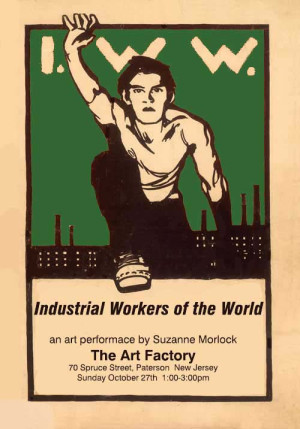
Performance by Wyoming artist remembers the 1913 IWW strike at a New Jersey factory


IWoftheWorld

Suzanne Morlock is a socially engaged artist from Wilson, Wyoming. This bucolic Rocky Mountain valley town is a long way from Paterson, N.J. But that's where Suzanne is traveling to mark a labor tradition shared by the hard-rock miners of the West and the factory workers of the industrial East.

The Industrial Workers of the World (IWW) were known as "Wobblies" and nobody seems to know how it got its nickname. Its organizers were fed up with the tactics of the larger unions and decided to take their fight to the streets and the factories and the mines. Joe Hill may be the best-known members of the Wobblies. Remember the folk song that Joan Baez made famous at Woodstock:
I dreamed I saw Joe Hill last night,
alive as you and me.
Says I "But Joe, you're ten years dead"
"I never died" said he,
"I never died" said he.
Hill was framed for murder by the "Copper Bosses"and executed in 1915 in Utah. His martyrdom has been used as a union rallying cry for a century. Hill himself was a talented poet and songwriter, dedicating his work to the union.

The Wobblies were active throughout Utah, Wyoming, Montana, Idaho and Colorado. They also were part of the Paterson, N.J., Silk Strike in 1913. Some 1,800 strikers were arrested, including organizers Elizabeth Gurley Flynn and Big Bill Haywood. In 1907, Haywood was tried for the murder of the retired governor of Idaho, who had been a fierce opponent of organized labor, especially Haywood's radical Western Federation of Miners. The WFM was involved in the Colorado Labor Wars in the Cripple Creek mining district in which 33 people were killed. The defeat of that strike led to the formation of the IWW a few years later

Which now leads to a performance and art exhibit by a Wyoming artist in New Jersey.

Here are the details from a press release via the CultureFront web site:
On Sunday, October 27, visual artist Suzanne Morlock from Wilson, Wyoming, will create a new kind of textile operation at The Art Factory in Paterson, New Jersey, from 1-3 p.m.

Morlock has reimagined the traditional art of fabric creation with her own brand of magic at venues from the Central Museum of Textiles in Lodz Poland to the Charles Schulz Museum in Santa Rosa California. Morlock brandishes a set of over-sized “needles” made from PVC pipes and re-imagines cast-off materials into new and curious forms.

This performance pays homage to the Paterson Silk Strike which took place 100 years ago in protest of poor working conditions for workers in textile manufacture industry in the town of Paterson, New Jersey. Morlock’s intent with this performance entitled Industrial Workers of the World, the name of the union at the time of the strike, is to also highlight other areas of the world where substandard working conditions run rampant. At the conclusion of the performance, the finished textile will be displayed for the remainder of the exhibition. Visitors to the exhibition will be invited to tie on strips of paper with the names of other manufacturing areas of the world where unacceptable working conditionals continue.

The Textile Show has been designed to celebrate Paterson’s rich textile heritage, highlight the role that the Art Factory is playing in that continuing history and showcase the talents of emerging and established textile-based artists – both domestically and internationally. This annual textile art exhibition opened in September in various locations within Art Factory properties. The exhibition will be open daily by appointment until the closing reception on Saturday, November 16. Contact 973.ART.1500 or email create@artfactory.us.com to arrange for a tour.

The Art Factory is a spacious, inspiring collection of 19th century textile mill buildings in the heart of Paterson’s Historic District. The Art Factory is restoring these historic textile spaces and converting them into galleries, studios, lounges, classrooms, workshops and event spaces.
You can see some of Suzanne's work in Wyoming at the Wyoming Arts Council's biennial fellowship show through Jan. 26 at the Nicolaysen Art Museum in Casper. She will be attending the exhibit's reception on the evening of Nov. 8. Come on out, view the work, consume some munchies, and talk art and Wobblies.

Friday, October 25, 2013

Mental health crisis makes the news from coast to coast

Allison Kilkenny wrote in The Nation on Oct. 21 about the rise in suicides and other mental health crises spawned by budget cuts:
Threats of sequestration in 2013 had a significant impact on people’s ability to access mental health services and programs, including children’s mental health services, suicide prevention programs, homeless outreach programs, substance abuse treatment programs, housing and employment assistance, health research, and virtually every type of public mental health support. The Substance Abuse and Mental Health Services Administration (SAMHSA) claimed it alone would be cutting $168 million from its 2013 spending, including a reduction of $83.1 million in grants for substance abuse treatment programs.
And here's the news from Chicago:
In Chicago alone, state budget cuts combined with reductions in county and city mental health services led to shutting six of the city’s 12 mental health clinics, Forbes reports.
What's the matter with Kansas:
The Kansas Department of Health and Environment recently released a startling report showing a 30 percent increase in suicides from 2011.

The Wichita Eagle reports that the largest increase in suicides in Kansas occurred among white males, who already were the segment of the population most likely to take their own lives. More than 80 percent of suicides in Kansas last year were men.
And what about Wyoming? Well, a chapter of the National Alliance on Mental Illness (NAMI) has been holding organizational meetings in Cheyenne. Look up NAMI Cheyenne on Facebook. Get more info by e-mailing namicheyenne@gmail.com

Neat staff editorial in the Casper Star-Tribune on Wednesday. It examined the sad story of a young schizophrenic teen, Sally Levin, who was killed by her father in 1937 Cheyenne. It was a suicide pact gone awry. The father shot and killed his daughter to allegedly put her out of her misery, but his self-inflicted wounds were not fatal. Once he recovered, the family moved away to California and the incident was lost to history. Almost.

Suzanne Handler heard about her grandfather's story, investigated and recently published a book on it, “The Secrets They Kept: The True Story of a Mercy Killing That Shocked a Town and Shamed a Family.”

So has has mental health treatment in Wyoming improved over the last 76 years?
Despite the creation of treatment centers in regions of the state and school-based counseling, the need for treatment in Wyoming’s small towns can be largely unmet due to rural health care challenges.

All counties in Wyoming are geographically designated mental health services shortage areas.

--clip--

In 2011-12 the Annie E. Casey Foundation identified 22,000 Wyoming children, 18 percent, as “Children ages 2 to 17 with a parent who reports that a doctor has told them their child has autism, developmental delays, depression or anxiety, ADD/ADHD, or behavioral/conduct problems.”
We still have a long way to go.

Monday, October 21, 2013

Laramie County Democrats meet Oct. 21

The Laramie County Democrats will meet on Monday, Oct. 21, 7 p.m., at the International Brotherhood of Electrical Workers (IBEW) Hall, 1810 Fremont Ave., Cheyenne.
 
Speakers will talk about the ongoing affects of the shutdown and furloughs on the State of Wyoming. More than 200 state employees were furloughed during the recent Republican-spawned federal government shutdown. At your last meeting, we had a number of new members. At least two of them were one-time Republicans who no longer can stomach the crackpot shenanigans of the Grand Old Party.

Also on the agenda is a discussion of upcoming events, projects and elections. One of those events is a chili feed on Thursday, Oct. 24, 6-8 p.m., sponsored by the Laramie County Democrats Grassroots Coalition. Due to road construction, the venue has been changed from the Old Community House in Lions Park to the South Room of the Kiwanis Community House. LCDGC Secretary Kathleen Petersen invites you to
Come on out and visit with local elected officials and eat some good chili. Bring a fruit pie to share for dessert. Bring a friend too.
Last time I went to one of these shindigs, the chili was spicy and plentiful and the company was friendly (a bit spicy, too). 

And pie.

Join us!

Saturday, October 19, 2013

UPLIFT Wyoming has vision

UPLIFT's vision is
Hope, health and well-being for all Wyoming children and families. 
You must have 20/20 vision for a statement like that. An abundance of hope.

The statistics are bleak. Alabama-bleak. Wyoming leads the nation is teen suicides. Not a single child psychiatrist lives and works within its 97,000 square miles. In 2012, Wyoming's overall health ranking dropped from 21st to 23rd. More than 23 percent of the population smokes.

OK, so maybe we rank better than Alabama by most measures. But we have problems. Most residents have to drive hours to reach mental health care. Youth are regularly sent out of state for mental health and substance abuse treatment. I know. My kids did just that. Broke the bank and almost broke the will. Only late in the process did we discover the state's children's mental health waiver, which paid for much of our daughter's care, both in-state and out.

Time will tell whether the Affordable Care Act (a.k.a. Obamacare) will make a difference with accessibility to quality mental health treatment. We do know that insurers no longer can disqualify you for pre-existing conditions. And caps have been removed on quantity of treatment sessions. And we can keep our daughter covered until she's 26 (our son has aged out). Most students with disabilities take longer to matriculate than others. It's not unusual for them to take six or seven years to graduate. It's not unusual for them to be a boomerang kid, landing in your basement after graduation, Daft Punk tunes wafting up through the heater vents.

I just returned from a two-day board and staff retreat for UPLIFT. I've been a board member since 1999 and am just about ready to retire. It's a volunteer position. Most of us on the board have had personal experiences with challenging children.Our son Kevin was diagnosed at 5 with ADHD and, later, struggled with drugs and alcohol. Our daughter faced mental health challenges, first diagnosed as bipolar and then with borderline personality disorder. As often happens, she did some self-medicating.

It is tough on children to have these challenges. It is also tough on parents.

UPLIFT comes to the rescue. When it can. The statewide organization has its own challenges. Its budget was cut by a third when the state decided to re-channel its funding. It lost three offices across the state and 11 staffers. This is why you have retreats that address strategic planning and tries to come up with some big ideas for the future.

Funding cuts and priority shifts have caused the 23-year-old organization to look at itself anew. Wish us luck. And donate at the web site. Better yet, make a pledge to donate a certain amount every month. Go here. You never know when you may need expertise at your I.E.P. meeting or tips on applying for the Medicaid waiver or just a kindly person to listen to your dilemma. 

Tell them Mike sent you.


  • Smoking remains high at 23.0 percent of the adult population, with 100,000 adults who smoke in Wyoming.
  • The infant mortality rate declined in the past year from 7.2 to 6.5 deaths per 1,000 live births.
  • - See more at: http://www.americashealthrankings.org/WY#sthash.h6kmkDfZ.dpuf
    Smoking remains high at 23.0 percent of the adult population, with 100,000 adults who smoke in Wyoming. - See more at: http://www.americashealthrankings.org/WY#sthash.h6kmkDfZ.dpuf

    Tuesday, October 15, 2013

    With national parks closed, Jackson Hole quiet on the eve of ski season

    When I was in Jackson Hole over the weekend, people were plenty sore about the Republican-spawned national park shutdown. Hotel reservations have been cancelled and tour buses rerouted to other parks, notably those in neighboring Colorado and Utah reopened by state funds. In Wyoming, alas, the constitution forbids state funds going to federal government operations. The tourism industry made an appeal to Gov. Mead. Alas, private dollars from Cody and Jackson were enough to plow the roads that got the parks opened in the spring but money couldn't be leveraged for general operating costs. That's fine with me, as I'm content to let Republicans stew in their own juices. Unfortunately, everyone in Teton County, D & R & I alike, is in that same gravy boat.

    The newly refurbished Snow King bar wasn't dead, not exactly, but it's a jumping place on sun-drenched summer evenings and frigid ski-season nights. Last Saturday night, with baseball playoffs on one TV screen and an SEC tiff on the other, only a few patrons lined the bar. Most of the rest of the 20-some people were connected with the Wyoming Arts Council's conference going on around town. We made reservations for 10 on Friday evening at the popular Rendezvous Bistro. The place was half-empty by the time we got around to dessert.

    Traffic flowed freely and no tourists seemed in danger of getting flattened by an RV; close calls are an every day summer occurrence. There just weren't that many targets (or RVs). 

    We heard rumors about a protest by Cody Tea Party types set for Yellowstone's east gate. I don't know if that happened. It was snowing most of the weekend, and that tends to take some steam out of Tea Party gatherings, as most attendees seem to be of advanced years. We did hear about some daredevils sneaking into the park, but they risked getting a ticket from park staff still on duty.

    Probably the best quote I heard about the closed national parks came from writer and activist Terry Tempest Williams. She's a Utah native but now lives in Teton County. At an arts conference talk on Monday, Williams spoke about taking a walk "on the periphery of Grand Teton National Park. I was surprised by how quiet it was."

    She wondered what the animals were doing and thinking. " 'Frolic' came to mind."

    The animals may be frolicking, but the humans, perturbed by Congress's antics, are in a sour mood.


    Cardiac Chronicles: Bush's "Widowmaker" blockage worse than reported in August


    The National Journal has a scoop today regarding Pres. George W. Bush's heart condition.

    Apparently, Bush's heart crisis in August was much more serious than reported at the time.

    If you remember, the ex-Prez went in for a physical in Dallas and his docs found some bad rhythms in an EKG during a stress test. A CT scan discovered a blockage of the Left Anterior Descending (LAD) artery, a.k.a. "The Widowmaker." Surgeons inserted a stent and, after a night in the hospital, sent Bush on his way. He's now back golfing and riding mountain bikes and clearing brush from his ranch. He does all of these vigorously, but not at the same brisk pace as before the surgery.

    And getting featured in news stories:
    Dr. Jonathan Reiner, an interventional cardiologist at George Washington University who has treated former Vice President Dick Cheney but was not involved in Bush's care, noted that a blockage of that magnitude wouldn't necessarily be fatal in all patients but is a very serious situation requiring prompt treatment.

    Even with a 95 percent blockage, Reiner said, blood will still be flowing through the impaired artery, but the heart muscle must work harder, particularly during vigorous activity. The added strain when blood flow is diminished can lead to serious cardiac complications, including a heart attack.

    "Every case is different," Reiner said. "It depends on several factors, including how quickly a blockage has developed. But it's a very important vessel. If you occlude that particular artery it can kill you."
    And this:
    A prominent internist who asked not to be identified added that Bush's blockage, if undiagnosed, would almost certainly have risked "a grave cardiac event."
    Finally, this:
    The 43rd president has exercised regularly for years and is generally believed to be in excellent health. 
    Pres. Bush and I have something in common. As I related in a post in August, we both had occlusions in the same artery. I hate to brag, but mine was 100 percent and I lived to tell the tale. I too had a stent, but spent a week in the hospital recuperating from congestive heart failure caused by the blockage. I was floored to hear the LAD called "the Widowmaker" by my cardiologist. Both of us were in fine shape. I don't clear brush or ride my bike. But I do swim every other day at the local YMCA.

    There are some differences. I went almost two weeks before my blockage was detected and treated. In the process, my heart muscles sustained what is probably irreparable damage. I'm not going to complain. If I had only known that stomach pain could mean "heart attack," I would have got myself to the hospital a lot sooner. I didn't have a crackerjack team of doctors available to the president at the renowned Cooper Center in Dallas. My regular doctor neglected to give me a stress test or an EKG. That would have helped. Instead, he treated me first for the stomach virus and then for pneumonia. I had lung congestion, but it was due to a malfuctioning heart and not a bacterial assault on my lung lining.

    I also now am equipped with an Implantable Cardioverter Defibrillator (ICD), just in case I get hit with an arrhythmia or, God forbid, catastrophic heart failure. 

    We are both lucky, Pres. Bush and I. We remain among the living. And we both have plenty of blogging material, although I rarely see Dubya tapping out communiques in the blogosphere.

    One other thing: If you're not a former president and don't have comprehensive health insurance, sign up for the Affordable Care Act. Heart attacks are expensive. Mine was $200,000-plus, almost all covered by a health plan that I have been paying into for 22 years, with the state picking up the lion's share.

    Make sure you get a stress test or an EKG. Either might save your life. 

    Tuesday, October 08, 2013

    Sherman Alexie at UW on Oct. 15

    Sherman Alexie, author of “The Absolutely True Diary of a Part-Time Indian,” will lecture and sign books Tuesday, Oct. 15, 7 p.m. in the University of Wyoming  College of Arts and Sciences auditorium in Laramie. The event is free and open to the public.

    Monday, October 07, 2013

    Furloughed NWS staffers keep the candles burning during Black Hills blizzard

    Paul Huttner, chief meteorologist for Minnesota Public Radio, had a compelling story about the federal government shutdown in his "Updraft" blog today. Furloughed National Weather Service staffers, trapped in their Rapid City office by the blizzard, tracked the storm and provided crucial weather info as some places in the Black Hills were walloped with 55-58 inches of snow. Huttner sums it up this way:
    The job performed by the staff at the Rapid City NWS was well above and beyond the call of duty last weekend. Especially considering they did it without the promise of a paycheck.
    Read the entire column here.

    Meanwhile, South Dakota's Republican governor has requested federal disaster assistance that probably won't arrive anytime soon due to the Republican shutdown of the U.S. government. Read more about that at Larry Kurtz's excellent and acerbic Interested Party blog.

    Sunday, October 06, 2013

    Poe Ballantine puts Chadron on the map, and some are not too happy about it

    I don't often attend a literary event that has its own security detail.

    Face it -- it's not often that writers get death threats. There was that Iranian fatwa against Salman Rushdie, a threat that forced him into hiding for a decade. It had expired by the time I heard him talk in Laramie a few years ago.

    A well-armed deputy sheriff was on hand at the Literary Connection on Saturday at LCCC in Cheyenne. I asked him if there had been a threat. He replied that the college was only interested in being prepared for all eventualities.

    At the podium were author Poe Ballantine of Chadron, Nebraska, and filmmaker Dave Jannetta of Philadelphia. They spoke in turn about a the mysterious case of a Chadron State College professor, a neighbor to Ballantine. His body was found out on the prairie. It was bound and horribly burned. Local law enforcement ruled it a suicide. Ballantine originally agreed. After investigating the case, he eventually decided that it was a murder. He wrote a book about his six-year saga of discovery, and Janetta is working on a documentary about it.

    The book is "Love and Terror on the Howling Plains of Nowhere." I began reading my signed copy yesterday evening and can't stop. Not only is Ballantine a fine writer. But wind-whipped Chadron and its residents are interesting characters on par with Savannah and the people portrayed in John Berendt's best-seller "Midnight in the Garden of Good and Evil." Who knew Chadron (pop. 5,844 -- a bit smaller than Torrington, WY, a two-hour drive across the border) could be so damn interesting?

    Leave it to a writer.

    And then there's the murder. In 2006, CSC math professor Steven Haataja disappeared. More than three months later, the man was found burned to death and tied to a tree in the hills behind the campus. Police were stumped. They finally ruled it a suicide. Ballantine, a novelist and essayist, was not particularly interested in writing a true crime book. But, during his short time in Chadron, he got to know most of the people involved -- so he jumped right in.

    The first part of "Love and Terror" is devoted to Ballantine's itinerant life. The writer had spent his adulthood knocking about the country, working odd jobs and trying to establish a writing career. He'd been pretty good at the first two. The third? Not so much.

    Until recently. With five books to his credit with the upstart Hawthorne Books & Literary Arts in Portland, Ballantine's career is on the move. Although he and his family are staying put in Chadron, despite the death threats.

    Haataja's family wants the dead to stay buried (see Ballantine's posts on the Hawthorne Books blog and read the comments). The police want the case off of their to-do list. The town fathers and mothers don't think that murders are the proper promotional schemes for tourism (although they may be wrong about that). Its motto invites to come to town and "Learn The History. Explore The Bounty. Firsthand." And the college? It may have a harder time drawing math professors to campus.

    I'm not sure why I'm blogging instead of reading Ballantine's fine book. So I'm going to remedy that right now.

    One more thing: Jannetta played us two clips from the film on Saturday. He's raised $33,000 on Kickstarter to do post-production work. He hopes to get it into some film festivals. Let's hope there's a screening in Chadron. The town's kooky population deserves to see itself up on the big screen. Find out more at "Love and Terror the Movie."

    Saturday, October 05, 2013

    Putting the blame where it belongs for national park shutdown: Wyo's lone congressional rep

    Jim Stanford on Oct. 1 at JH Underground:
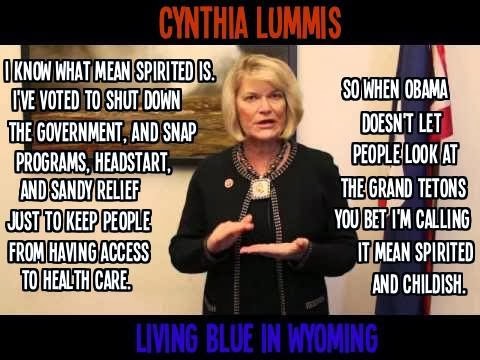
    Grand Teton and Yellowstone national parks are being barricaded today, and all public access closed, thanks in part to Wyoming’s lone congressional representative, Cynthia Lummis.

    Lummis is part of an extreme faction of the Republican Party seeking to hold the federal government hostage over implementation of the 2009 health care law. She voted repeatedly this weekend and last night to send a budget bill to the Senate that was dead on arrival.

    Without funding, all federal agencies, including the National Park Service, were forced to close.
    On her website, Lummis said she did so to protect Americans from “the onslaught of Obamacare.”
    Onslaught of Obamacare?

    Read the entire column here

    Albany County Democrats hosts Demtoberfest Oct. 12 in Laramie

    The Albany County Democrats are hosting Demtoberfest Oct. 12 at the Lincoln Community Center, 365 W. Grand Ave.in Laramie. Barbeque! Vegetarian options! Beer! Music by Libby Creek Original and Jeff Duloz! Food will be served around 6 p.m  and music starts around 7 p.m. There will also be a silent auction.

    Early birds arriving after the Homecoming game vs. New Mexico are welcome, as beer and beverages will be ready early.

    RSVP by ordering your tickets at https://secure.actblue.com/page/albanydems

    Tickets at the door, and the Dems will accept credit/debit cards as well as cash and check.

    Suggested Donation:

    Entry (Food, Drink, and Fun!) $15
    Darling, Daring Democrat $30
    Extremely Wonderful Democrat $50
    Ready to Win Elections $100

    Questions? Please email info@albanycountydems.com or call (307) 299-0204.

    Wednesday, October 02, 2013

    Drinking (and Talking) Liberally Thursday at the Albany

    Drinking Liberally will be held Thursday at 7 p.m. at the Albany in downtown Cheyenne. Come out and drink and talk liberally among friends. Special guest will be Ana Cuprill, vice chair of the Wyoming Democratic Party. More info at https://www.facebook.com/events/597770450261148/

    "Listening to Nature" features Navajo poet Sherwin Bitsui & friends

    This comes from the fine folks over at the Wyoming Outdoor Council:
    Listening to Nature is an annual community event featuring readings and visual artwork by scientists, writers, and artists!
    Navajo poet Sherwin Bitsui will join Wyoming presenters to read poems, essays, and other works. The readings will be preceded by a reception.
    This year you can catch the event in both Laramie and Riverton.
    Receptions for both evenings start at 6:30 p.m., readings at 7 p.m.
    Laramie: Friday, October 11
    Berry Biodiversity Conservation Center, University of Wyoming campus
    Riverton: Friday, October 25
    Wind River Room, Intertribal Education and Community Center, Central Wyoming College campus
    Both evenings are free and open to the public!
    The Wyoming Outdoor Council is co-hosting both events along with the University of Wyoming’s Haub School of Environment and Natural Resources, the MFA Program in Creative Writing, the American Indian Studies Program, and Central Wyoming College.
    For more information contact: Emilene Ostlind, 307-766-2604, emilene@uwyo.edu

    Tuesday, October 01, 2013

    Love & terror & poetry Oct. 4-5 in Cheyenne

    Attend a free writing workshop on Friday, Oct. 4, 9 a.m.-1 p.m. at Laramie County Community College’s Center for Conferences and Institutes.
    This Literary Connection event will be conducted by Poe Ballantine, Dave Jannetta and Lisa Zimmerman.
    Ballantine and Jannetta will present “Love and Terror: The Infinite Fascinations and Complex Problems of Portraying True Crime in a Small Town.”
    Zimmerman will talk about “Writing through the Block: Inventive Ways to Get Lines to the Page.”
    Continental breakfast provided.
    On Saturday, 10 a.m.-4 p.m., the three writers will talk in detail about their work at the Center for Conferences and Institutes. It will be followed by a book signing. Lunch is provided.  Fee is $45. Online registrations are now closed. Please call 307.778.1285 to register.
    About the Authors

    Poe Ballantine: Born in Denver, Poe Ballantine is known for his novels and essays, many of which appeared in The Sun. His second novel, Decline of the Lawrence Welk Empire, won Foreword Magazine’s Book of the Year. The odd jobs, eccentric characters, boarding houses, buses, and beer that populate Ballantine’s work often draw comparisons to the life and work of Charles Bukowski and Jack Kerouac. Ballantine is the author of the true-crime book Love and Terror on the Howling Plains of Nowhere (2012) and is also the subject of the documentary Poe Ballantine, A Writer in America. He has written four books – two collections of essays and two novels. Many of the stories he tells are taken from his personal experiences that include traveling, living on the road, and working some 75 odd jobs. One of Ballantine’s short stories, The Blue Devils of Blue River Avenue, was included in Best American Short Stories 1998 and his essay 501 Minutes to Christ appeared in Best American Essays 2006. He lives in Chadron, Nebraska, with his wife, Christina, and their son.

    Dave Jannetta: Dave Jannetta is the founder of 32-20 Productions, a Philadelphia-based production company covering the full spectrum of film and video production with a focus on telling quality stories of all shapes and sizes. Dave has worked closely with Poe Ballantine to turn his story Love and Terror on the Howling Plains of Nowhere into a documentary movie.
    Dave will discuss taking a literary piece and working with it to create a visual representation.

    Lisa Zimmerman: Lisa Zimmerman received a Master of Fine Arts in creative writing from Washington University in St. Louis. Her poetry and fiction have appeared in the Colorado Review, Redbook, Paper Street, Poet Lore, Eclipse, Atlanta Review and many other journals. Her poetry has been nominated three times for the Pushcart Prize. She has published two poetry chapbooks as well as the full-length collections How the Garden Looks From Here, winner of the 2004 Violet Reed Haas Poetry Award, and The Light at the Edge of Everything (2008). Lisa is an assistant professor of English at the University of Northern Colorado and has been the poet-in-residence at Colorado schools in Aurora, Brighton, Longmont, Fort Collins and Idalia.

    Monday, September 30, 2013

    Recalcitrant Equality State legislators urged to come out and learn something about equality

    Coming Out for Equality at the University of Wyoming
    Wednesday, October 9
    6:00 - 8:00 p.m.
    COE Library, University of Wyoming
    Room 506
    Laramie, WY
    On the 25th anniversary of national coming out day, full equality for LGBT Americans is closer than ever. Come learn about the progress we've made, and the steps ahead in our fight for full LGBT equality for everyone, everywhere.

    Learn. Take action. Lead.


    All HRC members, supporters, friends and family are welcome.

    Recalcitrant Wyoming Republican legislators (you know who you are) are invited to come out and learn something.

    Sunday, September 29, 2013

    Cowboy culture is important, but don't forget about the vaqueros, Native-Americans, railroads, dinosaurs, and so on

    Nifty staff editorial in this morning's Wyoming Tribune-Eagle. It argues that the city's Downtown Development Authority should follow the recommendations of the national Main Street group. Main Street urges Cheyenne: "Do not adopt a theme, like cowboys, for its downtown."

    The writers launch the editorial with this quote from the paper's comments section:
    "Oh Please! Enough of this stupid cowboy stuff. It's past time for this ... town to grow up!"
    Here's another one:
    "Cheyenne is Western. It is cowboys ... Most citizens of Cheyenne do not need newbies to make non-Western decisions for the rest of us who love the Western way of life."
    Just what is the "Western way of life?" Hard to say. The West's cowboy culture spawned a world of film, TV shows, books, handcrafted saddles, rodeo, storytelling, and song. That's a rich trove of material. It's celebrated in rodeos, such as our own CFD in Cheyenne, and in events such as the annual National Cowboy Poetry Gathering in Elko, Nevada. Wyoming boasts a number of talented cowboy poets and musicians, many of whom actually spent time working on horseback -- Mike Hurwitz, Jared Rogerson, Andy Nelson.

    Celebrate the cowboy but don't forget the Native American. The roots of the Western tribes go back much farther than the cowboy's. The dominant culture has just begun to appreciate this world. Much of what makes up cowboy culture was borrowed from The First Peoples and even The Second Peoples -- Spanish vaqueros predated the Wyoming cowboy by centuries. The term "buckaroo culture" is used by Hal Cannon, founding director of the Western Folklife Center in Elko. Folklorists contend that "buckaroo" is an Americanization of "vaquero."

    And what about horse culture? Long before Lakota and U.S. cavalry clashed on horseback, the Mongols, Cossacks and Arabs used horses as weapons. Forget about Hollywood-style cowboys for a second. We should celebrate many centuries of horse culture in the West. It's a shame to carve out a few decades of Western history and declare this the theme for all time. We have a rich and varied history. And I haven't even mentioned railroads, energy booms-and-busts, politics, dinosaurs, weather, geology, immigration, the military and agriculture.

    Let's not have one theme to our downtown. We are a complicated people. Let's reflect that in the ways that we revitalize our city.